Trump’s Iran War “Participation Trophy” Sparks New Fight in Washington as National Mall Statue Raises Bigger Questions
A giant golden trophy appeared on the National Mall with one message: the biggest battle may not be happening overseas, but inside the debate over what counts as victory.
A 10-foot satirical statue mocking President Donald Trump’s handling of the Iran conflict has transformed a section of Washington’s National Mall into the latest stage for America’s growing debate over war, leadership and political messaging.
The oversized “participation trophy” appeared as the United States and Iran remained locked in a tense confrontation marked by renewed strikes, threats against shipping, and uncertainty over the Strait of Hormuz, a narrow waterway that carries roughly 20% of the world’s oil shipments.
The timing gave the artwork extra impact. The statue arrived as officials debated whether military action alone should define success or whether a true victory requires a lasting diplomatic agreement, regional stability, and an end to continued threats.
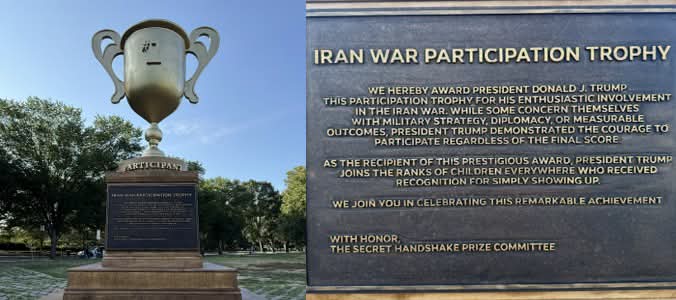
Created by the anonymous activist art group Secret Handshake, the sculpture uses humor and symbolism to challenge the Trump administration’s claims of success in the Iran conflict while raising a broader question about how America measures the outcome of war.
A 10-foot gold trophy appears in Washington during a tense conflict with Iran.
The statue looked like something designed for an awards ceremony, but its message was aimed directly at the White House.
Standing approximately 10 feet tall, the golden monument featured a giant “#1” design and a plaque that sarcastically honored President Trump with a “participation trophy” connected to the Iran war.
The installation encouraged visitors to leave smaller trophies nearby, turning the artwork into a public conversation rather than a simple display. Within hours, additional miniature awards appeared around the structure, adding to the growing attention surrounding the political statement.
The location made the message even stronger. The National Mall is home to some of America’s most significant monuments honoring presidents, soldiers and historic movements. Placing a satirical war trophy in that environment created a direct contrast between traditional symbols of achievement and a modern form of political criticism.
The statue appeared after a cycle of strikes, ceasefire talks, and renewed fighting.
The timing of the installation became one of its most powerful elements.
The Iran conflict had already moved through several major developments, including one major U.S. military operation, one attempted ceasefire, and a renewed wave of tensions involving military strikes and threats against international shipping.
The Trump administration argued that Operation Epic Fury achieved its primary military goals by targeting Iranian capabilities and weakening potential threats. Critics responded that continued instability showed the conflict had not reached a clear conclusion.
That disagreement explains why the trophy became such an effective political symbol.
The artists were not simply criticizing military action. They were challenging the idea that announcing success is the same as creating a lasting outcome.
The “participation trophy” message connects with Trump’s love of recognition.
The statue’s design also targeted a familiar part of Trump’s public image: his interest in awards, rankings and international recognition.
The artists used the trophy concept to reference Trump’s previous comments about receiving major honors, including his repeated statements that he deserved consideration for the Nobel Peace Prize.
The symbolism was built around a sharp contrast.
A traditional trophy represents a completed achievement earned through success. A participation trophy represents recognition simply for taking part.
By using that image, the artists suggested that the administration was celebrating involvement in the conflict before the final results were clear.
Supporters of Trump rejected that interpretation, arguing that military success should be judged by whether American objectives were achieved. Critics countered that wars must also be judged by their long-term consequences, including their effects on diplomacy, stability, and security.
White House pushes back against the criticism.
The Trump administration quickly responded to the artwork.
White House spokeswoman Anna Kelly criticized the anonymous artists and argued that they lacked an understanding of military strategy and foreign policy. She defended the administration’s position that American forces successfully completed their objectives during Operation Epic Fury.
The disagreement highlighted two competing views of victory.
The administration focused on military performance, including strikes against Iranian targets and the ability of U.S. forces to conduct operations.
Opponents focused on the broader picture, questioning whether continued fighting, unresolved diplomacy, and regional uncertainty suggested the conflict was far from finished.
That debate has followed many military campaigns throughout history, where battlefield achievements and political outcomes do not always move in the same direction.
The Strait of Hormuz turned the Iran conflict into a global economic concern.
Although the statue became a Washington political spectacle, the conflict behind it carried consequences far beyond the capital.
The Strait of Hormuz remains one of the world’s most important shipping routes, with approximately one-fifth of global oil supplies passing through the area under normal conditions.
Any disruption in the waterway can affect more than military calculations. It can influence fuel prices, shipping insurance costs, transportation expenses, and consumer prices across the United States.
For American households, a conflict thousands of miles away can eventually show up at gas stations, grocery stores, and other businesses as higher transportation costs.
That economic connection explains why every military development involving the strait receives international attention.
The 20% Hormuz cargo fee proposal added another layer of uncertainty.
The Iran conflict gained another economic dimension when Trump announced plans to introduce a 20% cargo fee for vessels passing through the Strait of Hormuz.
The proposal immediately raised questions about its potential impact on global trade.
Businesses questioned how the charge would work, who would ultimately bear the cost, and whether shipping companies would pass the expense on to consumers.
The announcement created concerns because the Strait of Hormuz is not only a military flashpoint but also a major artery for international commerce.
However, the proposal changed quickly. Within roughly one day, Trump stepped back from the fee plan and said Gulf nations would pursue investment arrangements with the United States instead.
The reversal intensified debate over the administration’s broader strategy, with supporters describing it as a sign of flexibility and critics calling it another sign of uncertainty.
Secret Handshake has built a reputation through political street art.
The participation trophy installation continues a pattern for Secret Handshake, the anonymous group behind several high-profile political artworks.
The group previously gained attention for a statue showing Trump and Jeffrey Epstein holding hands, a gold toilet sculpture criticizing White House renovation plans, and other temporary installations designed to challenge government messaging.
The group’s approach relies on transforming ordinary objects into political symbols.
A trophy usually represents achievement. A toilet can represent excess. A monument usually represents honor.
Secret Handshake reverses those meanings to create debate and public discussion.
The strategy works because the artwork is simple enough to understand immediately while leaving room for larger political arguments.
The bigger debate is how America defines victory.
Behind the statue’s humor lies a serious question about warfare and leadership.
America has historically measured military success in different ways. Some focus on battlefield results, including destroyed targets and completed missions. Others argue that true success requires lasting peace, reduced threats, and a stable political outcome.
The Iran conflict has exposed that divide.
Military officials may emphasize operational achievements. Political leaders may highlight strategic victories. Ordinary Americans may judge success by whether the conflict creates greater security and economic stability.
The participation trophy became controversial because it challenged the very definition of victory.
A temporary statue created a lasting political debate.
The National Mall sculpture may eventually disappear, but the argument surrounding it is likely to continue.
The artwork appeared during a moment of uncertainty, with renewed fighting, economic concerns, and unanswered questions about the future of U.S.-Iran relations.
Its message was intentionally provocative, but its influence came from the timing.
A trophy celebrating victory appeared even as the conflict’s final outcome remained unsettled.
That contradiction turned a temporary piece of political art into a symbol of a much larger national debate.