Egyptian Student Says Life in Egypt Was “Infinitely Better” Than Houston, Fueling a Fierce Online Debate
A few seconds of video can carry an astonishing amount of baggage.
In a viral clip reposted across YouTube, a woman described as an Egyptian student at the University of Houston says her life in Egypt was “infinitely better” and that she felt “much safer” there than she does in Houston. Other versions summarize her argument more bluntly: Egypt is better than the United States.
That was enough to set off a familiar online explosion. Some viewers defended her right to compare two countries she has experienced firsthand. Others accused her of insulting the nation providing her with an education.
Still, the debate her comments sparked raises a worthwhile question: Can someone move to the United States for an opportunity and still believe life felt better somewhere else?
Her Comment Became an Argument About Gratitude
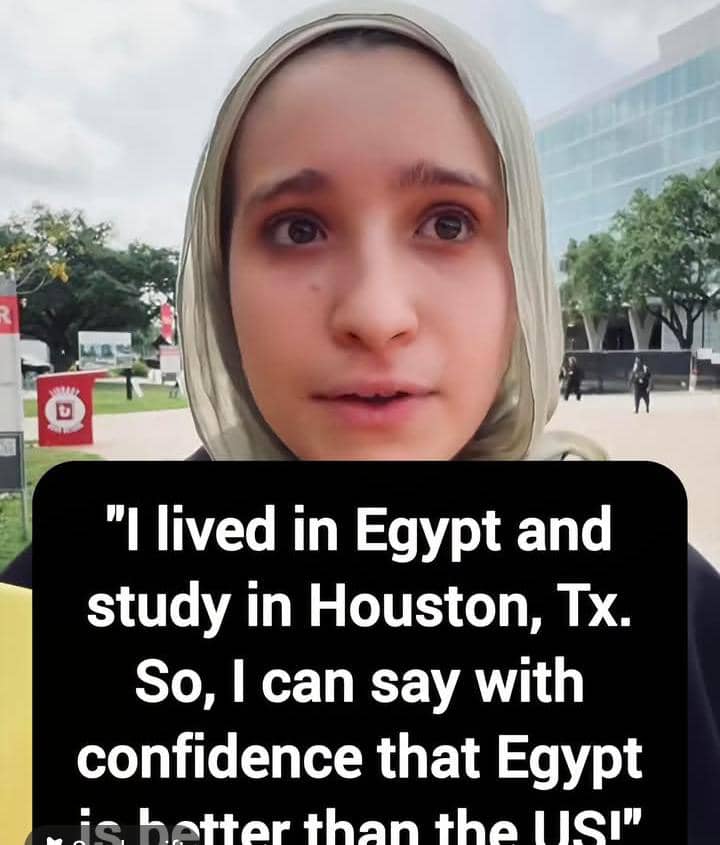
The strongest backlash did not focus solely on crime statistics or living standards. It focused on loyalty.
A YouTube post from the account @DerrickEvans4WV complained that the student was “trash[ing] the country” and argued that Americans should be placed first. Another repost presented the expected response even more simply: “Then go back.”
That reaction turns a personal comparison into a test of gratitude. But studying in a country does not require someone to declare that every part of life there is superior.
An international student might value an American degree, professional opportunities or academic resources while still missing the familiarity of home. Those feelings are not automatically contradictory. A person can admire Houston’s universities and still prefer Cairo’s streets, food, family life, religious environment or social culture.
For Muslim residents, Egypt may also offer a level of cultural convenience that is difficult to reproduce elsewhere. The call to prayer, readily available halal food and the experience of being surrounded by people who share familiar religious customs can make daily life feel less complicated. American Muslim Fatimah Abdul-Zahir described those features as part of the appeal of living in Egypt after relocating from the United States.
That does not make Egypt objectively better. It helps explain why it might feel better to her.
Her Safety Claim Is More Complicated Than Critics Suggest
The claim that a woman could feel safer in Cairo than Houston may sound unbelievable to some Americans, but it cannot be dismissed solely because it challenges expectations.
Crowdsourced crime-perception data published by Numbeo placed Cairo above Houston on its overall safety scale. Respondents also rated their sense of safety while walking alone at night higher in Cairo than in Houston. Numbeo’s figures are based on public perceptions rather than police records, so they do not prove that one city is definitively safer. They do show that the student’s experience is not impossible or unique.
Sarah Seefeldt, an American mother who lived in Cairo for 11 years before returning to Texas, described a similar experience. “There was never a time I felt unsafe living in Egypt with my children,” she wrote, crediting the country’s community-centered culture for helping her family feel protected and connected.
However, Egypt is not free from serious safety concerns. The U.S. State Department currently places the country at Level 2, advising travelers to exercise increased caution because of terrorism, crime and health risks. Its guidance also states that harassment of women is a problem and warns against travel to parts of the Sinai Peninsula, the Western Desert and Egyptian border regions.
Both realities can exist at once. Egypt can have national security concerns and harassment problems while one particular woman still feels safer in the neighborhood where she grew up than in an unfamiliar American city.
Personal safety is influenced by more than national rankings. Language, family connections, transportation habits, neighborhood knowledge and the presence of trusted people all matter. Someone who knows which streets to avoid in Cairo may feel more secure there than in Houston, where she is still learning the city.
“Better” Changes Depending on What Is Being Measured
Money offers one of the clearest explanations for the student’s preference.
Crowdsourced cost estimates updated in June 2026 put monthly living expenses for one person at roughly $483 in Cairo, compared with about $2,261 in Houston. Estimated rent, food and transportation costs were all substantially lower in Cairo. However, the same comparison estimated an average after-tax salary of about $190 in Cairo and $4,659 in Houston.
In other words, Egypt may feel dramatically cheaper to someone arriving with savings, family support or income connected to the United States. For an Egyptian worker earning a local salary, the picture can be far less comfortable.
The United States also provides broader formal protections for speech, political participation and religious expression. Freedom House’s 2026 assessment gave the United States a score of 81 out of 100 and classified it as “Free.” Egypt received 18 out of 100 and was classified as “Not Free,” reflecting restrictions on political opposition, journalism, assembly and public dissent.
Yet national ratings do not determine every individual’s happiness. Another Egyptian international student in Texas, Raghda Shahat, described her experience at Sam Houston State University very differently. “Sam feels like home,” she said, praising the professors, international student community and welcoming environment.
That contrast may be the real takeaway.
The viral student is entitled to say Egypt was better for her. Her critics are entitled to disagree. What neither side can honestly do is turn one woman’s brief personal statement into proof that either country is universally superior.
America may offer her educational and professional opportunities she could not find elsewhere. Egypt may offer family, cultural familiarity, affordability and a stronger sense of belonging.
Sometimes the place with the bigger opportunities is not the place that feels most like home.