President Donald Trump’s 7-Word Demand on Interest Rates Collides With Economic Reality.
The message was short and politically familiar: President Donald Trump’s seven-word push for lower interest rates. It landed like a challenge to the U.S. economy itself. The statement was meant to sound simple—cheaper borrowing, stronger growth, relief for households and businesses. But simplicity breaks apart when it meets inflation data, central bank independence, and the stubborn mechanics of modern markets.
What looks like a political demand on the surface is, in reality, a collision between two forces that rarely move in sync. On one side is the pressure for immediate economic relief. On the other hand, the Federal Reserve’s mandate is to keep prices stable, even when that is unpopular.
Right now, those two forces are moving in opposite directions.
A Simple Message That Masks a Complicated Economy
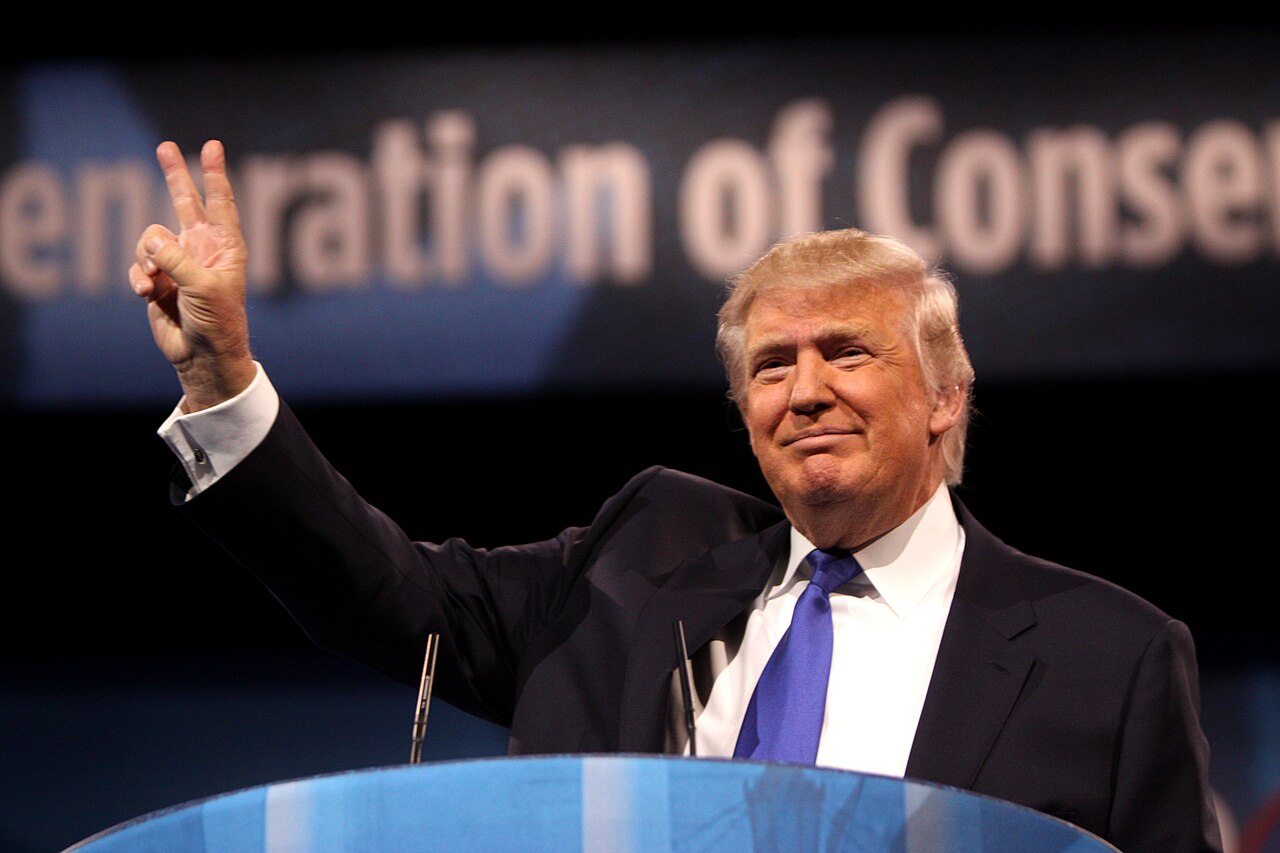
Image credit: Gage Skidmore, via Wikimedia Commons
Interest rates are not just numbers on a chart. They influence mortgage affordability, credit card debt, auto loans, business expansion, and even the pace of hiring. When rates are high, borrowing slows. When rates fall, activity tends to speed up.
That is why Trump’s demand for lower rates resonates with many households feeling squeezed by decades-high borrowing costs compared to the pre-pandemic era. For many Americans, the idea of cheaper money feels like immediate relief from financial pressure that has built up across housing, food, and everyday expenses.
But the Federal Reserve does not adjust interest rates based on sentiment alone. Policymakers are tasked with a dual mandate: maintaining price stability and supporting maximum employment. When inflation is elevated, rate cuts become difficult to justify, no matter how strong the political or public pressure may be.
That is where the conflict begins. The demand is simple. The environment is not.
Inflation Is Still the Central Barrier

The key obstacle to aggressive rate cuts is inflation. Price pressures have eased from their peak levels, but they have not yet returned to the Federal Reserve’s long-term target of around 2 percent.
Recent inflation readings continue to show that essential categories such as housing, services, insurance, and energy remain sticky. These are not isolated price spikes. They are broad-based pressures that affect household budgets across income levels.
For the Federal Reserve, this persistence matters more than political urgency. Cutting interest rates too early risks reigniting inflation, which would force even more aggressive tightening later. That cycle is exactly what policymakers are trying to avoid.
In simple terms, the Fed is not asking whether the economy needs relief. It is asking whether that relief would undo progress already made in stabilizing prices.
The Federal Reserve’s Position Is Not Personal

Federal reserve,via Wikimedia Commons
The Federal Reserve, led by its chair and voting members of the Federal Open Market Committee, operates independently from the White House. That independence is not symbolic. It is structural, designed to protect monetary policy from short-term political pressure.
Historically, when central banks lose credibility in controlling inflation, the consequences are severe. Prices become harder to stabilize, long-term borrowing costs rise, and investor confidence weakens. That is why Fed officials typically respond cautiously to political calls for rapid rate changes.
This tension is not new in American history. Presidents from both parties have at times expressed frustration with the Fed’s decisions. But the central bank’s response has remained consistent: decisions are driven by data, not political timelines.
That principle is now being tested again as Trump’s call for lower rates enters a broader environment in which inflation remains above target and global uncertainty continues to affect energy and supply chains.
Markets Are Not Fully Convinced Either
Financial markets often act as a real-time referendum on interest rate expectations. Traders analyze inflation data, employment numbers, and central bank commentary to price in future moves.
At the moment, market signals do not fully support immediate or aggressive rate cuts. Instead, expectations are shifting between a prolonged period of relatively high rates and a cautious, gradual adjustment path.
One of the reasons for this hesitation is that inflation has proven more persistent than many analysts initially expected. Even after earlier rate hikes slowed demand, price pressures in services and housing have remained stubborn.
This creates a difficult environment for investors. Equity markets generally prefer lower rates, which reduce borrowing costs and increase the value of future corporate earnings. But bond markets tend to react more directly to inflation expectations, and they are less forgiving when price stability is uncertain.
The result is a split financial landscape where optimism about growth collides with caution about inflation.
Why Lower Rates Are Not Automatically “Good News”
Politically, lower interest rates are often presented as economic relief. And in the short term, that is true for borrowers. Mortgage payments can become more affordable, business loans easier to secure, and consumer credit less expensive.
But the broader economic picture is more complex.
If rates fall too quickly while inflation remains elevated, consumers may temporarily feel relief even as prices continue to rise in the background. That combination can actually reduce purchasing power over time, even as borrowing becomes cheaper.
This is why central banks often describe their decisions as balancing acts. They are not simply trying to stimulate growth or restrict it. They are trying to prevent the economy from overheating or stalling in ways that cause long-lasting damage.
In that sense, rate cuts are not a reward for political pressure. They are a response to measurable economic cooling.
Housing Remains the Most Visible Pressure Point

Nowhere is the interest rate debate more visible than in the housing market. Mortgage rates remain significantly higher than many buyers were accustomed to during the ultra-low-rate environment of the early pandemic years.
As a result, affordability has tightened sharply in many regions. Buyers face higher monthly payments, while homeowners with existing low-rate mortgages are less likely to sell, reducing housing supply and keeping prices elevated.
Lower interest rates would normally ease this pressure by reducing borrowing costs. However, even housing does not respond instantly to Fed policy alone. It also depends on inflation expectations, construction costs, labor availability, and investor confidence in real estate markets.
This means even if rate cuts eventually arrive, the housing market may not immediately reset to earlier affordability levels. The adjustment is usually gradual, not immediate.
The Real Collision Is Between Politics and Timing
At the center of this debate is not just economics, but timing.
Political leaders operate on election cycles and public pressure. Economic policy, particularly monetary policy, operates on delayed effects. Interest rate changes made today can take months or even years to fully influence inflation, employment, and growth.
That mismatch creates constant friction between political demands for quick relief and central bank caution about long-term consequences.
Trump’s seven-word statement captures that tension in its purest form. It is a demand for speed in a system designed for patience.
What Happens Next Depends on One Key Factor
The next phase of this story will depend heavily on one thing: whether inflation convincingly moves back toward the Federal Reserve’s target range.
If price growth continues to cool steadily, the case for rate cuts becomes stronger, and policymakers may gradually shift toward easing financial conditions. That would likely bring relief to borrowers and support interest-sensitive sectors such as housing and manufacturing.
If inflation remains sticky, however, the Fed may be forced to keep rates higher for longer than many political actors would prefer. In that scenario, pressure from the White House and markets may intensify, but policy decisions would likely remain anchored in inflation data rather than political messaging.
Either outcome carries consequences. Faster cuts risk renewed inflation. Slower cuts risk prolonged financial strain.
A Familiar Pattern, A New Economic Reality
Trump’s demand is not the first time a president has called for lower interest rates, and it will not be the last. But the environment in which this demand is made is different from earlier cycles.
Post-pandemic inflation shocks, global supply chain disruptions, energy volatility, and shifting labor markets have made monetary policy more complex than in previous decades.
This is why the current moment feels less like a disagreement and more like a structural clash. One side is asking for acceleration. The other is trying to protect price stability.
And in between are millions of Americans navigating mortgages, loans, savings, and wages that respond to both sides of that equation.
The economy, ultimately, does not negotiate in soundbites. It responds to pressure, data, and time—and the final verdict will depend on which force proves stronger.