Supreme Court’s Marijuana Gun Ruling Exposes America’s Biggest Legal Contradiction
In much of America, marijuana is legal enough to buy, tax, advertise, and package in bright retail jars. But under federal gun law, that same cannabis use can still place a person near a criminal line. The Supreme Court just stepped into that contradiction and told Washington that marijuana use alone is not enough to erase a constitutional right.
The ruling in United States v. Hemani was narrow, unanimous, and far more disruptive than it first looked. The justices did not say guns and drugs are a safe mix. They did not say an intoxicated person has a right to handle a firearm. They said something more specific and more powerful: the government cannot treat every marijuana user as automatically dangerous.
That is why this case feels bigger than one Texas man and one gun. It lands in the middle of a national split-screen: legal cannabis stores on one side, federal firearms restrictions on the other, and millions of Americans caught between laws that no longer speak the same language.
A Case That Started With One Search and Ended With a National Warning
Ali Danial Hemani’s case began in Texas after federal authorities searched his family’s home in 2022. According to the Supreme Court’s opinion, the search began with suspicions unrelated to the final gun charge. Hemani cooperated, surrendered a firearm kept in the home, pointed agents to marijuana on the property, and told law enforcement he used marijuana about every other day.
That detail became the center of the case. More than six months later, the government charged him under 18 U.S.C. §922(g)(3), a federal law that bars unlawful drug users or addicts from possessing firearms. The charge was not about drug trafficking. It was not about using a weapon while high. It was not about threatening anyone with a gun.
The government’s theory was simpler: because Hemani used marijuana regularly, he could be treated as someone legally barred from having a firearm. The Court rejected that shortcut.
That is the part readers need to understand. This was not a case where the government proved a violent act, a drug deal, a loaded gun in public, or a firearm used during intoxication. The prosecution rested on marijuana use and gun possession at home. The justices saw that as too thin for a constitutional right.
The Court Did Not Bless Weed and Guns, and They Demanded Proof
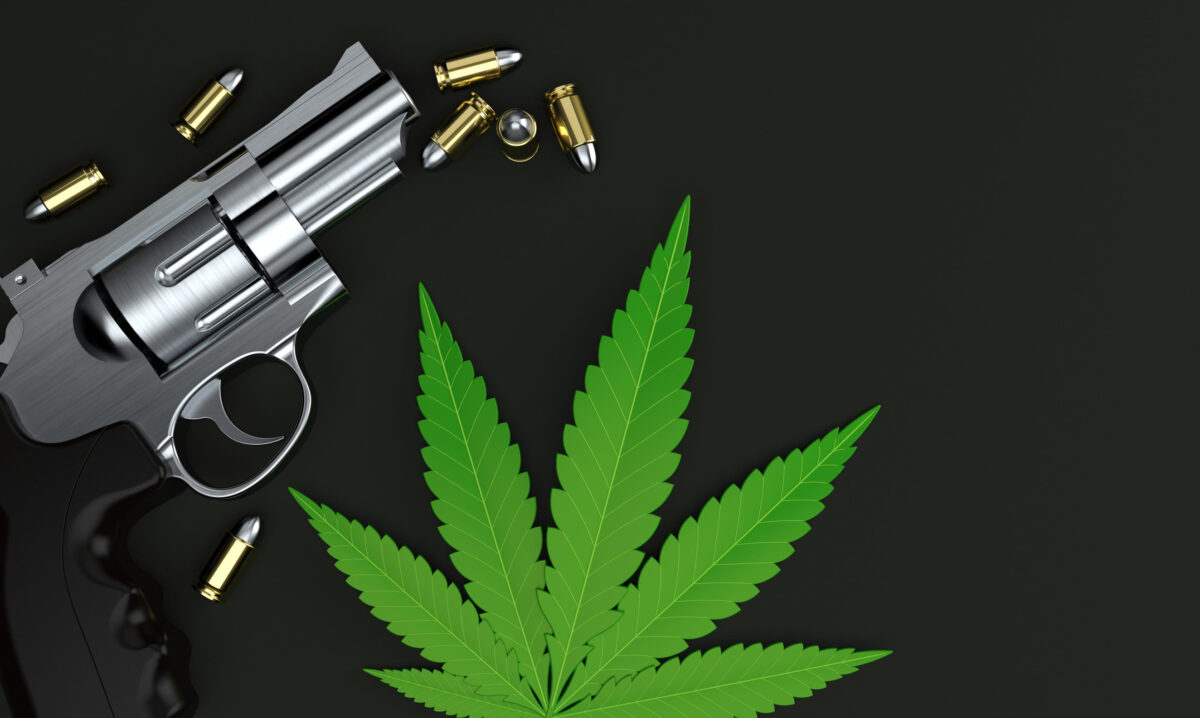
The strongest misunderstanding around this ruling is that the Supreme Court somehow endorsed mixing marijuana and firearms. It did not. The ruling is better understood as a proof ruling, not a pro-drug ruling.
The justices left room for future prosecutions where the facts are stronger. Someone who is addicted to illegal drugs, actively intoxicated while handling a firearm, threatening others, trafficking drugs, or otherwise shown to be dangerous could still face a different legal outcome. The Court’s problem was not public safety. The problem was automatic punishment based on a broad label.
That distinction gives the ruling its force. The government cannot simply point to cannabis use and declare the person constitutionally disqualified. It must show more. It must show a tighter connection between the person, the conduct, and the danger the law is supposed to prevent.
In a country where cannabis policy has changed dramatically, that proof requirement matters. Marijuana is still illegal under federal law, but many states have built legal markets around it. The government is now trying to apply older federal rules to a country where cannabis has moved from the shadows to storefronts.
The Federal Trap: Legal at the Counter, Risky on a Gun Form
This is the most explosive part of the story for everyday readers. A person can live in a state where cannabis is openly sold, walk into a licensed shop, show identification, pay state taxes, and leave with a product that local law treats as legal. But federal law still classifies marijuana in a way that can create serious firearm consequences.
That contradiction is no longer theoretical. It affects medical marijuana patients, recreational users, gun owners, veterans, hunters, and people who keep firearms at home for self-defense. Many may assume that state legalization protects them. Federal law says otherwise.
The Hemani ruling does not erase that conflict. It exposes it. The Court’s message is not that every marijuana user is protected in every gun case. The message is that the government cannot rely on marijuana use alone as a constitutional kill switch.
That creates a harder road for prosecutors. It also creates pressure on Congress to decide whether America’s firearms laws should still treat cannabis use the same way they did before state legalization became widespread.
When the ACLU, NRA, and Cannabis Advocates Land on the Same Side
One of the most unusual features of the case was the coalition behind Hemani. Civil-liberties advocates, gun-rights groups, and cannabis reform supporters found common ground, even if they arrived there for different reasons.
The ACLU framed the case as a warning against vague criminal laws that can strip rights from large groups of people. Gun-rights advocates saw it as another test of whether the Second Amendment protects ordinary firearm possession from broad federal restrictions. Cannabis advocates saw it as a challenge to a rule that treats marijuana users as automatically suspect even in states where cannabis is normalized.
That coalition makes the case more compelling because it does not fit a clean partisan script. This was not simply left versus right. It was Washington’s old drug-and-gun framework running into a new America where cannabis law, criminal justice reform, and gun rights increasingly overlap.
On the other side, gun-control and anti-legalization voices warned that drugs and firearms can be a dangerous combination. That concern remains politically powerful. But the Court drew the line at categorical assumptions. The government may regulate real danger; it cannot invent danger for everyone in a broad class.
The Hunter Biden Comparison Will Keep the Case in the Headlines
The ruling also carries an unavoidable political shadow because the same federal statute was used in Hunter Biden’s gun case. Biden was convicted in 2024 of gun charges tied to drug use and later received a presidential pardon from his father, President Joe Biden.
The cases are not identical. Hemani’s case centered on marijuana use and a firearm kept at home, without allegations that he used the gun while impaired or committed violence. Biden’s case involved different facts, including cocaine addiction and firearm-purchase paperwork.
Still, the comparison will keep the ruling in public debate. The Supreme Court has weakened the broad legal logic behind prosecutions built on drug use and firearm possession alone. That does not automatically rewrite every past case, but it gives defense lawyers a new tool and gives political commentators a familiar name to attach to an otherwise technical statute.
For readers, the Hunter Biden connection turns an abstract Second Amendment ruling into something recognizable. It reminds us that federal gun law is not just about violent crime. Sometimes it reaches into addiction, paperwork, private conduct, and the messy boundary between personal behavior and constitutional rights.
The Bigger Fight Is About Old Laws in a Changed Country
The core problem is simple: America’s cannabis laws changed faster than federal gun laws did.
For decades, marijuana was treated mostly as a criminal marker. Today, in many communities, it is a regulated product. Storefronts advertise it. States tax it. Investors fund it. Patients use it. Adults buy it legally under state systems. Yet federal firearm restrictions still operate as if marijuana use automatically places someone outside the circle of ordinary lawful gun owners.
That gap made the government’s argument feel dated. The Court did not say marijuana is harmless. It said the government’s sweeping assumption was too broad. Millions of people may use cannabis without being violent, intoxicated with a weapon, or addicted in a way that creates public danger.
That is where the ruling could echo. Future defendants may now argue that other broad firearm bans need individualized proof. Lawmakers may try to rewrite statutes in narrower terms. Prosecutors may bring fewer stand-alone cases based only on drug use and gun possession.
In short, the Court did not close the book. It opened the next chapter.
A Narrow Ruling With a Long Legal Tail
The Supreme Court sought to limit the decision. The justices did not strike down the entire drug-user gun law. They did not say Congress has no power to regulate firearms in relation to drugs. They did not protect people who were actively intoxicated or addicted. They decided the case before them.
But narrow decisions can still travel far. Hemani’s case gives lawyers a new phrase to build around: marijuana use alone is not enough. It gives cannabis users in legal states a reason to question federal treatment. It gives gun-rights groups another Second Amendment victory. It gives gun-control advocates another reason to worry about how hard the Court is making broad preventive laws.
Most of all, it forces a question Washington has avoided for too long. Can the federal government keep treating cannabis users as categorically dangerous while much of the country treats cannabis as a legal consumer market?
The answer from the Court was not a full yes or a full no. It was more precise and more challenging: show the danger, prove the risk, write the law narrowly, and stop using old assumptions as constitutional evidence.
That is why this ruling matters. It does not tell America that guns and marijuana belong together. It tells the government that constitutional rights cannot be taken away by stigma, suspicion, or outdated categories alone.