Rubio’s NATO Warning Turns U.S. Bases in Europe Into a Political Firestorm
Marco Rubio did not just complain about Europe. He lit a match under one of America’s oldest security arrangements.
The secretary of state’s argument was simple, sharp, and designed to sting: if the United States keeps troops and bases in Europe, but some European allies block Washington from using those bases when American interests are on the line, then what exactly is the deal?
That question has now exploded into a broader debate over NATO, U.S. troops abroad, and whether America’s military footprint in Europe is still a strategic bargain or a very expensive arrangement with too many strings attached.
Rubio’s comments came after several European allies pushed back against U.S. military operations linked to the war with Iran. France, Italy, and Spain all reportedly denied or restricted some U.S. military support, airspace, or base access connected to the conflict. Spain was especially vocal, saying its bases and airspace would not be used for attacks on Iran.
For Rubio, that was not a minor paperwork problem. It was a warning sign.
Rubio’s Message Was Blunt: What Is America Getting Back?
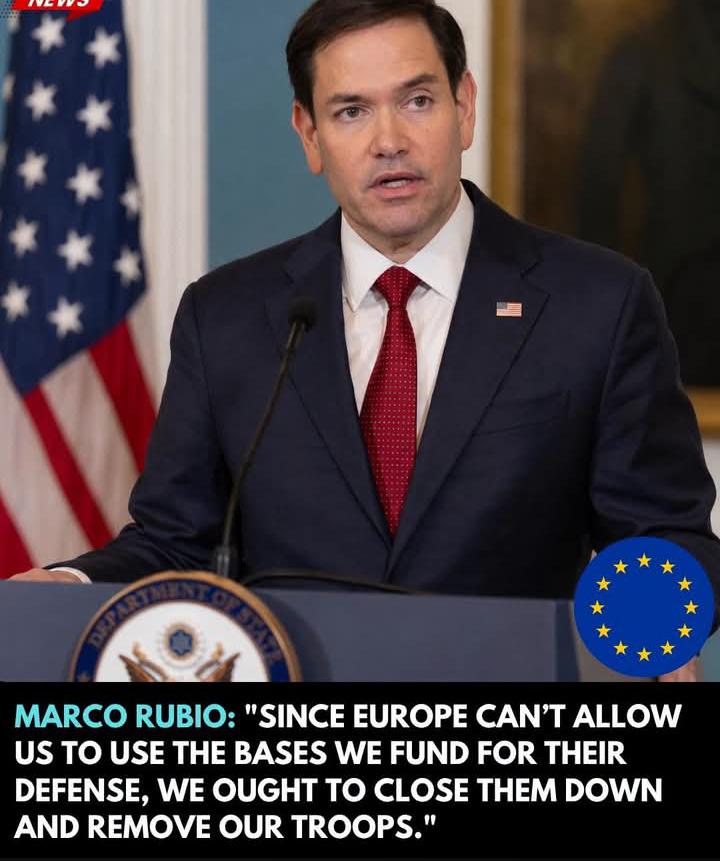
Rubio, speaking on Fox News, framed the issue as a basic question of alliance value.
“If now we have reached a point where the NATO alliance means that we can’t use those bases, that, in fact, that we can no longer use those bases to defend America’s interests, then NATO is a one-way street,” Rubio said.
Then came the line that made the argument impossible to ignore.
“If NATO is simply about us having troops in Europe to defend Europe, but when we need them to allow us to use their military bases, their answer is no, then why are we in NATO? You have to ask that question.”
That is the heart of the fight. Rubio is not arguing only about one base, one flight path, or one delayed authorization. He is asking whether NATO still works for the United States when allies disagree with a U.S. war.
The viral version of the argument has been even sharper: if Europe will not allow America to use bases it helps man and fund, Washington should close them and remove U.S. troops from Europe. That wording captures the political mood, but the important verified point is this: Rubio clearly said the relationship would have to be reexamined after the conflict with Iran.
“We’re very, very close to achieving our objectives,” Rubio said of U.S. operations in Iran, before adding that Washington would need to examine whether NATO still served its purpose or had become a one-way street.
That is a big shift coming from Rubio, who has long been seen as a strong defender of American power abroad. When someone like him starts asking whether U.S. troops in Europe are still worth it, allies listen.
And they should.
Europe Says This Is Not a Blank Check for War
European leaders are not simply saying “no” for fun. Their argument is that NATO is a defensive alliance, not an automatic permission slip for every U.S. military operation.
Spain has taken one of the clearest positions. Defense Minister Margarita Robles said Spain would not “accept lectures from anyone” about its commitment to peace. She also argued that the United States and Israel could not decide “what type of rules or peace apply in the world” without wider support.
That is not diplomatic small talk. That is Europe telling Washington: your bases may be on our soil, but our governments still have laws, voters, and limits.
Italy’s dispute was more procedural but still embarrassing. Reports said U.S. aircraft were denied permission to land at Sigonella in Sicily because authorization was requested too late for the required approval process. Rome denied that the incident caused serious friction and insisted relations with Washington remained solid.
France also drew Trump’s anger after reports that it blocked aircraft carrying military supplies to Israel from using French airspace. Trump blasted France as “VERY UNHELPFUL,” while his broader message to Europe was even less subtle. He told countries worried about energy and the Strait of Hormuz to “go get your own oil” and “build up some delayed courage.”
So now NATO is stuck in a strange place. The U.S. says Europe wants American protection without returning the favor. Some European governments say America wants allied territory to support a war they consider legally and politically questionable.
That is not a tiny disagreement. That is the alliance’s family argument happening in public, with everyone holding a microphone.
The Real Risk Is a Smaller U.S. Footprint in Europe
There is no confirmed order to shut down U.S. bases across Europe or bring every American service member home. But the threat is no longer theoretical.
Defense Secretary Pete Hegseth has announced a review of U.S. forces in Europe, warning NATO defense ministers that “some countries will fail, and others will pass with flying colors.” That sounds less like routine planning and more like a loyalty test.
The stakes are enormous. U.S. bases in Europe do not just protect Europe. They also help America project power into the Middle East, Africa, and beyond. Germany’s Ramstein Air Base, Italy’s Sigonella, bases in the United Kingdom, and facilities in Spain are not decorative pieces on a NATO map. They are part of the machinery that lets Washington move fast during crises.
That is why NATO Secretary General Mark Rutte has tried to cool the temperature while still acknowledging Rubio’s point. Rutte said Rubio was “spot on” that an alliance cannot be a one-way street. But he also reminded Americans that NATO was not one-way after 9/11, when U.S., European, and Canadian troops served and sacrificed together in Afghanistan.
Rutte’s broader message was clear: NATO protects Europe, but it also protects the United States. He said the alliance helps keep threats away from the U.S. mainland, including in the Arctic and Atlantic.
That is the part of the debate that gets lost in the shouting. America’s bases in Europe are expensive, yes. They also give Washington reach, speed, and leverage. Europe benefits from American troops, but America benefits from European geography.
Still, Rubio’s warning has landed because it touches a real frustration among many Americans. They see the U.S. paying heavily for global security while allies debate whether to help when Washington calls. European leaders, meanwhile, see Trump-era demands as pressure to support military operations they did not approve and may not legally back.
Both sides think they are being used.
That is why this fight matters. It is not just about Iran. It is not just about Spain, France, or Italy. It is about whether NATO can survive when America wants flexibility, and Europe wants limits.
Rubio has now forced the question into the open: if the U.S. funds, staffs, and defends a network of bases in Europe, should European governments be able to block their use when America says its security is at stake?
Europe’s answer is: sometimes, yes.
Rubio’s answer is: then maybe the arrangement needs to change.
And that is how a fight over basing rights turned into a warning shot for NATO’s future.