Tucker Carlson and Marjorie Taylor Greene Say They Are Done With the G.O.P.
Tucker Carlson and Marjorie Taylor Greene are no longer talking like disappointed Republicans. They are talking like political exiles from a movement they once helped define.
Their message is not soft, subtle, or wrapped in campaign-season politeness. Carlson says he can no longer support the Republican Party. Greene says he is not alone. Together, their public break with the G.O.P. has turned a long-simmering MAGA argument into a national political rupture, one centered on loyalty, foreign policy, donor influence, and whether the modern Republican Party still represents the “America First” voters it spent years courting.
For years, Carlson and Greene were not fringe critics standing outside the conservative machine. They were two of its loudest cultural messengers. Carlson helped shape right-wing media conversation from prime-time television to his own digital platform, often giving voice to voters who felt ignored by Washington. Greene built her political identity as a combative Trump ally from Georgia, someone who spoke directly to the Republican base and used confrontation as a political brand. That is why their split carries weight. It is not just another Beltway disagreement. It is a fight inside the emotional core of the Republican coalition.
Carlson’s Break With the Republican Party Was Built Around Betrayal
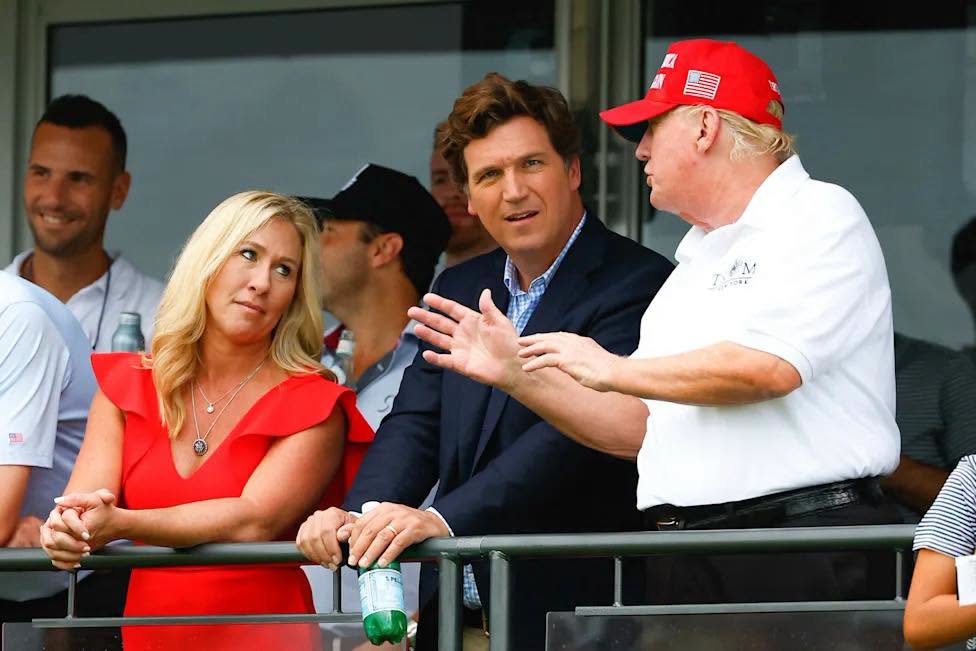
Carlson’s language has grown sharper because his argument is no longer just about policy. It is about betrayal. He has framed the Republican Party as a political organization that, in his view, no longer puts American citizens first. His anger has focused heavily on foreign policy, especially the party’s support for Israel and President Trump’s handling of the Iran conflict.
That matters because Carlson is not positioning himself as a Democrat, a centrist, or a traditional anti-Trump Republican. He is arguing from inside the old MAGA promise. The promise was simple and powerful: America first, foreign entanglements last, working people before donors, voters before lobbyists, and national interest before global commitments. Carlson now suggests the party has broken that promise.
His split lands at a dangerous time for Republican leaders. Midterm elections are approaching, foreign policy is dividing the right, and Trump’s second-term coalition appears more complicated than the loyalty machine many assumed it would be. Carlson’s statement that he is “out” does not automatically create a mass movement, but it gives frustrated conservatives permission structure. It tells them they can reject the Republican Party without calling themselves Democrats.
That is the real political threat. Carlson is not asking his audience to cross the aisle. He is asking them to stand apart.
Marjorie Taylor Greene’s Exit Makes the Rift Harder to Dismiss
Greene’s decision to echo Carlson turned the story from one commentator’s outrage into a broader symbol of MAGA disillusionment. Her message was blunt: Carlson is not the only one who has stopped supporting the Republican Party. She described a group of voters and activists who feel betrayed by a party they believe has abandoned its own base and country.
Greene’s words hit differently because her relationship with the G.O.P. has already been publicly damaged. She was once one of Trump’s fiercest defenders and one of the most visible faces of the Republican populist wing. Her break with Trump and Republican leadership did not happen overnight. It was built through fights over the Epstein files, support for Israel, health care subsidies, cost-of-living concerns, foreign wars, and whether “America First” still meant what voters thought it meant.
Her departure from Congress earlier this year gave her greater freedom to attack the party without worrying about committee assignments, primary challenges, or pressure from House leadership. Now, outside elected office, Greene can speak as a former insider claiming the system is broken. That is a powerful role in modern politics, especially for audiences already convinced Washington runs on donor pressure and backroom loyalty tests.
Greene is not simply saying the Republican Party made mistakes. She is saying it has become “America Last.” That phrase is designed to cut deeply into the party’s own branding. It turns the G.O.P.’s most successful slogan back against it.
The Israel and Iran Fight Has Become a MAGA Stress Test
The central tension behind this break is foreign policy. Carlson and Greene are attacking the Republican Party from an anti-interventionist, nationalist direction. Their argument is that Republican leaders are too willing to place foreign commitments ahead of American needs, especially when it comes to Israel and Iran.
This is a major shift from the older Republican consensus. For decades, strong support for Israel was one of the party’s most stable foreign policy positions. It united evangelical conservatives, national security hawks, donors, and many elected officials. But the MAGA era introduced a different strain of Republican politics, one suspicious of foreign wars, military spending, and international alliances that seem disconnected from everyday American life.
That strain is now colliding with the realities of governing. Trump’s current foreign policy choices have exposed the split between voters who backed him because they wanted less intervention overseas and leaders who still view American power abroad as central to Republican identity.
Carlson and Greene are betting that many voters feel the same conflict. They are speaking to Americans who hear about foreign wars, military aid, border pressure, inflation, insurance bills, housing costs, and grocery prices, and ask the same question: Why does Washington always seem to move faster for other countries than for its own citizens?
That question is politically combustible. It may not represent the entire Republican base, but it is emotionally powerful among voters who already feel economically squeezed and politically used.
This Is Not a Move Toward the Democratic Party
One of the most important parts of this story is what Carlson and Greene are not doing. They are not joining the Democrats. They are not embracing liberal politics. They are not presenting themselves as moderates who have suddenly found comfort in the other party.
That makes this split more complicated. In a two-party system, leaving one major party usually raises the obvious question: where do you go next? Carlson has not given a clear answer. Greene has suggested that being done with Republicans does not mean becoming a Democrat. Their position is less about finding a new party and more about rejecting the current one.
That rejection could lead in several directions. It could become a third-party flirtation. It could become a pressure campaign inside conservative media. It could become a 2028 positioning move. It could also fade if Trump and the Republican Party regain control of the narrative. But for now, it creates a lane for voters who feel politically homeless on the right.
That lane matters because modern politics is shaped as much by mood as by party registration. A voter does not have to formally leave the Republican Party to become harder to mobilize. They only have to stop donating, stop volunteering, stop defending candidates online, or stay home in a close race.
The G.O.P. Still Has a Strong Base, but the Warning Sign Is Real
Republican leaders may argue that Carlson and Greene are louder than they are representative. That may be true. Trump still commands deep loyalty among many MAGA voters, and the Republican Party remains the only practical vehicle for conservative power in most elections. A few high-profile defections do not automatically equal a mass exodus.
But politics is not just math. It is energy. It is enthusiasm. It is a belief. Carlson and Greene are dangerous to the party because they are not attacking from the Lincoln Project lane or the establishment Republican lane. They are attacking from inside the populist bloodstream of MAGA itself.
Their argument is that Trump’s Republican Party has drifted away from its own voters. That message could be dismissed if it came from Democrats. It is harder to dismiss when it comes from people who helped sell the movement to millions of conservatives.
The bigger danger for the G.O.P. is not that Carlson and Greene will immediately build a rival party. The bigger danger is that they normalize distrust among voters who already believe institutions are corrupt. Once those voters decide the Republican Party is part of the same machine they hate, getting them back becomes much harder.
Carlson and Greene Are Turning “America First” Into a Loyalty Test
The fight is also about who gets to define “America First.” For Trump and Republican leadership, the phrase remains a governing brand. For Carlson and Greene, it has become a measuring stick. They are asking whether the party’s decisions on war, foreign aid, donors, technology, immigration, health care, and household costs actually match the slogan.
This creates a brutal problem for the party. If Republican leaders dismiss Carlson and Greene, they risk looking like they are dismissing the voters who share those concerns. If they engage the argument, they may inflame a foreign policy debate that party leaders would rather contain before the midterms.
The phrase “America Last” is politically sharp because it does not merely criticize a policy. It questions motive. It suggests leaders have chosen someone else over their own voters. That kind of language can travel quickly in conservative media spaces because it feels simple, emotional, and accusatory.
It also creates a purity test that many Republican officials may struggle to pass. Candidates can say they support America First, but voters shaped by Carlson and Greene may ask harder questions: Do they oppose foreign wars? Do they question donor influence? Do they challenge party leadership? Do they speak against policies that raise costs for working families? Do they prioritize domestic frustration over international alliances?
Trump Is Still the Central Force in the Split
Even when Carlson and Greene criticize the Republican Party broadly, Trump remains the gravitational center of the story. Both figures rose in political relevance through the Trump era. Both benefited from the movement he built. Both now argue that the movement has drifted from its stated values.
That makes this split both personal and ideological. Greene’s fallout with Trump became public and bitter. Carlson’s criticism of Trump’s foreign policy has also grown more direct. Their frustration signals that the MAGA coalition is no longer held together by slogans alone. It now has to survive real decisions, real wars, real budgets, real donor pressure, and real governing tradeoffs.
Trump’s power has always rested on loyalty, but loyalty becomes harder to enforce when former allies claim they are the ones staying true to the original mission. That is the heart of this fight. Carlson and Greene are not saying they changed. They are saying the party changed.
That argument has a long history in American politics, but it is especially explosive inside a movement built around rebellion against elites. If the rebels decide their own party has become the elite, the brand starts eating itself.
Why This Break Could Matter Beyond 2026
The immediate impact may be limited. Carlson is a media figure, not an elected official. Greene is now outside Congress. The Republican Party still has money, infrastructure, ballot access, and Trump’s loyal base. But the long-term impact could be more serious.
Their break could shape the post-Trump succession fight. If the Republican Party moves toward a more traditional foreign-policy candidate in 2028, Carlson and Greene could become loud voices of opposition. If a more nationalist, anti-interventionist candidate emerges, they could help validate that lane. If the party suffers midterm losses, its argument that leadership betrayed the base may gain strength.
The real question is not whether Carlson and Greene can replace the G.O.P. The real question is whether they can weaken voters’ trust in it, the very voters who made MAGA powerful in the first place.
For now, their message is clear. They believe the Republican Party has stopped representing the voters it claims to serve. They believe “America First” has been watered down, sold off, or reversed. They believe foreign policy has exposed the gap between campaign promises and governing choices.
That is why this moment feels bigger than two famous conservatives walking away. Carlson and Greene are testing whether MAGA belongs to Trump, the Republican Party, or the voters who thought they were signing up for something different.