Dave Matthews Doubles Down on Call to End Global Violence, Says His Message Is About “All Children”
The frontman of the Dave Matthews Band addressed his views during a concert in Raleigh, North Carolina, where he pushed back against accusations that his criticism of Israeli government policies should be interpreted as hostility toward Jewish people.
Matthews used the stage not just to discuss the conflict in Gaza, but to widen the conversation to violence affecting civilians in multiple regions, including Lebanon, the Democratic Republic of Congo, Sudan, Ukraine, and immigrant communities in the United States.
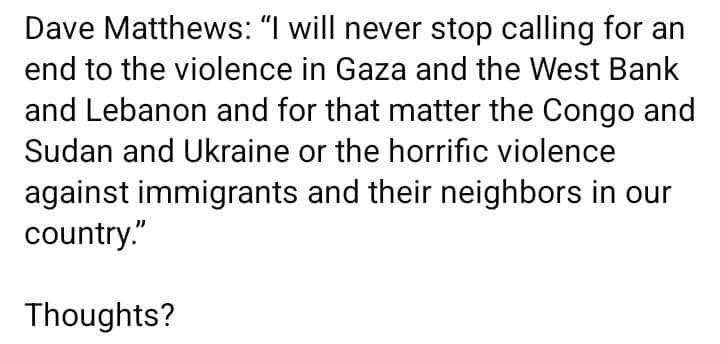
“I will never stop calling for an end to the violence in Gaza and the West Bank and Lebanon and, for that matter, the Congo, and Sudan, and Ukraine,” Matthews said during his remarks.
His statement has placed him once again at the center of a wider discussion about celebrities using their platforms to speak on international conflicts, human rights, and political issues.
Dave Matthews Says His Message Is About Ending Violence, Not Targeting a People

Matthews explained that his criticism has been focused on government policies and civilian suffering, not on any religious or ethnic group.
“It’s no secret, at least I don’t try to make it a secret, that I disagree with the policies of Israel and the United States, and their treatment of the civilian population in Gaza and the West Bank,” Matthews said.
The musician added that he did not want his views to be misunderstood or connected to antisemitism. He said his position came from a desire to oppose violence and protect civilians caught in conflicts.
“But that should by no means be twisted into anybody thinking that I am bigoted or antisemitic in any way at all,” Matthews said.
Matthews also spoke about his personal connection to the Jewish community, recalling that he was attending a close friend’s son’s bar mitzvah on October 7, 2023, when Hamas launched its attack on Israel. He described the event as a moment of celebration interrupted by news of violence overseas.
The singer said he condemned the October 7 attack while also expressing concern about the suffering of Palestinian civilians during the war that followed.
“I am opposed to violence from any government to any people and against children most of all,” Matthews said. “Because all children are our children.”
A Long History of Speaking Out on Global Issues
Matthews’ latest remarks are part of a pattern of political and humanitarian activism that has followed him throughout his career.
In 2024, Matthews joined a protest in Washington, D.C., against Israeli Prime Minister Benjamin Netanyahu’s address to Congress. During that period, he criticized U.S. support for Israel’s actions in Gaza.
“I’m ashamed that my tax dollars are going to the brutalizing of an entire people,” Matthews said in an interview with Al Jazeera at the time. “It’s shameful. And I’m ashamed that our government is welcoming him here.”
His comments have drawn both support and criticism. Supporters have praised him for speaking about civilian suffering, while critics have argued that his statements about Israel risk oversimplifying a complex conflict. Matthews has responded by emphasizing that his concern is the protection of human life regardless of nationality or background.
During his concert remarks, Matthews also addressed what he described as the danger of becoming numb to suffering around the world.
“My deepest fear is that we are becoming numb to it,” he said. “Let’s not do that. Let’s work as long as we can to make a better world for our children.”
Why Matthews’ Comments Continue to Fuel Debate
The singer’s remarks reflect a broader trend of musicians and entertainers using public appearances to discuss political and humanitarian issues.
For decades, artists have used concerts as spaces for activism, from anti-war movements to campaigns focused on poverty, climate change, and human rights. Matthews has often blended music with social causes, including work connected to environmental and humanitarian efforts.
However, celebrity activism can also create controversy. Public figures often face pressure from audiences who disagree with their political positions, especially when discussing conflicts involving deeply held beliefs.
Matthews’ statement attempted to draw a line between criticism of government actions and prejudice against a group of people. He said he respects Jewish people and does not want his opposition to violence to be used to promote hatred.
“I hold the Jewish people in the highest regard, and it breaks my heart that my opinions born out of deep commitment to nonviolent resolution and resistance can be twisted to serve any hateful, racist, or bigoted ideas,” Matthews said.
At the heart of his message was a plea that civilians, especially children, should not become forgotten victims of war.
As conflicts continue across different parts of the world, Matthews says he intends to keep speaking about what he sees as a humanitarian issue rather than a political battle.
His message remains focused on one idea: that protecting innocent lives should not depend on where those lives are found.