Huckabee’s “No America Without Israel” Claim Reveals a Bigger Rift in Trump’s Pro-Israel Message
Mike Huckabee did not just praise Israel. He flipped the entire power story on its head.
The U.S. ambassador to Israel repeated his claim that America would not exist without Israel, a line that instantly turned into more than another diplomatic compliment. It collided directly with Donald Trump’s own claim that Israel would not exist without the United States, and more specifically, without him.
That is where the story gets interesting.
This is not just a fight over one dramatic sentence. It is a revealing moment about how two powerful voices in Trump’s orbit are telling two very different stories about the same alliance.
Trump is talking about power. Huckabee is talking about roots.
And when those two messages land in the same news cycle, the result is a political contradiction too sharp to ignore.
Two very different versions of who needs whom
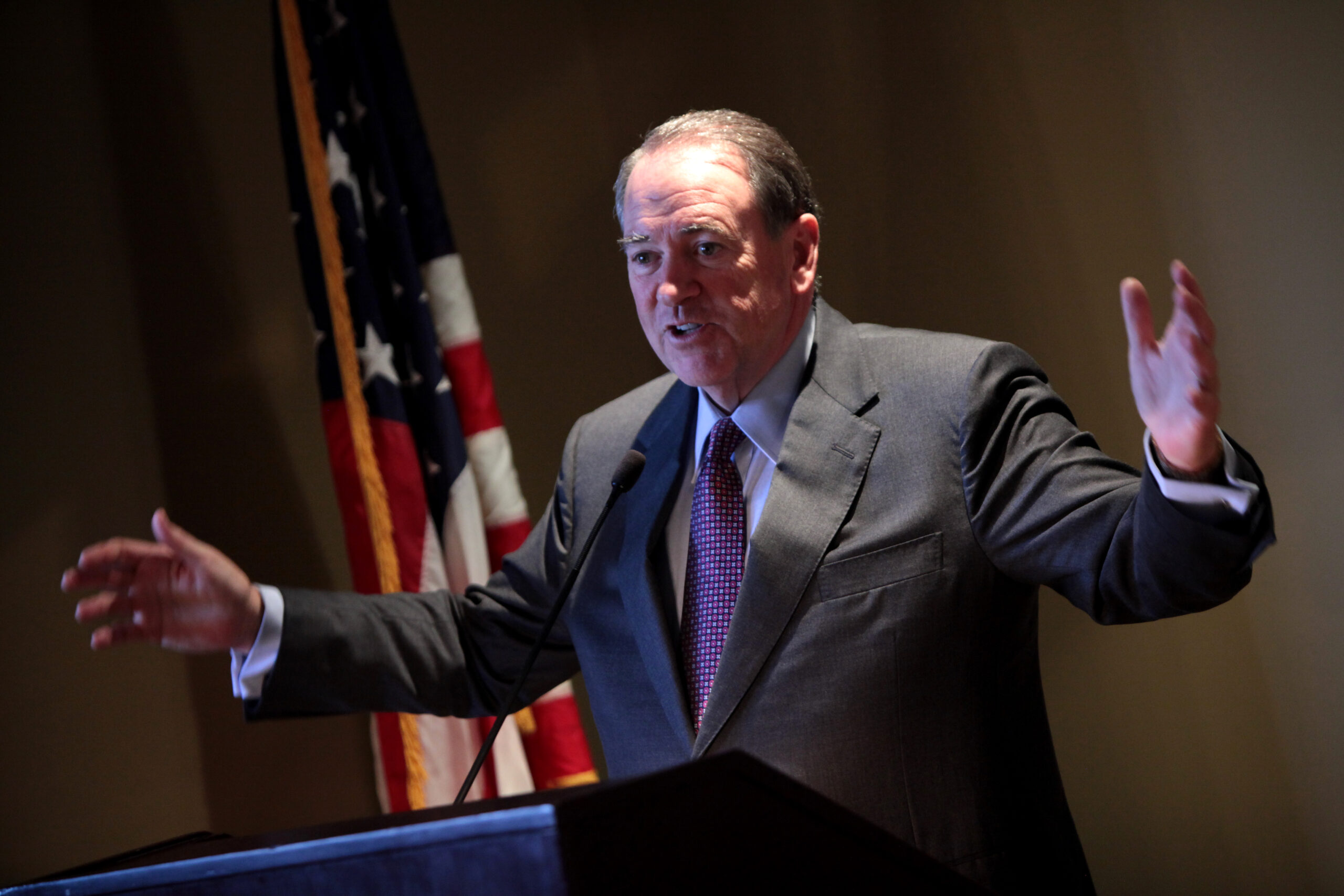
Gage Skidmore from Surprise, AZ, United States of America, CC BY-SA 2.0, via Wikimedia Commons Licensed under Mike Huckabee in 2015
Huckabee’s latest remarks came after he had already sparked controversy by saying that “without Israel and its Jewish foundation, there would be no America.” Speaking at a conference in West Jerusalem, he reportedly repeated the idea and argued that Western civilization was built on Jewish and Judeo-Christian foundations. “Without that, there would be no United States. It’s that simple,” Huckabee said, according to Middle East Monitor.
That is a sweeping claim.
It does not sound like routine embassy language. It sounds like a worldview.
Huckabee is not simply saying Israel is an important U.S. ally. He is saying America’s own identity depends on the Jewish foundation rooted in the land of Israel. That is a much bigger statement, and it helps explain why the reaction was so immediate.
The timing also made it louder.
Just days earlier, Trump had made the opposite argument at the G7 summit. In remarks captured by Sky News, Trump said, “Without us, without the United States, there would be no Israel. Without me, there would be no Israel.”
That is Trump in classic Trump form. Personal, blunt, and impossible to miss.
But placed beside Huckabee’s words, the message becomes strange. Trump says Israel survives because of America. Huckabee says America exists because of Israel’s foundation.
Both men are defending the relationship. But they are not telling the same story.
Trump sees leverage. Huckabee sees legacy.
This is the real angle.
Trump’s statement frames the U.S.- Israel relationship in terms of leverage. America is the protector. America is the power behind the scenes. Trump, in his telling, is the leader who did what others would not do.
It is political branding wrapped in foreign policy.
Huckabee’s statement comes from a different place. His language is not transactional. It is historical, religious, and civilizational. He is speaking as a diplomat, yes, but also as someone whose long public career has been shaped by evangelical support for Israel.
That difference matters.
One message says Israel owes America.
The other says America owes Israel.
That is why this story has more weight than a normal quote controversy. It reveals two competing emotional scripts inside the same political universe.
For Trump, the alliance can be described in terms of strength, support, and credit. For Huckabee, the alliance is almost sacred. It is about heritage, faith, and the moral story America tells about itself.
Those are not small differences. They shape how voters understand foreign policy. They shape how supporters talk about loyalty. And they shape how criticism of Israel is treated inside American politics.
Why one sentence became a political firestarter
Huckabee’s original comment reportedly came at the International Conference on Israeli Heritage in Judea and Samaria, where he said Israel’s heritage was also America’s heritage. “Without Israel, without the Jewish foundation, there would not be America. We owe our very existence to what happened in this land,” he said, according to The Media Line.
That phrasing is powerful because it does two things at once.
First, it elevates Israel from ally to origin story.
Second, it places America’s national identity inside a biblical and Jewish historical frame.
For many supporters of Israel, especially religious conservatives, that language may feel natural. It echoes the way many evangelicals have long talked about Israel as central to biblical history and Western moral development.
But for critics, the statement goes too far. They see it as an ambassador making a sweeping historical claim that blurs the line between diplomacy, theology, and national identity.
That is where the controversy lives.
Huckabee was not delivering a quiet academic lecture. He was speaking as America’s representative to Israel. His words carry the weight of office, even when they sound like a sermon, a campaign speech, or a cultural argument.
And because Trump had just made the reverse claim, Huckabee’s comment did not float by unnoticed. It landed like a direct contrast.
The bigger story is not just Israel. It is America.
This is why the headline matters.
The drama is not only about Israel. It is about how American leaders explain America to Americans.
Is the United States primarily a global superpower that sustains its allies through military, diplomatic, and financial backing?
Or is it a nation whose moral imagination was deeply shaped by biblical history, Jewish tradition, and the land of Israel?
Trump and Huckabee are not answering that question the same way.
Trump’s answer is modern and muscular. He points to American power and his own presidency.
Huckabee’s answer reaches backward. He points to heritage, faith, and the Jewish foundations of Western civilization.
Both approaches are politically useful. Trump’s version appeals to voters who like strength and dealmaking. Huckabee’s version speaks to voters who see Israel through a religious and cultural lens.
But when the two versions collide, the contradiction becomes hard to smooth over.
It also comes at a sensitive time. U.S. Israel politics has become more emotionally charged, especially as debates over war, civilian suffering, regional security, Iran, Gaza, Lebanon, and Netanyahu’s leadership continue to divide public opinion. That makes every major statement about Israel feel heavier than it might have a decade ago.
Huckabee’s defenders may argue that he was speaking about spiritual and historical influence, not making a literal claim that the United States government was created by Israel.
His critics may argue that an ambassador should choose words more carefully, especially when speaking in a region where history, land, faith, and sovereignty are already explosive issues.
Either way, the moment tells us something important.
The U.S. Israel relationship is no longer described in one simple voice. Even inside Trump’s own political world, there are competing ways to frame it.
One voice says America saves Israel.
Another says America owes Israel.
And between those two lines sits a much bigger debate about power, faith, history, and who gets to define what America stands for.