Sherpa Missing on Everest for a Week Is Found Crawling Back …After Family Began Funeral Rites
When the phone call came early Thursday morning, it stunned a family, a community, and the climbing world: a Sherpa guide long presumed dead on Mount Everest was alive, crawling toward base camp after nearly a week alone on the world’s highest mountain.
His name is Dawa Sherpa, a 52‑year‑old Nepali guide whose survival has been described by mountaineers as “nothing short of a miracle.”
This is not an Everest tale of beating a summit record. It’s a story of endurance, fear, loss, and an almost unbelievable escape from one of the harshest environments on Earth.
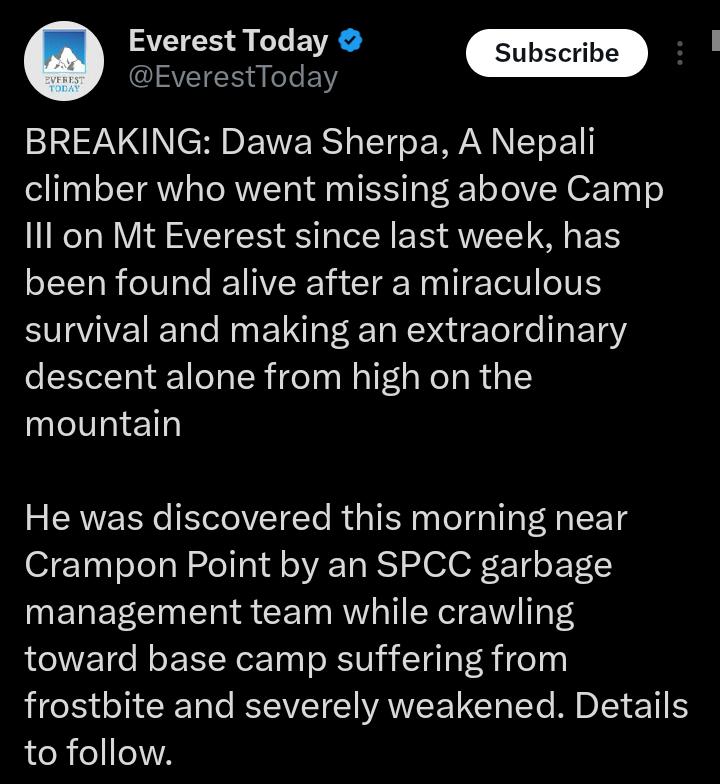
The trouble began on May 29, during what was supposed to be a routine descent near the end of the 2026 climbing season. Dawa was guiding a Polish climber down from the heights above Camp III, a stretch of the mountain often called the “death zone” because oxygen levels are too thin to sustain human life for long.
While his client reached base camp safely, Dawa did not. There was no sighting, no phone call, no check‑in, and no sign that he had made it down, triggering immediate alarm among his team and family.
But within days, hope faded. The climbing season was ending; fixed ropes and ladders were being taken down; the route was being cleaned; and the harsh mountain was emptying out for the winter. In Kathmandu, the guide’s family made a heart‑wrenching decision: they began funeral rituals, believing he had died high on the mountain.
To many who knew Dawa, that feeling of loss was painfully real until Thursday broke that silence in the most surreal way.
Found Crawling Through Icefall
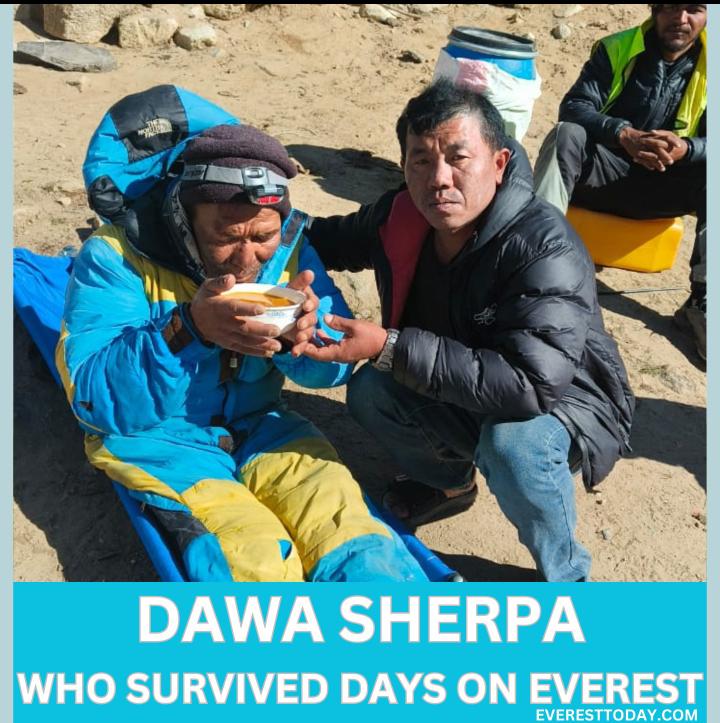
The discovery came unexpectedly. Teams from the Sagarmatha Pollution Control Committee (SPCC), who were on the mountain not to rescue anyone but to remove equipment and clean the trails after the climbing season, stumbled upon something they weren’t planning for.
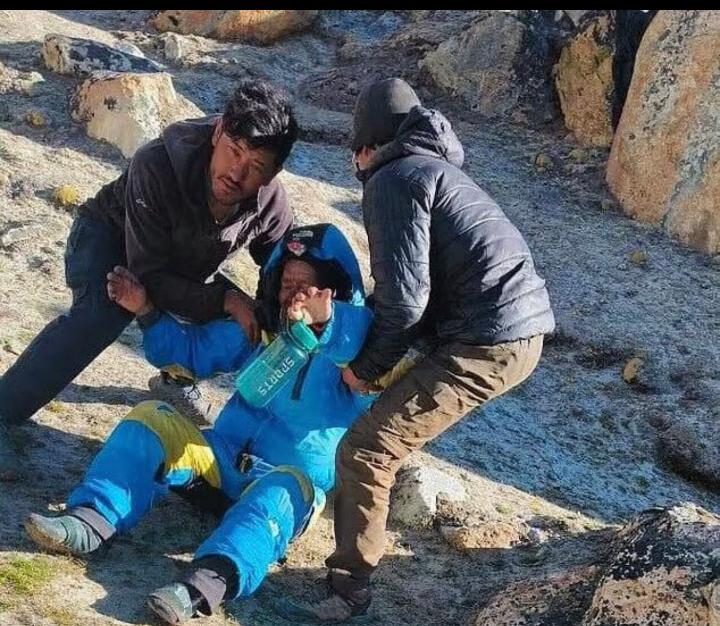
There, just above Base Camp near the dangerous Khumbu Icefall, they saw a figure slowly moving across the snow. It was Dawa, crawling, weak, and frostbitten, yet unmistakably alive.
“It was astonishing,” said Pemba Sherpa, executive director of 8K Expeditions, the team that coordinated the effort on the ground. “He was found in a condition where he was slowly sliding down through the icefall. It is in itself an astonishing incident.”
That word, astonishing, kept appearing in mountaineering circles. It is rare, almost unheard of, for someone to survive an extended time at extreme altitude without supplemental oxygen, food, or water. Yet Dawa did it. According to Reuters, he survived about a week without food, water, or oxygen, navigating treacherous slopes that have claimed countless climbers.
In fact, as the climbing season ended and ladders were being removed from the Khumbu Icefall, a route infamous for collapsing ice towers and hidden crevasses, Dawa kept going. That meant not only surviving physically but also navigating a maze of ice and snow that most climbers only attempt with full support teams and ladders in place.
His discovery was so unexpected, said Pemba Sherpa, that many on the mountain initially couldn’t believe their eyes.
Reunion With Family: “He Recognized Me… He Is Good and Speaks”
Once spotted, Dawa was quickly brought to safety, given food and water, and flown by helicopter to HAMS Hospital in Kathmandu for treatment.
When his wife, Damu Sherpa, learned the news, she was flooded with disbelief and relief. “We first heard that he was still alive on the local news and from a person we know who called with the news that … he is being brought down,” she told journalists. “At first, we were not sure if that person was indeed our husband. So to be certain we asked for photos to be sent, and then only we were sure and very happy.”
Their teenage daughter, Mendo Lhamu Sherpa, described the surreal emotional roller coaster her family went through. They had started multiple days of funeral rituals when the phone rang. “When we first heard about it (the rescue), we could not be sure if that person was indeed our father … then we were sure and very happy,” she said.
Once at the hospital, Dawa reportedly recognized his family, spoke with them, and was in stable condition, though he was being treated for frostbite and other complications.
“He recognized me … is good and speaks,” his daughter said. “We are happy.”
But Dawa didn’t wait to be rescued; he self‑rescued. Crawling mile after mile, slope after slope, he moved toward base camp at an altitude and in conditions that would defeat most climbers within hours.
His survival has led to widespread awe from climbers and guides alike. Many point not just to physical strength, but to the deep mountain experience and instinct that Sherpas develop over decades of working on these peaks.
And yet it has also sparked uncomfortable questions in some circles about how missing Sherpas are searched for and supported, especially when compared with foreign climbers who have large support teams. But while those discussions continue outside the mountain, inside HAMS Hospital, one family is simply overjoyed that their relative will live to see another day.
This year’s Everest climbing season was one of the busiest ever, with more than 1,000 climbers and guides attempting the peak, and five deaths reported.
For many, the mountain is a place of triumph and tragedy in equal measure, where success and loss can sit side by side on the same slope. But for Dawa, there will be no plaque on a summit. Instead, the mountaineering community will remember him for something even rarer: the climb down that shouldn’t have been possible.
As one mountaineer put it, reflecting the sentiment of many who have followed the story: surviving above 26,000 feet without oxygen or sustenance and making it back alive is more extraordinary than nearly any summit record.
Whether the mountain finally releases its hold on Dawa or not, his return has already reshaped how climbers and supporters alike talk about endurance, grit, and the human spirit.
And in Kathmandu, a family that had already mourned him is now planning a different kind of celebration, one that honors not just his life, but the fact that he lived through a week in the world’s deadliest heights and found his way home.