Russia Is Paying a Terrible Price in Ukraine, and Putin’s Victory Story Is Cracking
Russia’s war in Ukraine no longer looks like a short, sharp campaign of pressure. It looks like a grinding test of how much blood, steel, money, and patience one government can burn before the bill becomes impossible to hide.
For Vladimir Putin, the danger is not only that Russia is taking heavy losses. The deeper problem is that those losses are buying less than they once did. A war machine can survive pain when it produces visible victory, but it becomes harder to defend when the battlefield turns into a slow, expensive treadmill.
That is the question now hanging over Moscow: how long can Putin keep fighting if the price keeps rising and the reward keeps shrinking?
The Numbers Are Becoming Harder To Ignore
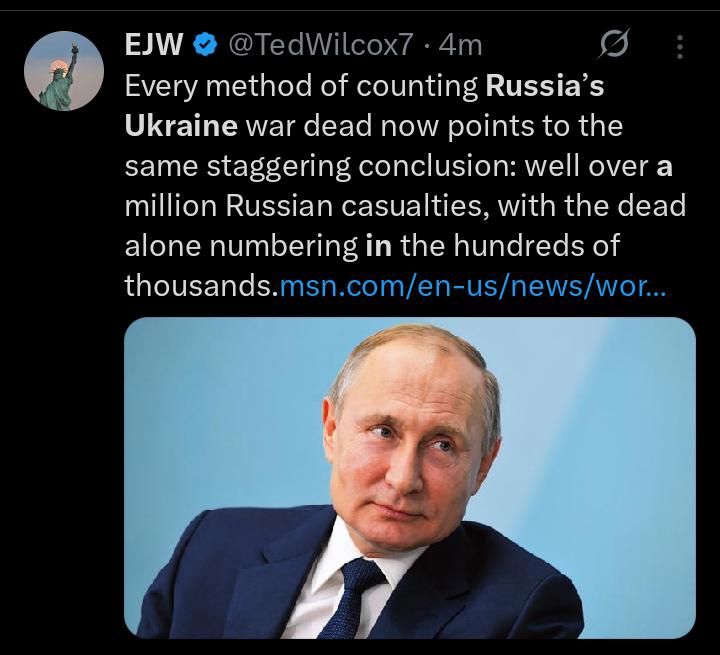
War figures are always disputed, and each side has reasons to frame the battlefield in its favor. Still, the scale of Russia’s reported losses has become one of the defining facts of the conflict. Ukraine’s military now claims that Russian personnel losses since the full invasion began have climbed beyond 1.3 million, a figure that includes killed, wounded, captured, and otherwise removed from the fight.
Even if outside analysts treat those numbers with caution, the trend is difficult to dismiss. Russia has been forced to replace men, armor, artillery, drones, trucks, and air defense systems at a punishing pace. This is not just a battlefield problem. It is a national pressure point that reaches into factories, families, regional budgets, and the hidden corners of Russian society.
Small Gains Are Coming At A Brutal Price
The old Russian formula relied on pressure. Send more troops, fire more shells, accept more casualties, and grind forward village by village. That approach worked better when Ukraine was under heavier ammunition pressure, and Russia could present even limited gains as proof of momentum.
Now the math looks uglier. Analysts say Russia’s advances have slowed, while Ukrainian defenses, drones, and counterattacks have made every kilometer more costly. When an army spends thousands of lives to move lines on a map by tiny amounts, the victory starts to look less like progress and more like exhaustion dressed in military language.
Putin Still Wants Donbas, But Time Is Fighting Back
Putin has tied his war goals to control of Donbas, especially the remaining Ukrainian-held areas of Donetsk. That makes retreat politically dangerous for the Kremlin. If he cannot show that Russia is still moving toward that goal, his claims of inevitable victory become harder to sell.
The problem is that Donbas is not open ground waiting to be taken. It is full of fortified cities, ruined industrial zones, drone-covered roads, and defensive belts that have been hardened by years of war. Russia can still attack, but an attack is not the same as a breakthrough. The longer this drags on, the more Putin’s promise of control begins to look like a hostage note written to his own regime.
The Drone War Has Changed The Battlefield
Drones have turned the front into a hunting ground. Soldiers who once feared tanks and artillery now also fear cheap flying machines that can track a vehicle, follow a squad, or strike a trench with shocking precision. Ukraine has used drones to make Russian movement more dangerous and Russian logistics more fragile.
This matters because Russia’s traditional advantage was mass. More men, more guns, more ammunition, more pressure. But drones punish mass. They spot columns, expose supply routes, and turn old military habits into visible targets. Russia can adapt, but it will take time, money, trained operators, and electronic warfare systems. Ukraine has made sure that every Russian advance now travels under a digital shadow.
Russia’s Economy Is No Longer Looking Invincible
For a long time, Moscow avoided the economic collapse many expected. Energy revenue, state control, wartime production, and trade workarounds helped Russia absorb sanctions better than some Western officials predicted. That resilience gave Putin room to keep going.
But resilience is not the same as strength. Russia’s economy is now facing slower growth, high rates, sanctions pressure, labor shortages, and the high cost of feeding a permanent war economy. Weapons production may lift certain sectors, but tanks and shells do not make ordinary citizens richer. They do not repair consumer confidence. They do not create a normal future.
The Labor Problem Is Quietly Dangerous
A long war eats workers as well as soldiers. Men sent to the front are removed from factories, farms, construction sites, transport companies, and local economies. Others are drawn into defense production, where the state’s priorities reshape the labor market to meet war needs.
That creates a strange economy in which the government can keep military factories busy while other parts of the country struggle to find workers. Wages may rise in some sectors, but so do costs, shortages, and pressure on businesses. The Kremlin can hide casualty numbers more easily than it can hide a country where labor is tight, prices are stubborn, and young men keep disappearing into the machinery of war.
Air Strikes Cannot Replace Ground Victory.
Russia has leaned hard into missile and drone strikes against Ukrainian cities and infrastructure. These attacks can cause fear, damage, outages, and civilian suffering. They also let Moscow project power when the ground war stalls.
But air strikes do not automatically win territory. They can punish Ukraine, but they cannot by themselves occupy cities, hold supply lines, or force Kyiv to surrender political independence. If anything, repeated attacks on civilians have often hardened Ukrainian resolve and strengthened the case for more Western support. Bombing can make headlines, but it cannot forever mask battlefield frustration.
The Kremlin’s Biggest Risk Is The Cost-Benefit Trap
Putin does not need the war to look good in Western media. He needs it to remain manageable at home and useful politically. As long as the Kremlin can present sacrifice as necessary, controllable, and tied to future victory, the system can keep moving.
The danger comes when the war begins to look like a bad exchange. More casualties for less land. More spending for weaker growth. More repression for less confidence. More propaganda for fewer visible results. That is the cost-benefit trap. It does not always collapse a regime overnight, but it narrows its choices and makes every new promise harder to believe.
Ukraine’s Strategy Is To Make Russia Pay Every Day
Ukraine does not need to defeat Russia in one dramatic blow to change the war’s direction. It can also win by making Russia’s campaign too expensive, too slow, and too politically awkward to sustain comfortably. That is why strikes on logistics, depots, refineries, command posts, and supply routes matter so much.
This kind of pressure is not glamorous, but it is strategic. It forces Russia to defend more places, spend more resources, move more carefully, and explain more failures. Every destroyed vehicle, burned depot, and disrupted supply chain adds weight to the same question: how much longer can Moscow pretend the price is acceptable?
Putin Can Keep Fighting, But Not For Free
The uncomfortable answer is that Putin can probably keep fighting for some time. Russia still has manpower, weapons production, security services, censorship, and a political system built to absorb pain without asking voters for honest permission. The war will not end simply because the losses are high.
But the second answer matters more. He cannot keep fighting at this pace for free. The bill is rising across the battlefield, the economy, the labor market, and the political imagination of Russia’s future. Putin may still believe he can outlast Ukraine and the West, but the war is now testing whether Russia can outlast the consequences of his own gamble.