Obama Center’s Bold Chicago Tower Opens a Bigger Fight Over Taste, Legacy, and Who Gets to Define a President
Some buildings arrive as landmarks. Others arrive as arguments. The Obama Presidential Center on Chicago’s South Side has managed to become both before many Americans have even stepped inside.
The long-awaited campus in Jackson Park opened to the public with the kind of symbolism only Barack Obama can still command. It is part museum, part civic space, part tribute, part neighborhood bet, and part national memory test. But instead of a quiet celebration around the country’s first Black president, the loudest conversation has centered on the building’s tower, a massive vertical statement now being praised by some visitors and roasted by others online.
That is what makes this story bigger than architecture. Americans are not only judging stone, glass, concrete, and carved words. They are arguing over Obama himself, over Chicago’s South Side, over what presidential legacy should look like, and over whether a public landmark should comfort the eye or challenge it.
A Presidential Center Built to Stand Out
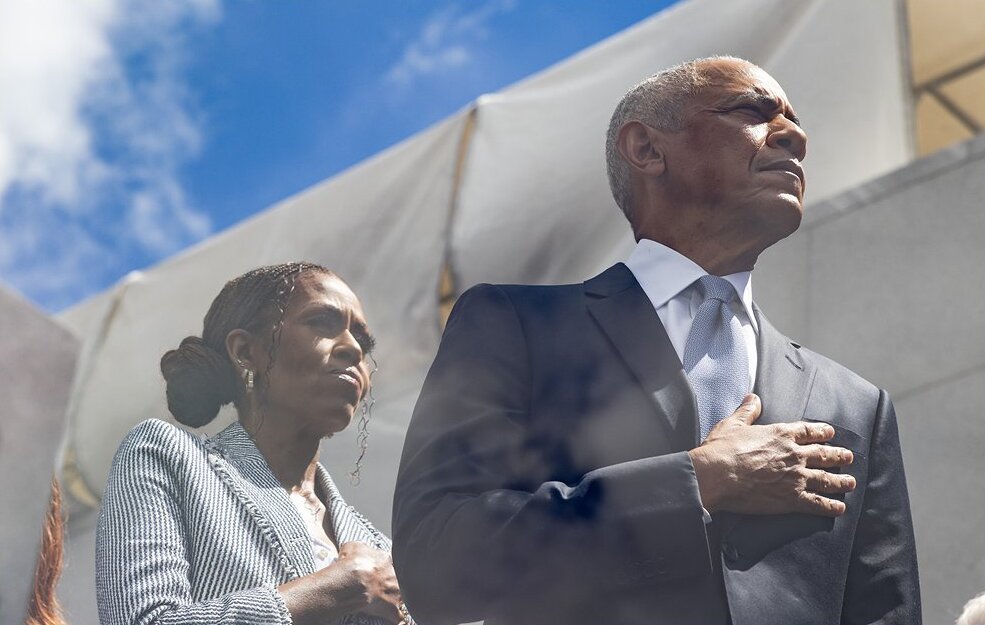
Barack Obama Presidential Center, Public domain, via Wikimedia Commons Licensed under Grand opening of the Barack Obama Presidential Center
The Obama Presidential Center sits on a 19.3-acre campus in historic Jackson Park, close to neighborhoods that shaped Obama’s early public life. The center includes a museum, a library branch, gardens, a public plaza, sports areas, and community spaces designed to make the site more than a traditional presidential archive.
At the center of the debate is the museum tower. It is tall, heavy, unusual, and impossible to ignore. Unlike the polished marble temples Americans often associate with presidential memory, this tower does not try to disappear into good manners. It rises with blunt confidence, carrying words from Obama’s speeches across its face.
Structural engineer Chris Bird, who worked on the upper part of the tower, has defended the design against critics who called it ugly, monstrous, and insulting to architecture. He said the tower was designed to make a bold statement, not simply to look safe or familiar.
The detail that has drawn the most attention is the lettering. The tower includes 91 words from Obama speeches, shaped through 433 large letters, each roughly five feet tall. That alone tells us what the designers wanted. This was not meant to be a quiet building with a quote tucked near the entrance. It was meant to turn language into structure.
The Internet Saw a Target
Online, that kind of ambition can quickly become bait. Photos of the tower spread fast, and with them came the usual flood of instant judgment. Some people called it a concrete nightmare. Others treated it as proof of political ego, bad taste, or modern architecture gone too far.
The criticism was sharp because Obama remains one of the most symbolic figures in American politics. For supporters, he represents hope, history, intelligence, and a presidency that changed the country’s self-image. For critics, he remains a deeply political figure whose name still triggers arguments about power, race, class, and the direction of America.
That is why the tower became more than a tower. People who already admire Obama may see the building as brave, emotional, and fitting for a president whose speeches helped define his rise. People who dislike him may see the same building as excessive, self-important, or out of touch.
In other words, many Americans are not looking at the same structure. They are looking through their own politics.
Chicago Pride Meets Chicago Pressure
For Chicago, the Obama Center is a major civic prize. It brings global attention to the South Side, a part of the city too often discussed in terms of crime statistics, poverty, and political neglect rather than its history, culture, families, churches, schools, businesses, and talent.
Supporters see the center as a long-overdue investment. They argue that it gives the South Side a world-class destination, new public space, tourism energy, educational programming, and a visible reminder that one of the most important political stories in modern America rose from those streets.
But pride is only one side of the story. The center also sits at the center of a serious neighborhood debate over money and displacement. Some residents in nearby communities such as Woodlawn, South Shore, and Hyde Park have worried for years that the center could raise property values, increase rents, attract investors, and push longtime residents out of the very communities the project says it wants to honor.
That is where the beauty debate becomes almost too small. Whether the tower is attractive matters to people, of course. But for many residents, the deeper question is not whether the building looks good in photos. It is whether the people who stayed through decades of disinvestment will still be able to afford the neighborhood when the cameras move on.
A landmark can bring pride. It can also bring pressure.
The Building Is Asking Americans to Pick a Side
The most interesting thing about the Obama Center is that it refuses to be neutral. It does not look like a building in the background. It does not behave like a modest plaque. It stands there like a statement, and statements invite arguments.
That may be exactly why the design has become so polarizing. A safe building would have been praised politely and forgotten quickly. A daring building forces people to react. It gives supporters something to defend and critics something to attack.
For Obama, whose political gift was often built on language, the tower’s use of words feels intentional. His speeches were not side notes to his career. They were part of the engine. From the 2004 Democratic National Convention to his presidential campaigns and national addresses, Obama used language to sell a vision of America that millions found moving and millions questioned.
Now those words have been turned into architecture. Some see poetry. Others see concrete wrapped in ego. That split may be the most honest reflection of Obama’s place in American memory.
A Legacy Too Big for Quiet Approval
The Obama Center was never going to open as just another museum. Obama is not just another former president. He is the first Black president, a Chicago political figure, a global celebrity, a culture war symbol, and a man whose presidency still divides Americans nearly a decade after he left the White House.
That makes the public reaction almost predictable. A building tied to Obama was always going to carry more than design criticism. It was going to carry every old argument about his presidency, every feeling among his supporters, every frustration among his critics, and every hope among those who still see him as a historic figure.
Maybe that is why the tower works, even for people who dislike it. It has already done what public architecture is supposed to do. It has started a conversation. It has made Americans look, judge, debate, defend, mock, praise, and ask what kind of monument a president deserves.
The real question is not whether everyone likes the Obama Center. They clearly do not. The real question is whether a presidential landmark should be beautiful to most people, meaningful to its community, bold enough to last, or humble enough not to dominate the surrounding landscape.
That is where Americans will disagree, and that disagreement may be the most American part of the whole project.
So now the question moves from Chicago to the rest of the country: is the Obama Center’s tower a bold tribute to a historic presidency, or did the designers mistake size and symbolism for beauty?