Newly Released Connecticut Prison Video Reignites Questions Over Inmate Death Ruled a Homicide
The newly released video of J’Allen Jones inside Garner Correctional Institution does more than reopen a painful 2018 prison death case. It forces Connecticut to confront a question that has followed this case for years: when a person in state custody is in a mental health crisis, restrained, struck, pepper-sprayed, hooded, and later dies, who is responsible for what happens next?
Jones, a 31-year-old Black man from Atlanta, was serving a 10-year robbery sentence at Garner Correctional Institution in Newtown, a prison known for housing people with significant mental health needs. On March 25, 2018, correctional staff were moving him to a medical unit when the encounter turned violent, according to reports and court records. The video, released after a long legal battle, shows officers restraining Jones as he appears to be in psychological distress.
For years, the public had only summaries, official statements, court filings, and arguments from attorneys. Now, the footage has shifted the story from paperwork to public view. What Connecticut residents are seeing is not just a prison incident. It is a timeline of force, delay, medical distress, and institutional defense that has become a larger test of transparency in the state’s correctional system.
A Mental Health Crisis Became a Use-of-Force Encounter
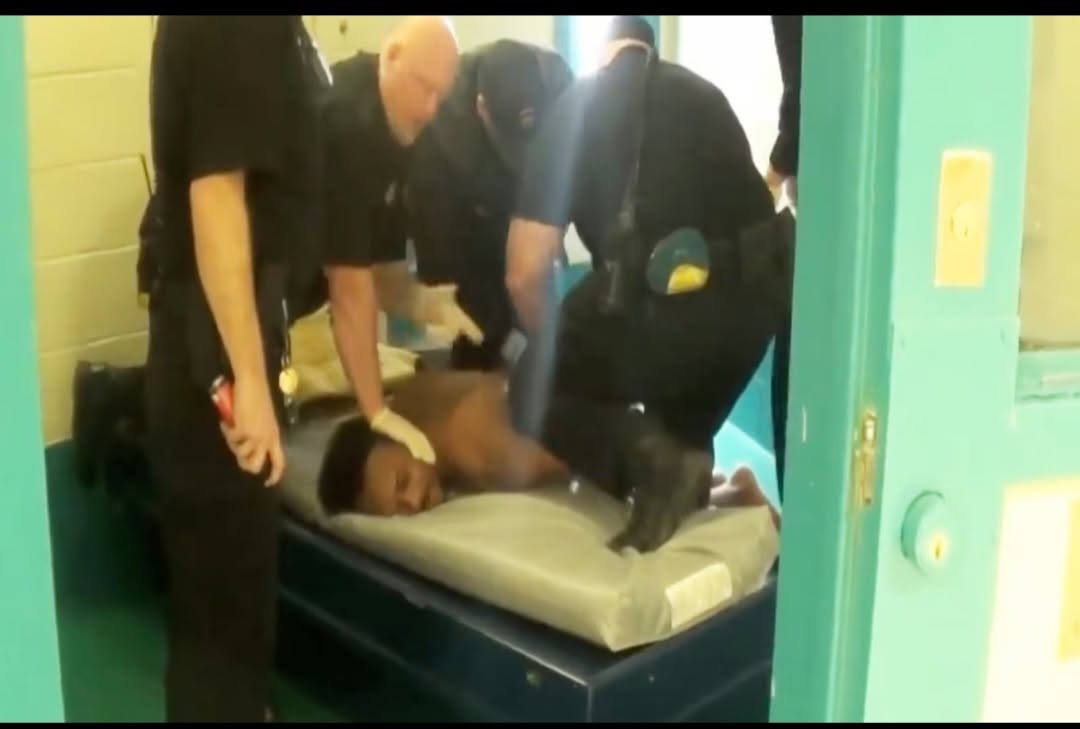
The central fact that makes this case so troubling is that Jones was not simply being moved through a prison routine. He was reportedly experiencing a serious mental health episode. In the video described by news outlets, Jones is handcuffed behind his back and later shackled at the legs while officers attempt to control him.
During the encounter, he shouts religious phrases and appears disoriented. Officers repeatedly tell him to calm down and stop resisting. But the scene escalates. Jones is struck with knees and fists, forced down, stripped naked, fitted with a spit hood, and exposed to pepper spray.
That sequence matters because every decision in a correctional setting can either reduce danger or compound it. A person in crisis may not respond to commands the way a calm person does. A person who is restrained, struggling to breathe, exposed to chemical spray, and held down may quickly move from behavioral resistance to a medical emergency.
The public debate now turns on that distinction. Was Jones treated mainly as a security problem when he needed urgent medical intervention? Did the officers recognize the difference fast enough? And did the system that reviewed the case ask hard enough questions after he died?
The Video Timeline Raises Questions About Force, Breathing, and Delay
The released video reportedly runs about 52 minutes, but the most disturbing stretch happens early. Jones appears to have trouble breathing after the spit hood and pepper spray are used. Several minutes pass before the staff begins treating the situation as a medical emergency.
One officer is heard saying Jones is being “dead weight” and wants a nurse to check him. By that point, Jones appears limp. CPR begins later, and emergency medical services arrive after additional time has passed. Jones was eventually pronounced dead at a hospital.
The medical examiner ruled the death a homicide, a medical classification that means death resulted from another person’s actions, though it does not automatically mean a crime occurred. The stated cause involved sudden death during struggle and restraint, with chest compression and pepper spray exposure, along with underlying cardiovascular disease.
That finding sits at the heart of the public anger. Connecticut authorities later determined that no criminal charges would be filed. An internal Department of Corrections investigation found that excessive force was not used, but it did find that staff violated policy by failing to recognize Jones’ medical distress for more than seven minutes. The punishment reported for the officers and the nurse involved was a one-day suspension without pay.
For many readers, that contrast is the story: a man died, the death was ruled a homicide, policy violations were found, yet the discipline amounted to one day off without pay.
Why the Video Was Kept Sealed for Years
The video’s release did not happen quickly. The Department of Corrections sought to keep it sealed, arguing that making it public could create security risks by revealing prison layout, staffing patterns, and operational details. Jones’ family, civil rights advocates, the ACLU of Connecticut, local NAACP officials, and media organizations argued that the public had a right to see evidence central to a death in state custody.
That fight matters because prison deaths often happen behind layers of institutional language. Official statements can reduce a chaotic, violent, or medically urgent event into phrases like “non-compliant,” “combative,” or “became non-responsive.” Those words may be technically meaningful inside a corrections agency, but they can also flatten the human reality.
In Jones’ case, the original Department of Corrections statement said he became non-compliant and combative, then became non-responsive. It did not describe the full use-of-force sequence now seen in the video. That gap is why the footage has become so important. The question is not only what happened to Jones. The question is what the public was allowed to know about it.
A Family’s Lawsuit Became a Transparency Battle
Jones’ family filed a lawsuit against correctional officers and a prison nurse, and the video became central evidence in that case. Their argument for release was simple: the public cannot evaluate a state custody death if the most important evidence remains hidden.
Attorney Ron Murphy, representing the family, urged viewers to remember that Jones was a father and a son. That framing cuts through the language of lawsuits and investigations. Before Jones was an inmate, a plaintiff’s decedent, or a subject in a state report, he was a person whose family spent years trying to make the public record match what they believed happened.
The legal fight over the video also placed Connecticut’s institutions under pressure. If the footage supported the state’s position that no excessive force occurred, advocates asked, why should it remain sealed? If the footage was too sensitive to release, why was it being used in court to defend the state’s handling of the case?
Those are not small procedural questions. They go to the heart of public trust.
The Connecticut Prison System Is Already Under Scrutiny
Jones’ death is now being discussed within a broader moment for correctional oversight in Connecticut. The state’s Office of the Correction Ombuds has been reviewing the case and broader prison conditions. Recent oversight work has included medical care, mental health access, use-of-force documentation, legal access, heat conditions, lockdowns, and transparency around prison operations.
That wider context matters. The Jones video is not an isolated policy memo. It is a visual record that lands in the middle of an ongoing debate about how Connecticut supervises prisons, investigates deaths, disciplines staff, and responds when incarcerated people show signs of medical or psychiatric crisis.
Connecticut has also moved to strengthen the Correction Ombuds’ authority, including subpoena power and expanded inspection powers. Those reforms show that lawmakers already recognized a need for deeper oversight. The video gives that debate a face, a name, and a timeline.
The Hardest Question: What Should Officers Do Differently?
It is easy to describe the video as disturbing. The harder task is naming what should change.
First, mental health crisis response inside prisons must be treated as a specialized emergency, not a routine compliance problem. If a person is hallucinating, incoherent, or religiously fixated, staff need more than commands. They need de-escalation tools, medical backup, and clear limits on the use of force.
Second, any use of pepper spray, spit hoods, prone restraint, or chest compression should trigger immediate medical monitoring. Breathing cannot be treated as an afterthought. Once a restrained person appears limp, the situation has already moved beyond discipline.
Third, policy violations after a death must lead to discipline that the public can understand. A one-day suspension in a death ruled a homicide will strike many residents as institutionally inadequate, even if investigators concluded there was no crime.
Fourth, video evidence in custody-death cases should not take nearly eight years to reach the public. Redactions may be reasonable for security or privacy, but secrecy cannot become the default answer when the state’s own employees are involved in a death.
Connecticut Now Faces a Public Trust Test
The Department of Corrections says it is improving mental health training and services. Interim Commissioner Sharonda Carlos has expressed sympathy for Jones’ family and said the agency remains focused on improving care for incarcerated people with mental health needs. Those statements now face a public test.
The test is not whether officials can say the right words after the video’s release. The test is whether Connecticut can prove that the next person in crisis will be handled differently.
That means clearer rules on force. Faster medical intervention. Stronger independent oversight. Serious discipline when policies fail. Public access to evidence in custody-death cases. And a correctional culture that understands mental illness as a medical reality, not merely a security threat.
J’Allen Jones died in state custody in 2018. The video came years later. The question now belongs to Connecticut: after seeing what happened, will the system change in a way that can be measured, enforced, and trusted?