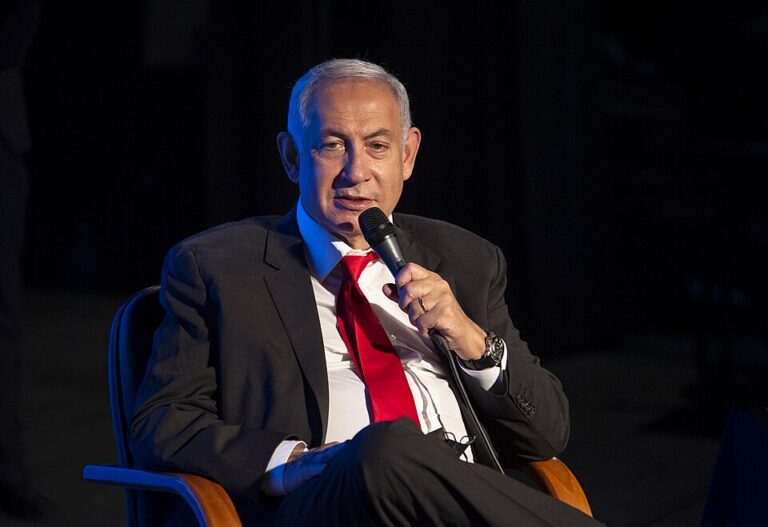
“You Will Not Outrun Justice”: Mark Ruffalo Fires Back at Netanyahu After ICC Prosecutor’s Removal, Calling Him a “Murderous Maniac”
Hollywood actor Mark Ruffalo has launched one of his fiercest public attacks yet against Israeli Prime Minister Benjamin Netanyahu, calling him a “murderous maniac” and warning that he would not escape accountability for Israel’s actions in Gaza. The explosive remarks came after Netanyahu celebrated the dismissal of International Criminal Court Prosecutor Karim Khan as a “very positive development.”
The exchange quickly became bigger than a confrontation between an actor and a world leader. It opened a fresh argument over whether Khan’s personal downfall changes the criminal proceedings he helped initiate, including the ICC arrest warrant against Netanyahu. Legally, the answer is clear: Khan’s removal does not cancel any active warrant because only ICC judges have the authority to withdraw one.
Ruffalo turns Netanyahu’s celebration into a public confrontation

Ruffalo responded directly to Netanyahu’s comments on X, using language that immediately drew attention across social media. He accused the Israeli leader of believing that Khan’s dismissal would erase the allegations surrounding the Gaza war, before declaring, “You will not outrun justice.” The actor also argued that political lobbying could not erase how history would remember Netanyahu’s conduct.
The message was more than a celebrity expressing political frustration. Ruffalo attempted to separate Khan’s personal misconduct case from the much larger question of alleged crimes committed during the war. His central argument was that the removal of one prosecutor cannot make evidence, victims or existing judicial decisions disappear.
Ruffalo has repeatedly used his public platform to support Palestinian civilians and criticize Israel’s military campaign. His latest intervention pushed that activism into unusually personal territory, replacing careful diplomatic language with a direct attack on Netanyahu’s character. That wording will energize supporters who believe stronger moral language is necessary, while critics are likely to view it as inflammatory celebrity politics.
Netanyahu says Khan’s removal exposes corruption at the ICC
Netanyahu presented Khan’s dismissal as evidence that the prosecutor’s actions against Israeli officials had been politically motivated. In his statement, the prime minister suggested that Khan pursued arrest warrants against him and former Defense Minister Yoav Gallant to distract attention from allegations concerning Khan’s own conduct. Netanyahu said the prosecutor’s supposed “political shield” had finally been torn away.
The Israeli leader went further by accusing both the Office of the Prosecutor and the ICC itself of deep corruption. He argued that Khan’s removal exposed what Israel has long described as an unfair campaign against a democratic country defending itself after the Hamas-led attacks of October 7, 2023. Israel has challenged the ICC’s jurisdiction and rejects the allegations behind the warrants.
Netanyahu’s celebration also carried an important political message for audiences outside Israel. By connecting Khan’s misconduct case to the Gaza investigation, he sought to cast doubt on the entire process rather than merely the individual who once led it. That distinction matters because the court’s judges, rather than Khan alone, reviewed the applications and decided that the legal threshold for issuing warrants had been met.
Why ICC member states removed Karim Khan
ICC member states voted on July 24 to dismiss Khan after the court’s governing body determined that he had committed serious misconduct and a serious breach of duty. Eighty-two of the ICC’s 125 member states supported his removal. It was an extraordinary institutional decision that immediately triggered the process of selecting a new chief prosecutor.
The case centered on allegations involving a junior ICC lawyer. The court’s governing bureau concluded that Khan had engaged in an inappropriate sexual relationship, while the woman later alleged publicly that the relationship had been non-consensual. Khan has denied wrongdoing, and his lawyers have said he denies having any sexual relationship with the woman.
Khan’s attorney, Tayab Ali, said the former prosecutor would challenge the fairness and legality of the decision through every available legal mechanism. His defense maintains that the process did not provide him with a proper opportunity to respond. Those arguments may continue in separate legal proceedings, but the vote removed him from office immediately.
Khan’s dismissal does not erase Netanyahu’s arrest warrant
The prosecutor who requested an arrest warrant can be removed, but the warrant belongs to the court, not to that prosecutor. ICC judges issued warrants for Netanyahu and Gallant on November 21, 2024, after finding reasonable grounds to believe they bore responsibility for alleged war crimes and crimes against humanity. The allegations included starvation as a method of warfare, murder, persecution, and other inhumane acts.
An arrest warrant is not a criminal conviction. It means judges determined that the evidence presented met the preliminary legal standard required to seek a person’s arrest and appearance before the court. Netanyahu and Gallant deny wrongdoing, and no trial has taken place.
Reuters reported that active ICC warrants remain valid following Khan’s removal because only judges can withdraw them. That means Netanyahu’s legal exposure before the court has not disappeared, regardless of how damaging Khan’s dismissal may be to the institution’s reputation. Any attempt to overturn the warrant would have to succeed through the court’s judicial process rather than through political statements about the former prosecutor.
The ICC is fighting for survival as well as credibility
Khan’s dismissal arrives during one of the most difficult periods in the ICC’s history. The United States, which is not an ICC member, has intensified its campaign against the court and imposed sanctions on judges and prosecutors connected to investigations involving American and Israeli officials. Washington welcomed Khan’s removal but said it would continue efforts to weaken or dismantle the institution.
That pressure creates a complicated picture. Removing Khan may demonstrate that the ICC is capable of holding its own senior officials accountable, but the scandal also gives the court’s opponents new ammunition. Supporters must now defend the institution’s independence while acknowledging serious failures inside its leadership.
Deputy prosecutors Nazhat Shameen Khan and Mame Mandiaye Niang are leading the prosecution office while member states design the process for selecting a replacement. A final vote on the next prosecutor is not expected before 2027. The court has said its investigations and broader mandate will continue during the transition.
Ruffalo and Netanyahu are fighting over two different versions of justice
Netanyahu’s position is that Khan’s dismissal reveals a poisoned prosecution driven by personal motives and institutional hostility toward Israel. Ruffalo’s position is that misconduct by the prosecutor does not erase alleged crimes, civilian suffering, or judicial decisions already made by independent judges. Both arguments are now competing for public attention far beyond the walls of the court in The Hague.
That is why Ruffalo’s phrase, “You will not outrun justice,” has gained traction. It reduces a complicated legal and political crisis to a direct moral warning. Yet justice in an international court depends on evidence, procedure, state cooperation and judicial rulings, not the force of a celebrity’s language or a prime minister’s social-media statement.
Khan’s career at the ICC may be over, but the cases connected to his tenure are not. Netanyahu remains wanted by the court, the allegations against him remain unproven at trial, and Israel continues to reject the ICC’s authority. The next prosecutor will inherit an institution under pressure, active investigations surrounded by political fury and a global audience demanding to know whether international law can survive when powerful governments decide it has gone too far.