U.S. Investigates Germany Over Low Drug Prices, and the Fight Is Bigger Than It Sounds
It sounds like a headline designed to make Americans spit out their coffee: the United States is investigating Germany because medicine may be too affordable.
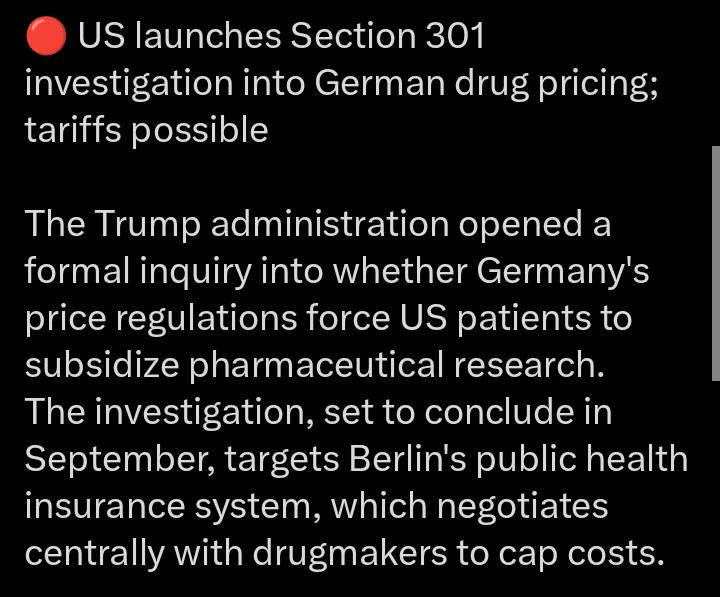
The real story is more serious, but the irony is still hard to miss. Washington has opened a trade investigation into Germany’s pharmaceutical pricing system, arguing that Berlin pays too little for innovative medicines and leaves American patients carrying too much of the global cost of drug research.
This is not an investigation into German hospitals, doctors, or patients. It is a Section 301 trade probe, a legal tool the U.S. uses when it believes another country’s policy is unfair to American commerce.
Still, the message is explosive. Germany says it is trying to control healthcare costs. The U.S. says those low prices may be part of the reason Americans pay so much more for the same kinds of breakthrough drugs.
That is why this story is not just about pills. It is about power, trade, money, and one uncomfortable question: who should pay for medical innovation?
What the U.S. Is Really Saying

U.S. Trade Representative Jamieson Greer launched the investigation on June 18, 2026, under Section 301 of the Trade Act of 1974. His office said the probe will examine whether Germany’s “persistent underpayment for innovative pharmaceutical products” is unreasonable, discriminatory, or harmful to U.S. commerce.
That phrase, “persistent underpayment,” is the heart of the fight.
Washington is not simply angry that Germany negotiates lower drug prices. Many wealthy countries do that. The claim is that Germany’s pricing system pushes payments so low that drugmakers recover less money abroad, then lean harder on the American market to fund research and development.
Greer put it bluntly.
“President Trump has made clear that American patients should not be shouldering a disproportionate share of global pharmaceutical research and development,” Greer said.
He also criticized Germany’s proposed reforms, saying he was “particularly concerned” that Berlin was fast-tracking legislation that would further reduce spending on innovative medicines. Greer called it “a serious step backwards” and said U.S. trading partners needed to “start paying their fair share.”
In simple terms, the U.S. argument is this: Germany gets the drugs, Germany pays less, and Americans get stuck with the bigger bill.
The Federal Register notice gives the investigation real teeth. It says USTR will look into whether Germany suppresses pharmaceutical prices below fair market value, thereby forcing American patients to underwrite a disproportionate share of global drug research and development.
The process is already moving. Written comments are due by August 10, 2026, and a public hearing is scheduled for September 22, 2026. If USTR eventually finds Germany’s policies actionable, tariffs or other trade measures could be considered.
Germany Says It Is Protecting Its Health System
Germany’s response is not complicated: healthcare costs are rising, and the government is trying to keep the system affordable.
Germany’s cabinet approved a draft reform in April 2026 to stabilize the country’s statutory health insurance system. The plan came as officials faced a major funding gap and mounting pressure to prevent health insurance premiums from rising.
Part of that reform focused on medicine prices. The government initially explored variable discounts on pharmaceuticals, meaning companies would have to offer discounts tied to overall drug spending and health system revenues. After backlash from the industry, a government source told Reuters that Germany was moving toward fixed discounts instead, so companies could plan more clearly.
Health Minister Nina Warken has defended the broader cost-cutting effort. “Every sector must play its part in this reform,” she said.
She also rejected the idea that Germany is hostile to pharmaceutical innovation. “Germany remains an attractive location for the pharmaceutical industry,” Warken said, pointing to reimbursement through statutory health insurance and opportunities for clinical trials and medicine development.
Then came her strongest defense of the German system: “Compared to other European countries, we have the fastest access to innovative medicines in Germany.”
That is Germany’s pitch. It is not saying that new drugs do not matter. It is saying public healthcare cannot be treated like an open checkbook.
German Chancellor Friedrich Merz also pushed back against Washington’s pressure. “As for the reimbursement of modern, innovative medicines by our health insurers, that is a decision that falls within our national jurisdiction,” he said.
That line matters because it turns the dispute into a sovereignty issue. Germany is basically saying, “Our health insurance system is our business.”
Why This Could Get Messy Fast
The pharmaceutical industry has been warning Europe for months that aggressive price controls could affect investment.
Reuters reported that Eli Lilly’s CEO said the company would halve its originally planned 2.3 billion-euro investment in Germany. Eli Lilly and Boehringer Ingelheim have also been cited as companies cutting or freezing planned investments in response to German policy proposals.
The German association of innovative pharmaceutical companies, VFA, said it had previously “highlighted the importance of a thorough impact assessment” of planned price cuts and said further decisions were up to the “democratic decision-making process.”
That is polite language, but the message is clear: drugmakers are worried, and they want Germany to slow down.
The U.S. is now giving those concerns diplomatic muscle. Greer even pointed to a U.S.-U.K. pharmaceutical pricing arrangement announced on April 2, 2026, saying Germany should follow suit with “constructive negotiations” to address the imbalance.
This is where the story gets bigger than Germany.
For years, Americans have complained that prescription drugs cost far more in the U.S. than in other wealthy countries. European governments often negotiate harder, regulate prices more tightly, or use public insurance systems to keep costs down. Many Americans have looked at that and asked why the U.S. cannot do the same.
Now Washington is flipping the argument. Instead of only asking why U.S. prices are so high, it is asking whether other wealthy countries are paying too little.
That is politically clever, but it is also controversial. Critics may argue that America’s high drug prices are not simply Germany’s fault. They point to the U.S. system itself, including insurance complexity, patent strategies, pharmacy benefit managers, and limited price negotiation.
Both arguments can exist at the same time. Germany may pay less than U.S. officials think is fair, while the American system may still have its own deep pricing problems.
And that is why this story feels so strange. On the one hand, Germany is trying to prevent healthcare costs from crushing its public insurance system. On the other hand, the U.S. says that those lower prices shift the burden onto American patients.
So yes, the viral version sounds ridiculous: America is investigating Germany for making medicine too affordable.
But the actual fight is much bigger. It is about whether drug prices should be set as domestic health policy or treated as international trade policy. It is about whether low prices in one country raise costs in another. And it is about whether patients, governments, or drugmakers will absorb the pressure.
For now, the investigation is only beginning. But the message is already clear: in 2026, even cheaper medicine can become a trade war.