Trump Says Jewish Democrats Baffle Him, Then Calls Himself Israel’s Best President
Donald Trump has a gift for turning one sentence into a political bonfire.
This time, the spark came during a CNBC interview where the president was talking about Iran, Barack Obama, Israel, and why he cannot understand Jewish Americans who vote Democratic. Then came the line that instantly sounded like it was built for cable panels and social media clips.
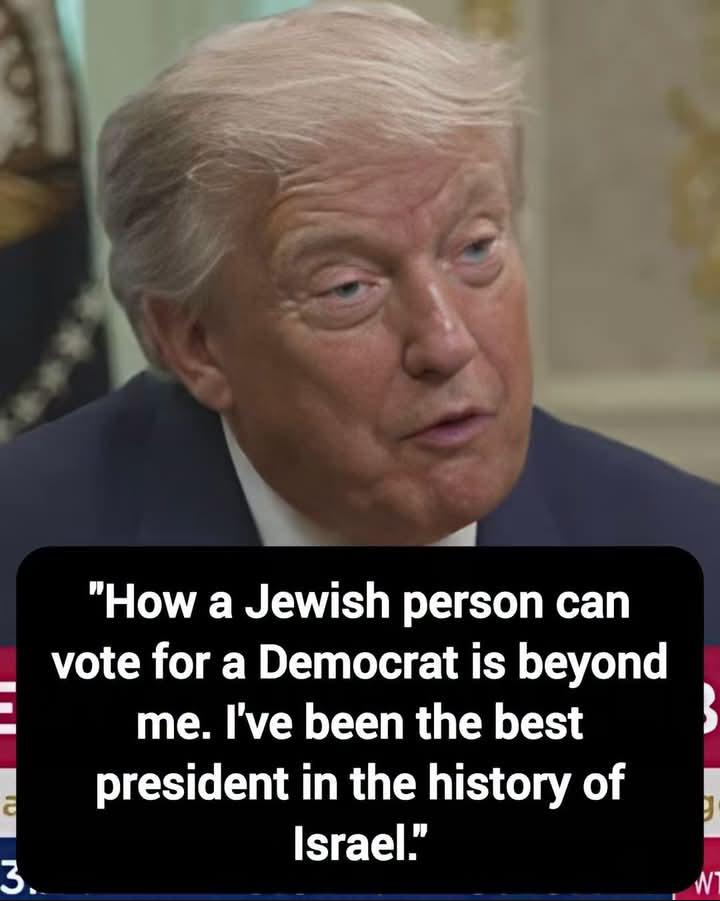
“They actually went on the other side, and how a Jewish person can vote for a Democrat is beyond me,” Trump said, according to a transcript of the July 2 interview. Moments later, he added: “Because I’ve been the best president in the history of Israel,” before saying Israelis “acknowledge” it and claiming, “in Israel I think I was at 99% or something.”
It was classic Trump: part boast, part grievance, part foreign-policy flex, and part political dare. But it also landed on one of the most sensitive nerves in American politics, the long-running fight over Jewish voters, Israel, antisemitism, and whether any politician should talk as if an entire religious community owes its vote to one party.
The Comment Came During a Bigger Fight Over Iran
Trump’s remark did not come out of nowhere. It came while he was criticizing Obama’s 2015 Iran nuclear deal and defending his own approach to Tehran. In the interview, Trump argued that Iran must not be allowed to obtain a nuclear weapon and said: “no other president even thought of doing what I did.”
The Jerusalem Post reported that Trump also defended the U.S. war with Iran during the CNBC interview, describing it as “not a war per se” but “the de-nuking of Iran.” He added: “You can’t let them have a nuclear weapon.”
That is the policy frame Trump wants voters to see. In his version of the story, he is the president who took the harder line against Iran, stood firmly with Israel, and did what previous presidents would not. His first term also included major pro-Israel moves: recognizing Jerusalem as Israel’s capital, moving the U.S. Embassy there from Tel Aviv, and recognizing Israeli sovereignty over the Golan Heights. Reuters noted those moves while covering earlier backlash to Trump’s comments about Jewish Democrats.
So, yes, there is a real policy record behind the brag. Trump is not inventing the fact that many Israeli conservatives and Netanyahu allies praised him heavily. Prime Minister Benjamin Netanyahu has repeatedly called Trump Israel’s greatest friend in the White House. Just this week, Netanyahu said, “Trump is a great, the greatest friend we ever had in the White House, and I stand by that completely,” while also stressing that Israel has “some other friends.”
But Trump being popular with many Israelis, or praised by Netanyahu, does not automatically explain how American Jews vote. That is where the politics get messy.
Why the Jewish Vote Is Not as Simple as Trump Makes It Sound
Trump’s argument sounds simple: I helped Israel; therefore, Jewish voters should support me.
American Jewish politics has never worked that neatly.
Pew Research Center found in its major survey of Jewish Americans that about seven in ten U.S. Jews identify with or lean toward the Democratic Party, while about 26% identify with or lean toward the Republican. Pew also found a major exception among Orthodox Jews, who lean much more Republican and were far more supportive of Trump.
The 2024 election data told a similar story. A Jewish Electorate Institute survey found that 71% of Jewish voters cast ballots for Kamala Harris, while 26% voted for Trump. But the same poll also showed deep variation inside the Jewish electorate: Orthodox voters broke heavily for Trump, while Reform, Conservative, unaffiliated, and non-denominational Jewish voters leaned strongly Democratic.
That is the part Trump’s one-liner skips. Jewish voters are not a single political machine with one button marked “Israel.” Many care deeply about Israel, but they also vote on democracy, abortion rights, healthcare, immigration, antisemitism, the economy, education, and how politicians speak about minority communities.
Even in 2026, the picture remains mixed. A spring Jewish Electorate Institute poll found that American Jewish voters still leaned heavily Democratic, while also showing concern about what the Democratic Party stands for on Israel. The poll also found broad support for Israel’s right to exist as a Jewish homeland, alongside caution about U.S. military escalation in Iran. JEI Chair Barbara Goldberg Goldman summed it up bluntly: “This poll reinforces a simple truth that the Jewish community is not monolithic, and the Jewish vote should not be taken for granted.”
That sentence could have been written directly in response to Trump’s latest complaint.
The Line Revives an Old Backlash
Trump has made versions of this argument before, and each time it tends to draw the same criticism: that he is treating Jewish identity as if it comes with a required political loyalty test.
In 2024, Trump said Jewish Americans who vote for Democrats “hate their religion” and “hate everything about Israel,” remarks that drew condemnation from Jewish organizations and Democrats. Reuters reported that the Anti-Defamation League, the American Jewish Committee, and the Jewish Democratic Council of America condemned those comments for tying religion to voting behavior. Then-White House spokesperson Andrew Bates said there was “no justification for spreading toxic, false stereotypes that threaten fellow citizens.” Senate Majority Leader Chuck Schumer wrote that Trump was making “highly partisan and hateful rants.”
The American Jewish Committee made a similar point after another Trump remark in 2024, saying Jews should not be blamed for election outcomes and warning that “scapegoating Jews can lead to antisemitic hate and violence.” AJC added: “Like all Americans, some Jews will vote for President Trump and some will vote for Vice President Harris. None of us, by supporting the candidate we choose, is ‘voting for the enemy.’”
That history is why Trump’s latest quote did not land like a harmless campaign joke. To supporters, it sounded like Trump asking why Jewish voters would reject a president with a pro-Israel record. To critics, it sounded like another attempt to flatten Jewish Americans into a single-issue voting bloc.
There is also a twist: even in Israel, Trump’s standing is not as simple as his “99%” boast suggests. The Israel Democracy Institute reported in June that 44% of Israelis believed Israel’s security was a central consideration for Trump, a sharp decline from earlier measurements. Among Jewish Israelis, the share fell from 64% in March to 41% in the latest survey.
So the big picture is this: Trump has a strong pro-Israel record, Netanyahu has praised him loudly, and many Jewish conservatives agree with his argument. But most American Jewish voters have continued to favor Democrats, and polling shows their decisions are shaped by far more than Israel policy alone.
That is what makes the quote so combustible. Trump is asking why Jewish Democrats exist. The answer is not mysterious. They exist because Jewish voters, like every other group of American voters, are complicated.
And in politics, “complicated” is usually where the real story begins.