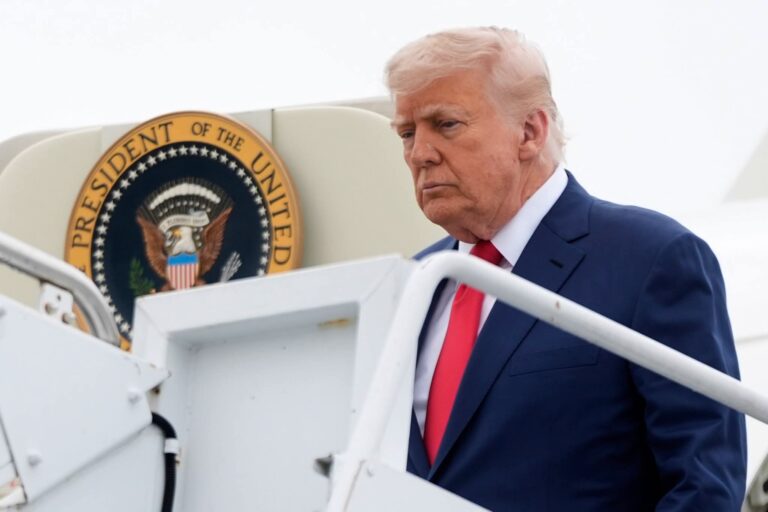
Trump Tried to Trap Canada With Tariffs. Instead, He Helped Break America’s Grip
Donald Trump’s tariffs were designed to remind Canada which country held the stronger hand. The United States had the larger economy, the larger consumer market and the leverage that came from buying most of Canada’s exports. Washington expected Ottawa to absorb the pressure, offer concessions and return to the negotiating table from a weaker position. That calculation produced a different result.
The tariffs did hurt Canadian industries, disrupt investment and expose the country’s dangerous dependence on one market. But they also accelerated a shift that decades of speeches, reports and trade missions had failed to deliver. Canadian companies began searching more aggressively for customers outside the United States. Governments moved to dismantle internal trade barriers. Supply chains were reconsidered. Canadian products gained political and commercial value at home. Trump attempted to use economic dependence as leverage. Canada responded by treating that dependence as a problem to be fixed.
The Trump tariff strategy relied on Canada having nowhere else to
go.

On March 4, 2025, the Trump administration imposed tariffs on Canadian goods under emergency economic powers. The measures included a 25 percent tariff on products that did not satisfy United States-Mexico-Canada Agreement rules, alongside lower 10 percent rates for certain Canadian energy products and potash. Two days later, the White House adjusted the policy to exempt goods that qualified for preferential treatment under the USMCA. The modification reflected an immediate complication: American and Canadian manufacturing systems were too deeply connected for tariffs to punish Canada without also creating problems for U.S. companies.
Automobiles offered the clearest example. Parts can cross the border repeatedly before a finished vehicle reaches a dealership. A tariff imposed at one stage does not remain neatly contained on the Canadian side. It moves through the supply chain, raising costs for manufacturers, suppliers, dealers and eventually consumers. The original strategy appeared to assume that Canada’s dependence on the American market would force rapid concessions. That assumption was not unreasonable. For decades, geography had made the United States the natural destination for Canadian oil, vehicles, minerals, lumber, agricultural goods and manufactured products.
Yet dependence also created a powerful Canadian incentive to change. Once Washington demonstrated that access to the U.S. market could be disrupted by executive action, Canadian businesses could no longer treat that access as permanently secure.
Canada answered with targeted economic retaliation.
Ottawa did not respond with symbolic outrage alone. Canada announced a plan for 25 percent counter-tariffs on C$155 billion worth of U.S. imports, beginning with approximately C$30 billion in goods. The first list included politically recognizable products such as American orange juice, peanut butter, wine, beer, spirits, appliances, clothing, cosmetics and motorcycles. The selection allowed Canada to impose costs while directing attention toward products associated with identifiable American industries and regions. Canada also created a remission process to reduce unintended damage to domestic businesses that could not easily replace essential American inputs. That detail mattered. A careless retaliation package could have punished Canadian manufacturers almost as severely as U.S. exporters.
Most of the broad March counter-tariffs were eventually removed in September 2025 after the United States continued allowing most USMCA-compliant Canadian goods to enter tariff-free. However, Canada retained responses connected to heavily affected industries, including automobiles, steel and aluminum. The Canadian response therefore became more than a contest over who could impose the largest tariff. It evolved into a strategy of selective retaliation, domestic protection and long-term diversification. (
Canadian businesses began looking beyond the United States.
The most important reversal did not occur at a podium in Ottawa or Washington. It occurred inside Canadian companies. Businesses that had spent years concentrating on the enormous U.S. market began exploring customers in Europe, the United Kingdom, the Indo-Pacific, the Middle East, Africa and other regions. Some also searched for suppliers outside the United States, reducing their exposure to American trade policy. The shift appeared clearly in Canada’s 2025 trade results. Exports to the United States fell 3.7 percent, while exports to non-U.S. markets increased 11.1 percent. Markets outside the United States accounted for 32.8 percent of total Canadian exports, the highest share in more than four decades. In 2024, the non-U.S. share had been 29.7 percent.
That change cannot be attributed entirely to a broad manufacturing breakthrough. Gold exports to the United Kingdom contributed heavily, while crude oil shipments to Europe and the Indo-Pacific also played a major role. Nevertheless, the direction of travel was unmistakable. Canada was selling a larger share of its output beyond the American market. The number of Canadian companies exporting goods to non-U.S. destinations also increased in 2025. Statistics Canada reported that 292 more enterprises exported outside the United States, the first annual increase since 2019.
Meanwhile, the number exporting to the United States declined by 542. Growth was recorded in destinations across Europe, the Middle East and Africa. Nigeria, Ghana, the United Arab Emirates and several European markets attracted additional Canadian exporters. Canada did not replace the United States, but its businesses began building more doors into the global economy.
Energy infrastructure gave Canada an escape route.
Canada’s ability to redirect trade did not emerge from diplomacy alone. Infrastructure helped make the shift possible. The expanded Trans Mountain pipeline entered its first full calendar year of operation in 2025, giving Western Canadian crude producers greater access to the Pacific coast. That capacity allowed more oil to move toward China, South Korea, Singapore and other Indo-Pacific destinations instead of depending almost entirely on American buyers. Canadian exports to the Indo-Pacific increased by 4.6 percent, supported largely by crude oil. Exports to the European Union rose more sharply, with goods exports increasing 23.5 percent in 2025. European buyers purchased more Canadian crude oil, aluminum, canola seed and other commodities.
This is where Trump’s strategy encountered a structural limitation. A tariff can make an established route more expensive. It cannot prevent a country from building another route. Every new pipeline connection, port expansion, overseas contract and trade agreement weakens the power of future U.S. threats. Diversification does not eliminate Canada’s dependence overnight, but it changes the bargaining equation gradually and permanently.
The tariff fight exposed Canada’s internal economic weakness.
Canada’s vulnerability was not limited to its dependence on the United States. The crisis also highlighted barriers between Canadian provinces. For years, businesses faced different licensing standards, procurement rules, transportation regulations and product requirements across provincial borders. In some cases, selling goods or providing services in another province could involve more administrative difficulty than entering a foreign market. The tariff threat transformed those old inefficiencies into a national security issue. In June 2025, Canada passed the One Canadian Economy Act, which created mechanisms for recognizing comparable provincial and territorial regulations and improving labor mobility. The federal government also removed its remaining exceptions under the Canadian Free Trade Agreement.
These reforms did not eliminate every provincial barrier. Provinces and territories still control many rules that affect commerce. However, the federal measures established a clear principle: Canada could not credibly demand secure access to foreign markets while tolerating unnecessary obstacles inside its own economy. The Trump tariff campaign therefore produced an outcome Washington was unlikely to have intended. It encouraged Canada to make its domestic market more integrated, efficient and resilient.
Canadian supply chains started reducing their U.S. exposure.
The adjustment extended beyond exports. Canadian companies also reconsidered where they purchased materials, components and finished products. The Bank of Canada found that businesses increasingly looked for suppliers within Canada or in countries outside the United States. Canadian imports from the United States fell noticeably after the trade restrictions began, while imports from other countries increased.
Approximately 80 percent of the decline in the U.S. share of Canadian imports occurred in sectors covered by Canadian counter-tariffs. Some of the shift reversed after most countermeasures were removed, showing that price still matters and that established supply relationships remain difficult to replace. Even so, the experience changed corporate risk calculations. A supplier may offer the lowest price today, but that advantage becomes less valuable when a sudden tariff can interrupt production tomorrow. Canadian companies learned that resilience sometimes requires maintaining additional suppliers, accepting higher short-term costs, and purchasing directly from overseas markets rather than routing goods through the United States.
The strategy backfired politically as well as economically.
Trump’s approach was intended to isolate Canadian negotiators. Instead, it strengthened the political case for Canadian economic nationalism. Industries, provincial governments and consumers that often disagreed over trade policy suddenly faced a common external threat. Calls to buy Canadian became more prominent. Provincial liquor authorities removed certain American products. Governments discussed domestic procurement, strategic industries and major infrastructure with renewed urgency. By December 2025, the federal government had implemented a Buy Canadian Policy for procurement. The policy was designed to give Canadian suppliers greater opportunities in federal contracts and support strategically important domestic industries.
This did not mean Canada was closing itself to international commerce. The larger strategy combined domestic purchasing with international diversification. Canada wanted to produce more at home while selling more abroad. That is fundamentally different from simple protectionism. It is an attempt to reduce the risk created when too much production, investment, and trade depend on the political decisions of a single partner.
Canada did not escape without paying a price.
Calling the Canadian response a complete victory would distort the evidence. Tariff-exposed industries suffered. Auto manufacturers, steel producers, aluminum companies and exporters faced weaker demand and greater uncertainty. Investment decisions were postponed. Companies absorbed higher costs while searching for alternative suppliers and customers. The Bank of Canada estimated that exports in the third quarter of 2025 were 4 percent below their pre-tariff level. Canada’s real gross domestic product grew only 1.9 percent in 2025, its weakest expansion since the pandemic. Export volumes became a drag on economic growth, and trade-exposed sectors underperformed.
Other markets also failed to replace all lost American demand immediately. In May 2025, Canadian exports to the rest of the world rose sharply, but the increase did not fully offset the decline in exports to the United States. Diversification is expensive because geography cannot be rewritten. Shipping goods across an ocean costs more than transporting them across a nearby land border. New customers require marketing, regulatory approvals, distribution networks and long-term trust. Canada flipped the script not by avoiding pain, but by refusing to let the pain preserve the old dependency.
The United States remains Canada’s biggest market, but no longer its only plan.
Canada and the United States remain economically intertwined. No European or Asian market can fully reproduce the combination of scale, proximity and integrated infrastructure offered by the United States. Canadian factories will continue selling to American customers. American companies will continue depending on Canadian energy, minerals, agricultural goods and components. A complete economic separation would be damaging and unrealistic for both countries. But that was never the only possible outcome.
The more consequential change is that Canada now treats overdependence on the United States as a strategic liability rather than an unavoidable fact. Ottawa’s new trade diversification strategy aims to double non-U.S. exports by 2035, while expanding commercial relationships with Europe, China, India and other markets. This shift will take years. It will encounter setbacks. Some companies will return to familiar U.S. suppliers whenever tariff pressure eases. Certain industries will remain tied to American infrastructure regardless of political tensions. Still, the psychological barrier has already been broken. For decades, Canada discussed diversification while continuing to send most of its exports south. Trump’s tariffs converted diversification from an abstract ambition into a commercial necessity. Washington wanted Canada to feel trapped by its dependence. Instead, Canada began dismantling the trap. Trump tried to use the size of the American market to force Canada back into line. Canada’s answer was to start building an economy that would be harder to threaten the next time.