Army Identifies Sgt. Michael Swinton, Killed While Making a Downed Drone Safe in Iraq
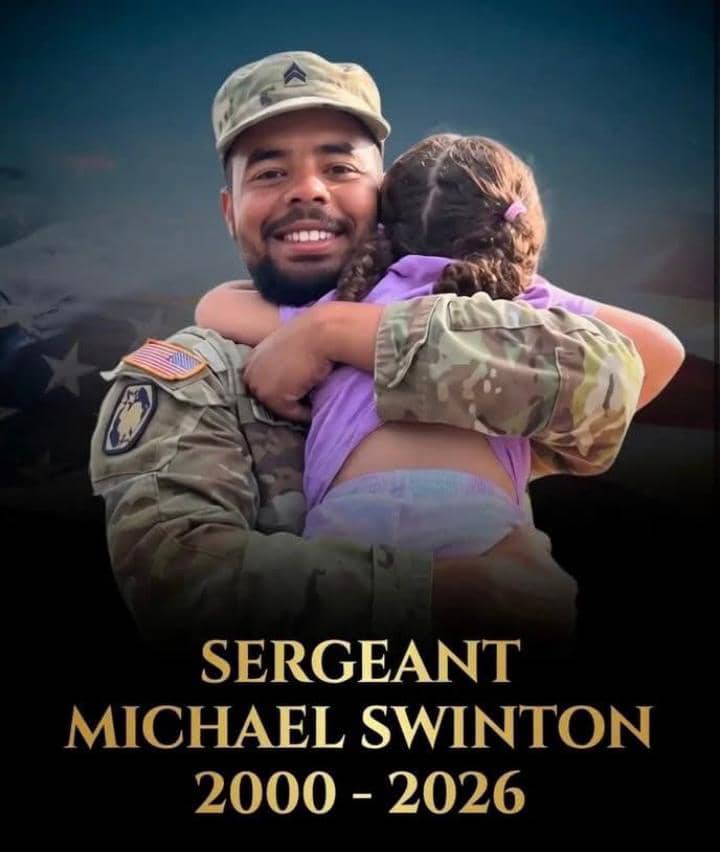
The U.S. Army has identified the soldier killed during a dangerous drone-disposal operation at Erbil Air Base in northern Iraq as Sgt. Michael Emmanuel Swinton, a 30-year-old husband and father from Fayetteville, North Carolina.
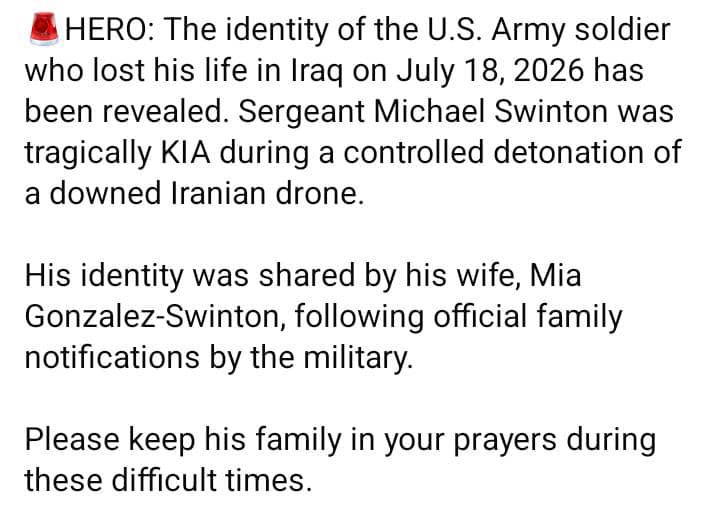
Swinton was not killed in a conventional firefight. He died while military personnel were carrying out a controlled detonation of a downed one-way attack drone, an operation intended to remove a threat from the base and protect other service members. A second service member suffered minor injuries. The precise circumstances remain under military investigation.
There is one important date correction. Although some early reporting placed the incident on July 18, the Army and the Department of War’s official casualty notices say Swinton was killed on July 19, 2026. The American soldier who died on July 18 was 1st Lt. Tyler James Feehan, who was fatally wounded in an enemy attack at a base in Jordan.
What Sgt. Swinton was doing when the explosion occurred
Military officials said Swinton was taking part in the controlled detonation of a downed one-way unmanned aerial system at Erbil Air Base. Such aircraft are designed to fly toward a target and explode, meaning a drone that has crashed or been intercepted can still contain dangerous unexploded material.
The Army has not publicly described Swinton’s exact actions in the moments before the explosion. It has also not said whether the drone detonated unexpectedly, whether equipment failed or whether another problem occurred during the disposal process. Those unanswered questions are part of the continuing investigation, so any more detailed explanation would be speculation.
Lt. Gen. John L. Rafferty, commanding general of U.S. Army Space and Missile Defense Command, said Swinton died “during an operation to safeguard fellow Soldiers.”
“His service will not be forgotten, and his sacrifice is not in vain,” Rafferty said. “We will support Sgt. Swinton’s family and his unit during this difficult period. His loss will inspire his fellow Soldiers to continue the mission.”
The description matters because it shows the threat did not necessarily end when the drone came down. Someone still had to approach the wreckage, assess the explosives, and help make the area safe. Swinton was part of that hazardous work when he was killed.
A soldier with nearly a decade of Army service
Swinton joined the Army in 2017 as a 14H Air Defense Early Warning System Operator. That job involves helping detect, track, and communicate information about airborne threats, including missiles and aircraft.
He later retrained as a 14E Patriot Fire Control Enhanced Operator and Maintainer, working with the Patriot air-defense system. In 2025, he was assigned to D Battery, 2nd Battalion, 55th Air Defense Artillery Regiment, part of the 108th Air Defense Artillery Brigade at Fort Bragg, North Carolina.
Brig. Gen. John L. Dawber, commander of the 32nd Army Air and Missile Defense Command, remembered Swinton as a respected noncommissioned officer.
“Sgt. Swinton was an experienced noncommissioned officer who took great pride in his work and the people around him,” Dawber said. “He answered the call to duty with courage, honor, and selfless dedication.”
During his Army career, Swinton received decorations including the Army Commendation Medal, Army Achievement Medal, Army Good Conduct Medal, National Defense Service Medal, Global War on Terrorism Expeditionary Medal, Army Service Ribbon and Combat Action Badge.
The Army said he will receive the Bronze Star and Purple Heart and will be posthumously promoted to staff sergeant.
His family remembers the man behind the uniform
Swinton leaves behind his wife, Mia Gonzalez-Swinton, a 6-year-old son and a 4-year-old daughter. His wife described him as “an amazing man” who made an impression on the people he met.
“He was an amazing father, and amazing leader,” she said. “He cared and loved hard for everyone in his life.”
His mother, Christel Swinton Andujar, said her son had a contagious laugh, enjoyed making people smile and could “light up any room.” She described him as adventurous, fearless and deeply committed to his family.
“Above all else, Michael’s greatest love was his family,” she said. “His wife, Mia, and two beautiful children were the center of his world. Every decision he made, and every sacrifice he endured, was with them in his heart.”
She said her son should be remembered not only because he served in uniform, but also because of the way he treated those around him.
“Michael wasn’t just a hero because he wore the uniform,” she said. “He was a hero because of the way he loved, protected, encouraged, and inspired everyone around him.”
Swinton’s final assignment placed him in one of the least visible but most dangerous parts of modern warfare: dealing with a weapon after it had already fallen from the sky. The investigation may eventually explain exactly what went wrong, but the Army’s account already makes one fact clear. He was participating in an operation meant to remove a deadly threat and protect the soldiers around him.