Mullin’s Mixed Immigration Message Deepens DHS Credibility Crisis as Conservatives Revolt
News analysis: The homeland security secretary’s conflicting remarks on deportations, foreign workers, and immigration reform have left American workers with more questions than answers.
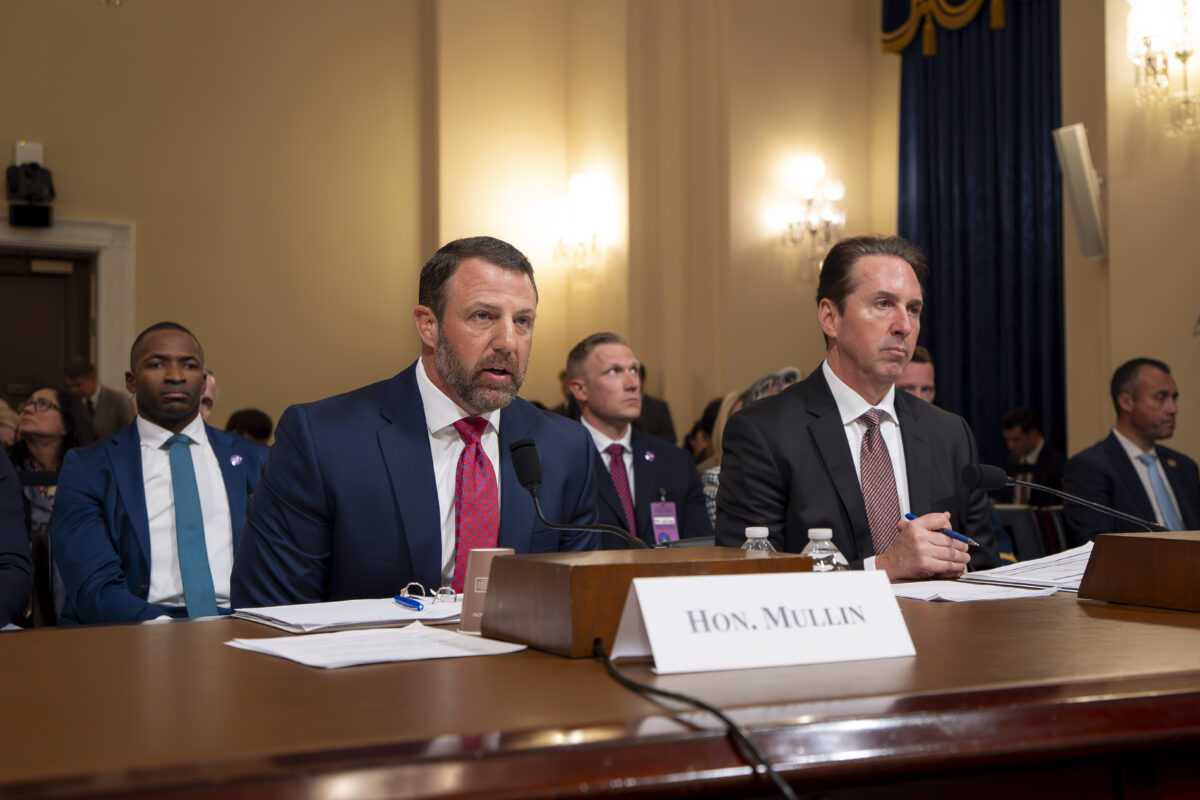
Homeland Security Secretary Markwayne Mullin responded to growing conservative criticism Monday by dismissing former Border Patrol commander Gregory Bovino as “irrelevant.” The insult may have ended Mullin’s answer to reporters, but it did nothing to resolve the policy dispute now consuming President Donald Trump’s immigration coalition. Video of Mullin’s response
The uproar began after Mullin appeared Saturday, August 1, at the National Governors Association Summer Meeting in Oklahoma City. During a discussion with Oklahoma Gov. Kevin Stitt, Mullin endorsed immigration reform and more flexible employment visa programs. Hours later, he posted an uncompromising message declaring that there would never be amnesty and promising detention and deportation for immigrants living in the country illegally.
Mullin’s clarification created more confusion.
A cabinet secretary overseeing immigration enforcement should be able to explain the difference between legal immigration, temporary work visas, legalization, and amnesty. Mullin instead delivered remarks broad enough to satisfy employers but vague enough to alarm American workers. His later social media statement looked less like a policy explanation and more like emergency damage control.
Mullin wrote, “No amnesty for illegal aliens. Ever.” That line sounded decisive, but it did not address his suggestion that foreign labor could “plug those holes” in the economy. It also failed to identify which visa programs he wants to change, how many workers he would admit, or how the administration would prevent companies from using foreign labor to suppress wages. Fox News documented the speech and conservative backlash.
For families already struggling with rent, groceries, health insurance, and utility bills, those details matter. Americans do not experience immigration policy as an abstract argument in Washington. They experience it when wages remain flat, when a construction job receives dozens of applicants or when a local business cannot find enough qualified workers to remain open.
American workers hear a warning about cheap labor.
Mullin framed employment visas as a practical response to low labor participation. Employers in agriculture, hospitality, health care, construction, and food processing frequently report staffing problems. However, American workers have heard similar arguments for decades, often followed by corporate demands for a larger labor supply without equal attention to wages, training, or working conditions.
When a company says it cannot find workers, several explanations may apply. The job may require specialized credentials, or it may exist in a region with too few available applicants. The employer may also be offering wages that no longer cover housing, transportation, and child care. Expanding foreign worker programs without examining those differences could reward companies for avoiding the harder work of improving pay and conditions.
The latest federal data show why Mullin’s argument requires more scrutiny. The United States had about 7.6 million job openings in May, but it also had 7.1 million unemployed people in June. Another six million people outside the labor force said they wanted jobs, according to the Bureau of Labor Statistics.
Those figures do not prove that every unemployed person can fill every vacancy. They do show that millions of Americans remain disconnected from available work while the DHS secretary discusses importing additional labor. Before expanding visa programs, the administration should explain why those Americans cannot be recruited, trained, or offered wages that make returning to work possible.
Employers still face genuine staffing problems.
None of this means every labor shortage is imaginary. A rural hospital cannot turn an unemployed retail worker into a registered nurse overnight. Farms require seasonal labor in places where the local workforce may be too small, while manufacturers need technicians with specific skills that take years to develop.
Yet Mullin did not give Americans a plan for separating legitimate shortages from corporate cost-cutting. He offered no proposed wage floor, recruitment requirement, industry limit, or enforcement mechanism. He also failed to explain whether “permanent solutions” meant longer temporary visas, more employment-based green cards, or an entirely new worker program.
That omission left both workers and employers guessing. A hotel owner listening to Mullin might hear relief from a staffing crisis. A hotel employee might hear that the government plans to bring in more people willing to work for less. When a Cabinet official uses the same statement to send two opposing messages, distrust becomes inevitable.
The 1959 claim damaged Mullin’s credibility.
Mullin also claimed that the United States had not achieved real immigration reform since 1959. That statement is historically inaccurate if read literally. Congress passed transformative immigration laws in 1965, 1986, and 1990, each of which changed who could enter, who could remain, and how employers could hire foreign workers.
The Immigration and Nationality Act of 1965 eliminated the national origins quota system and reorganized immigration around family relationships and employment skills. The 1986 Immigration Reform and Control Act legalized millions of qualifying unauthorized immigrants while creating penalties for employers who knowingly hired workers without authorization.
The 1990 law expanded legal immigration and created new employment categories. The House historian and USCIS records confirm that history. Mullin may have meant that Congress has not passed a modern comprehensive agreement capable of surviving political opposition.
If so, he should have said that. Precision is not optional for the officials responsible for ICE, Customs and Border Protection, the Transportation Security Administration, and other agencies employing roughly 260,000 people.
The mistake was especially damaging because immigration hardliners view the 1986 law as a warning. They argue that Washington delivered legalization immediately but failed to create lasting control over illegal immigration. When Mullin casually misstated the history, he reinforced suspicions that the administration was discussing another compromise without acknowledging the failures associated with earlier bargains.
Deportation numbers raise another credibility problem.

The Trump administration regularly describes its immigration enforcement record as historic. In January, DHS reported more than 675,000 formal removals and estimated that approximately 2.2 million additional immigrants had voluntarily left the country. Those figures sound enormous, but they combine two very different measurements. DHS published the totals in January.
Formal removals are government actions documented through immigration systems. Estimated voluntary departures are harder to verify because the government does not individually record every person leaving the country. Presenting both categories as though they carry the same evidentiary weight makes the administration’s total appear more precise than it is.
Conservative organizations have separately argued that documented deportations remain well below the scale Trump promised. That dispute explains Bovino’s claim that mass deportation is not happening. It also exposes a basic problem for DHS: the agency wants credit for unprecedented enforcement while its own hardline supporters say the numbers prove failure.
Americans deserve a transparent dashboard showing arrests, removals, voluntary departures, criminal convictions, detention costs, and case outcomes. Instead, they receive political slogans, selective totals, and dueling claims from former and current officials. That confusion damages public trust regardless of which faction wins the argument.
Bovino’s extreme record does not rescue Mullin.
Bovino’s criticism resonates with voters who believe Trump promised mass deportations without qualification. However, his record makes him a deeply flawed messenger. He became known for aggressive urban enforcement operations that drew lawsuits, protests, and accusations of excessive force.
Bovino has also supported deportation targets far beyond the estimated unauthorized immigrant population. Earlier reporting found that he advocated aiming for 100 million deportations even though the unauthorized population was estimated at roughly 14 million.
Such a target would inevitably raise questions about whether legal residents, visa holders, or even citizens could become caught in an enforcement system operating under extreme numerical pressure. The Washington Post detailed Bovino’s position.
Mullin therefore faces criticism from someone whose preferred policy may be impossible to execute without enormous financial, constitutional, and humanitarian consequences. Yet calling Bovino irrelevant allowed the secretary to avoid answering the central question. Is DHS still pursuing the mass deportation policy Trump promised, or has it quietly adopted a narrower strategy?
Americans need that answer stated clearly. They should not have to interpret social media posts, edited video clips, and personal insults between federal officials. A government exercising the power to arrest, detain, and remove people must operate with greater precision than a political argument online.
Americans are caught between two damaging extremes.
Public opinion shows that Americans do not fit neatly into either political camp. A Pew Research Center survey conducted in April found that 52 percent believed the administration was doing too much on deportations. At the same time, 28 percent of Republicans believed it was doing too little. Pew published the full results.
A March Fox News poll revealed another apparent contradiction. Sixty-seven percent supported allowing employed unauthorized immigrants to remain and apply for legal status, while 59 percent also favored deporting immigrants living in the country illegally. The poll shows how Americans distinguish among different cases.
Those opinions are not necessarily inconsistent. Many Americans support deporting violent criminals while opposing indiscriminate workplace sweeps or family separation. They can support legal immigration while demanding that employers hire Americans first. They can also recognize genuine labor shortages without accepting unlimited access to cheaper foreign workers.
Mullin had an opportunity to explain those distinctions. Instead, he offered a vague employment argument, an inaccurate historical claim, and a social media slogan after criticism erupted. His performance did not clarify the administration’s policy. It revealed how uncertain that policy has become.
Trump now owns the immigration confusion.
Mullin was sworn in on March 24 as the ninth homeland security secretary after serving Oklahoma in Congress and building a career as a businessman and rancher. His background should help him understand both workforce pressures and public frustration with illegal immigration.
Instead, it has produced a message that sounds different depending on which audience is listening. DHS provides Mullin’s official biography here. President Trump must now decide which policy his administration actually supports.
He can demand highly visible mass deportation operations, pursue Mullin’s quieter enforcement strategy, or combine targeted removals with carefully regulated legal worker programs. Continuing to promote all three messages at once will deepen mistrust among workers, employers, and conservative voters.
The controversy is larger than one poorly handled appearance in Oklahoma City. It exposes an administration struggling to reconcile campaign promises with economic pressure, legal limitations, and declining public confidence in aggressive enforcement.
Until Trump and Mullin provide clear numbers, specific visa proposals, and enforceable protections for American workers, their immigration message will remain what it became this weekend: contradictory, defensive and increasingly difficult to believe.