Steak ’n Shake Switched to 100% Grass-Fed Beef, and Sales Jumped 18.2%. Here’s What Happened
Fast-food restaurants are always looking for ways to attract customers. Some introduce bigger burgers, others offer cheaper meal deals, and many rely on flashy promotions. But Steak ’n Shake decided to take a different approach: change what goes into its food.
The American burger chain made a major announcement in 2026, saying all its Steakburgers would be made with 100% grass-fed, grass-finished beef starting June 1. It was not presented as a limited-time offer or a special burger for health-conscious customers. The company said the new beef standard would apply across its Steakburger menu.
Then came an interesting development. Biglari Holdings, Steak ’n Shake’s parent company, reported that comparable sales at its domestic company-operated and franchise-partner-operated restaurants increased by 18.2% during the third quarter of 2026.
That is an impressive number, especially in an industry where restaurants constantly compete for customers. But did the grass-fed beef make all the difference? The story is a little more complicated.
The Big Switch to Grass-Fed, Grass-Finished Beef
Steak ’n Shake first announced its beef transition in April 2026, giving June 1 as the effective date. The company said all its Steakburgers would use 100% grass-fed, grass-finished beef.
The two terms are important. Grass-fed means cattle are raised on a diet based primarily on grass and other forage after weaning, subject to permitted exceptions. Grass-finished means they also receive forage during the final stage before slaughter rather than being conventionally grain-finished.
This is different from simply advertising a burger as natural or fresh. Those descriptions do not automatically tell customers what the animal ate.
The company also used pasture-raised language when discussing the change. However, it has not publicly identified the ranches, processors, or specific suppliers responsible for providing the new beef in the research reviewed.
That leaves some unanswered questions about where the beef comes from and how the company verifies its sourcing standards.
Still, the decision represents a significant change for a traditional burger chain. Instead of competing only on price, portion sizes, and convenience, Steak ’n Shake is making ingredient quality a bigger part of its identity.
Grass-Fed Beef Wasn’t the Only Ingredient Change
The beef announcement did not come out of nowhere. Steak ’n Shake had already been changing several ingredients across its menu.
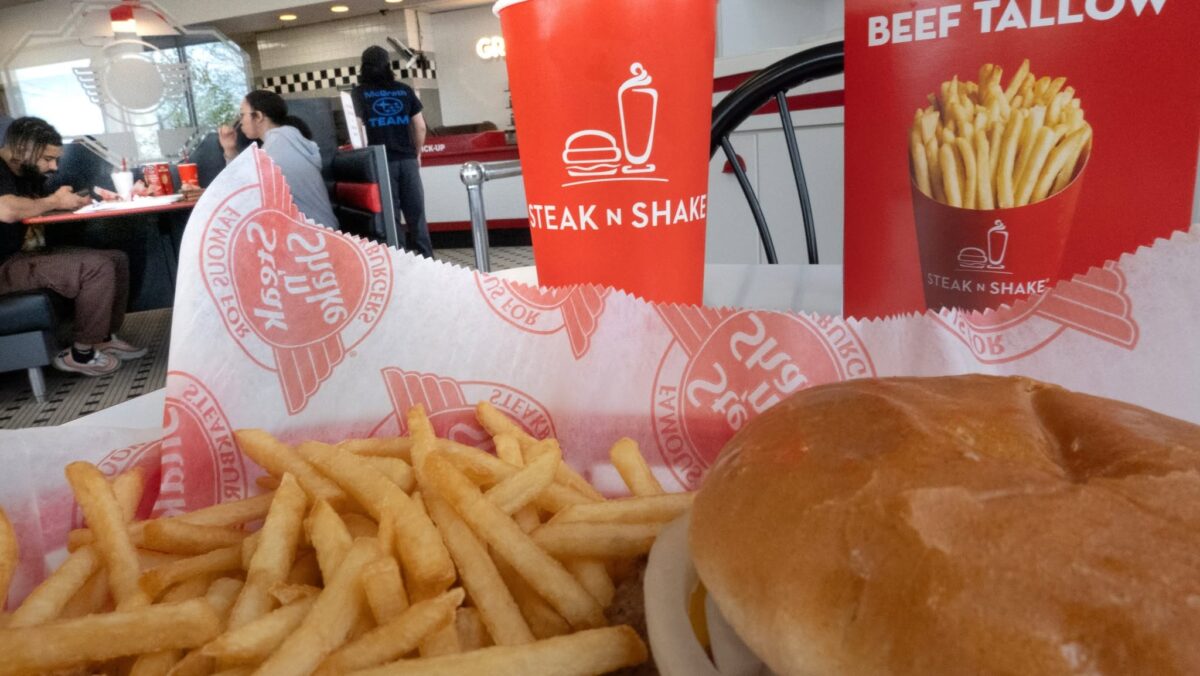
In January 2025, the company announced plans to replace the vegetable oil used for cooking its French fries with 100% beef tallow. The rollout was targeted for completion by the end of February.
Beef tallow is rendered beef fat that can be used for frying. The company also invested in removing vegetable oil used by manufacturers to partially fry its fries and tots before they reached restaurants. This was an important distinction because changing the oil in restaurant fryers alone would not address the entire preparation process.
The chain also introduced other changes:
- Wisconsin butter: In April 2025, it began replacing a buttery blend used on selected burgers and sandwiches with Grade A Wisconsin butter.
- Cane-sugar Coca-Cola: The company introduced bottled Coca-Cola made with cane sugar in August 2025.
- A2 milk: Starting December 1, 2025, it introduced A2 Milk and Hershey A2 Milk.
- Seed-oil-free buns: In October 2026, the company announced that all its buns would be seed-oil-free and finished with Grade AA Wisconsin butter.
These changes show that the beef transition was part of a much wider ingredient strategy.
However, it is worth keeping the timeline straight. The seed-oil-free bun announcement came in October, after the July-to-September sales period. It should not be counted as a change that necessarily drove the third-quarter results.
Sales Increased 18.2%, but There Is More to the Story
The headline sales figure came from Biglari Holdings, which released its third-quarter 2026 financial results on November 6.
According to the company, Steak ’n Shake’s same-store sales across domestic company-operated and franchise-partner-operated restaurants increased by 18.2% compared with the same quarter in 2025.
The breakdown is also interesting. Company-operated restaurants recorded 15.5% comparable-sales growth, while franchise-partner-operated restaurants recorded 19.1%.
These numbers suggest that the improvement was not limited to one group of restaurants.
However, there is an important detail: the 18.2% figure measures comparable sales, not necessarily the number of additional customers walking through the doors. Sales can change because of customer traffic, menu prices, product mix, or average spending.
Biglari did not provide a detailed breakdown showing how much each factor contributed.
It also did not establish that grass-fed beef alone caused the increase.
In fact, Steak ’n Shake was already experiencing positive momentum before the June 2026 beef transition. Its comparable sales increased by 10.2% during 2025.
So, while the latest figures are encouraging, it would be inaccurate to credit the entire improvement to the new beef.
Better Ingredients Come With Higher Costs
There is another side to the story that customers may not immediately notice: sourcing ingredients can be expensive.
Steak ’n Shake made these changes during a challenging period for the American beef market. USDA reports in 2026 described tight cattle supplies and strong wholesale beef prices. The agency also forecast U.S. beef production to decline by 4% during the year.
Grass-fed beef can present additional supply challenges. Cattle may take longer to reach finishing weight, and producers need suitable grazing land, forage, processing facilities, and reliable supply arrangements.
USDA’s third-quarter 2026 grass-fed beef report listed average direct-to-consumer prices of $10.78 per pound for ground beef that was 80% to 89% lean. That figure is not what Steak ’n Shake pays its suppliers, but it illustrates the market for grass-fed products.
The company’s financial statements also show that restaurant food costs increased from 31.3% of net sales in the third quarter of 2025 to 33.6% in the same period of 2026.
Management attributed the higher percentage primarily to improvements in ingredient quality. However, it did not separate the cost of grass-fed beef from the costs of its other ingredient changes.
In other words, better ingredients came with a financial trade-off, and the company has not shown exactly how much the beef transition costs per burger.
Can Other Fast-Food Chains Follow the Same Approach?
Steak ’n Shake is not the only American burger chain offering grass-fed beef. Elevation Burger, for example, advertises 100% grass-fed organic beef patties.
What makes Steak ’n Shake’s move interesting is that it announced a grass-fed, grass-finished standard for all its Steakburgers rather than introducing one specialty burger.
It is also trying to combine ingredient changes with a wider business turnaround.
Since 2020, the company has introduced self-order kiosks, simplified its menu, adjusted operating hours, and expanded its franchise-partner model. These changes are designed to improve restaurant productivity and give operators greater responsibility for daily operations.
That means the ingredient strategy is only one part of a much bigger plan.
For customers, the real question is whether the company can maintain its new sourcing standards, keep its food appealing, and manage costs without making its burgers less affordable.
Steak ’n Shake’s 18.2% comparable-sales increase is certainly worth watching. But one strong quarter cannot prove that grass-fed beef is responsible for the turnaround.
What it does show is that a traditional fast-food chain is betting on ingredient quality while trying to rebuild its business. Whether that approach delivers lasting success will become clearer as more financial results and sourcing details emerge.