
Disturbing Costa Concordia Details Netflix’s “Shipwrecked: Nightmare at Sea” Does Not Fully Explain
The Costa Concordia did not plunge beneath the sea in a single violent moment. It became a death trap slowly, while passengers waited for instructions, officers debated the danger, and water silently overwhelmed the ship’s most important systems.
Netflix’s Shipwrecked: Nightmare at Sea uses survivor testimony, recordings and previously unseen footage to reconstruct the terrifying events of January 13, 2012. More than 4,000 passengers and crew had boarded the luxury cruise ship before it left Civitavecchia, Italy, and diverted toward the Tuscan island of Giglio. The documentary captures the fear inside the listing vessel, but several disturbing details deserve closer examination.
When we reconstruct the Costa Concordia disaster through the official investigation, criminal proceedings, and subsequent safety reforms, we find multiple catastrophic decisions. We find a chain of navigational mistakes, delayed warnings, misunderstood orders, and leadership failures that continued long after the hull struck a rock.
The collision killed 32 passengers and crew members. It also created one of the most complicated maritime salvage operations ever attempted and permanently changed international cruise safety rules.
The ship was moving dangerously fast near an unforgiving coastline.
Costa Concordia deviated from its planned route to make an unscheduled close pass near Giglio, often described as a sail-by salute. Such maneuvers allow ships to pass close enough to land for passengers and people ashore to see one another, sometimes accompanied by the sounding of the vessel’s horn.
The Italian accident investigation found that the ship approached the coastline at approximately 15.5 knots. That speed left the bridge team little time to identify danger, correct the course, or recover from a mistaken steering command. The vessel entered a poorly illuminated coastal area where reefs and rocky projections demanded careful navigation.
The problem was therefore larger than a single hidden rock. The ship had been deliberately placed in a narrow operating environment where a single late turn could have irreversible consequences.
Investigators also found no company rule that clearly governed unscheduled close passages near Giglio. A previous approach to the island had occurred in daylight, at a safer distance, and at a slower speed. The fatal nighttime maneuver placed an enormous passenger ship in conditions dramatically less forgiving than the earlier voyage.
Bridge officers failed to challenge the dangerous maneuver.
Modern passenger ships do not rely on a single person. A bridge team normally includes officers responsible for monitoring charts, radar, steering, position, and communication. The system works only when team members share information and challenge decisions that threaten the vessel.
On the Costa Concordia, investigators found that officers became passive during the approach. They did not provide an effective warning about the developing danger, question the captain’s strategy or intervene decisively as the ship moved toward the rocks.
This failure exposed a weakness in bridge resource management. Technology could display the ship’s location, but instruments could not compensate for a team that failed to communicate or oppose an unsafe plan.
The investigation also described several officers as disoriented after the collision. Instead of forming a coordinated command structure, key personnel waited for instructions that either came late or never arrived. The same breakdown that preceded the impact continued during the evacuation.
Misunderstood steering commands consumed the final seconds.
The helmsman received a series of rapid commands as Costa Concordia closed in on the reef. Some orders were repeated incorrectly, while others were carried out in the wrong direction before being corrected.
Investigators found that the Indonesian helmsman sometimes struggled to understand Captain Francesco Schettino’s instructions. At one critical moment, the ship initially turned toward starboard rather than making the requested port movement. By the time the error was corrected, the available sea room had nearly disappeared.
Schettino later argued that the steering mistake caused the collision. That claim did not absolve him of responsibility for bringing the ship so close to the rocks at high speed. The captain had created a situation in which a brief misunderstanding could become fatal.
The bridge’s communication problems extended beyond the helmsman. Investigators identified wider language difficulties among the multinational crew, including confusion during the emergency. A ship carrying thousands of people had entered its greatest crisis without a consistently understood command language.
Schettino said he was navigating visually.
Schettino testified that he knew the waters around Giglio and was navigating partly by sight. Reports from the trial also said he had left his reading glasses in his cabin and asked another officer to consult the radar for him.
Visual navigation is not inherently unusual when used alongside charts, radar, electronic positioning, and disciplined bridge procedures. The disturbing element was the degree of confidence placed in personal familiarity while the ship moved through darkness toward a rocky coast.
The official investigation found that Schettino used a private mobile phone during the maneuver. It also established that people with no navigational role were present on the bridge, contrary to good safety practices.
None of these facts alone proves that a phone call, missing glasses, or a visitor caused the crash. Together, however, they describe a bridge environment filled with unnecessary distractions at the precise moment when concentrated teamwork mattered most.
A romantic companion was among the unauthorized visitors to the bridge.
Domnica Cemortan, a Moldovan woman who had previously worked for Costa Cruises, was aboard the ship without being listed as a paying passenger. She testified during Schettino’s trial that the two were romantically involved.
Cemortan had dined with the captain and later entered the bridge area. Her presence generated intense public attention because Schettino was married and because unauthorized visitors should not have been near the ship’s command team during a difficult coastal maneuver.
No court established that Cemortan distracted Schettino or directly caused the collision. Presenting that accusation as proven would go beyond the evidence.
Her presence remains relevant for a different reason. It illustrates how informal the bridge environment had become. The command center of a vessel carrying more than 4,000 people was not being treated as a tightly controlled safety space while the ship deviated from its approved route.
The hull damage overwhelmed five watertight compartments
The collision tore a rupture roughly 50 to 60 meters long along the ship’s port side. Seawater rushed into machinery spaces, disabling propulsion, steering, and electrical systems.
Costa Concordia had been designed to remain survivable after flooding in two adjoining watertight compartments. The impact flooded five contiguous compartments, many of which contained equipment essential to the vessel’s operation.
Investigators concluded that the extent of the structural damage exceeded the ship’s applicable survivability standard. In practical terms, the vessel had sustained a wound far more severe than its safety design required it to withstand.
That conclusion does not excuse the decisions that created the collision. It explains why recovery became nearly impossible once the rock ripped through the hull. The ship’s fate was largely sealed within minutes, even as many passengers were told the problem involved little more than an electrical blackout.
Passengers were sent away from possible escape points.
After the impact, some passengers moved toward muster stations because they felt the violent shudder, noticed the blackout, or saw water entering lower areas. Instead of preparing them for evacuation, crew members repeatedly assured them that the situation remained under control.
Investigators found that passengers were directed away from muster stations and told to return to lounges or cabins. The hotel director failed to perform assigned emergency duties and made misleading announcements that delayed guests’ movement toward evacuation areas.
Returning people to their cabins carried serious risks. Corridors, elevators, and stairways could become unusable as the ship listed. Passengers sent below might later have to climb steeply inclined passageways in darkness while furniture and unsecured objects slid across the decks.
The delay also caused crowds to form after the emergency could no longer be concealed. By then, many passengers had lost confidence in the crew and began acting independently, creating confusion around stairways, lifeboats, and exterior decks.
Nearly 700 new passengers had not completed a muster drill.
Approximately 700 passengers had joined the Costa Concordia in Civitavecchia on the day of the disaster. Their safety drill was scheduled for the following day.
At the time, international rules allowed passenger musters to occur within 24 hours of embarkation. Costa Concordia therefore departed legally, even though hundreds of people had not physically practiced where to assemble or what to do when alarms sounded.
That gap became terrifying once the ship began to tilt. Some guests did not know their assigned muster stations. Others could not identify the proper emergency signal, quickly locate life jackets, or determine which routes remained usable.
The disaster demonstrated that a lawful delay could still be dangerously inadequate. An emergency can occur during the first hour of a voyage, long before the regulatory window for training has closed.
The captain concealed the seriousness of the emergency.
The rock strike occurred at approximately 9:45 p.m. Officers soon received reports that several watertight compartments were flooding. The loss of propulsion, steering, and stable electrical power made the danger unmistakable.
Yet the ship initially told maritime authorities that it had experienced a blackout and that the situation remained under control. Schettino requested tug assistance without immediately acknowledging the scale of the flooding.
This minimization delayed a full emergency response. It also reinforced the inaccurate announcements being given to passengers.
The official abandon-ship order came more than an hour after the collision, by which time Costa Concordia had already developed a severe list. Lifeboats work best from a relatively upright vessel. As the angle increased, boats on one side became difficult or impossible to lower safely, while passengers struggled to stand, climb, and move through the ship.
The evacuation began without effective central control.
Emergency plans assign specific responsibilities to bridge officers, hotel staff, technical personnel, and lifeboat crews. Costa Concordia’s evacuation did not unfold through a single coordinated command.
Investigators found chaos around the survival craft and an absence of direct bridge control. Crew members received incomplete instructions. Passengers entered boats without an effective roll call, and personnel did not consistently count how many people boarded each craft.
Some crew members performed courageously once the evacuation was underway. Local residents, ferry workers, emergency personnel, and private boat operators also rushed toward the ship and helped carry survivors ashore.
Individual bravery, however, had to replace the organized system passengers had expected. The rescue succeeded in removing thousands of people, but it did so through improvisation under conditions made worse by the delayed alarm.
Lifeboats became useless as the ship rolled farther over.
Costa Concordia’s increasing starboard list changed decks into slopes and walls. Staircases became climbing surfaces. Windows and exterior openings shifted position relative to the sea.
The first wave of lifeboats reached the water, but later launches became increasingly difficult. Boats on the higher port side hung far above the water, while equipment on the lower starboard side became obstructed as the vessel leaned toward the shoreline.
Some passengers jumped into the cold sea. Others descended improvised ropes or ladders. Several remained inside the vessel, trapped by flooding, blocked passageways, or the vessel’s changing interior orientation.
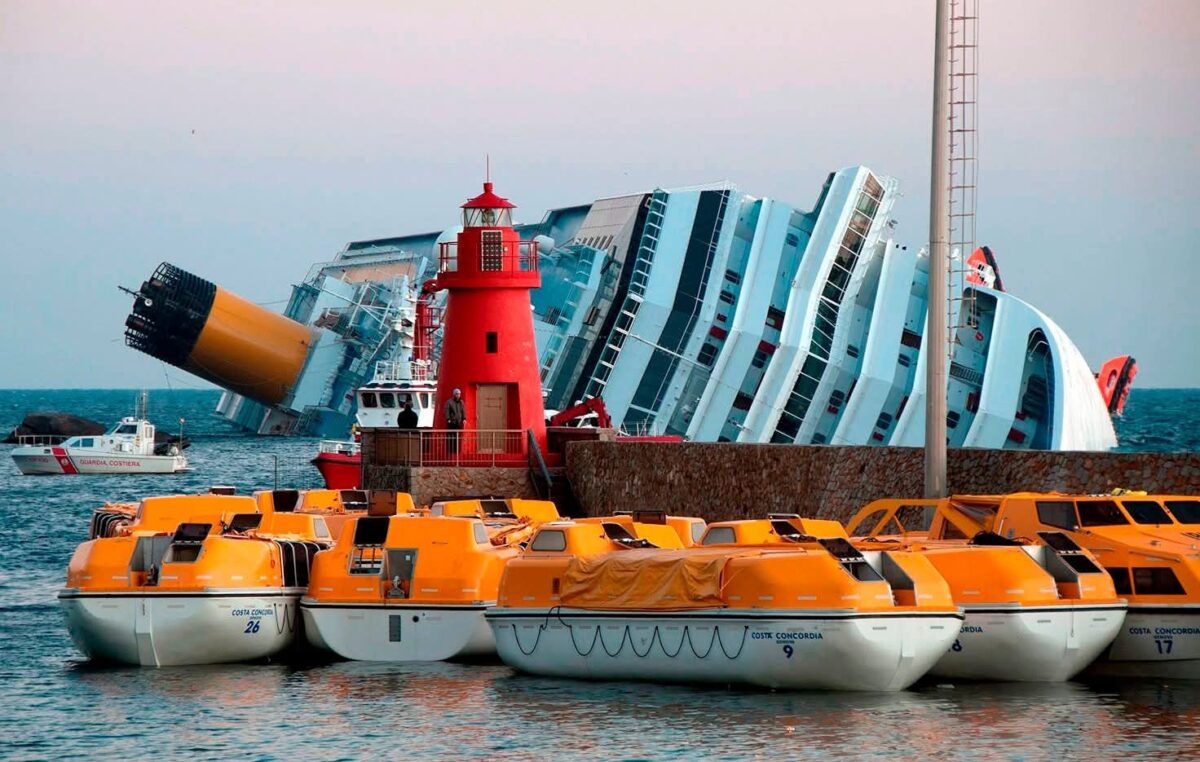
The ship eventually settled on a rocky underwater ledge. That geography prevented it from disappearing entirely beneath the surface, but it also created a maze of submerged rooms and tilted corridors where rescuers searched for survivors and bodies.
Schettino claimed he accidentally fell into a lifeboat.
Schettino left the vessel while passengers and crew members remained aboard. A recorded exchange later captured Coast Guard officer Gregorio De Falco ordering him to return and coordinate the evacuation.
The captain maintained that he had not deliberately abandoned the ship. He said the vessel’s angle caused him to trip and fall onto the roof of a lifeboat while he was helping with its launch.
He later argued that returning became impossible once the boat reached the water. Prosecutors rejected that explanation, and the criminal case centered in part on his departure before the evacuation was complete.
Italy’s courts convicted Schettino of multiple manslaughter, causing the shipwreck and abandoning passengers. He received a 16-year sentence, which Italy’s highest court upheld in May 2017. He then reported to Rebibbia Prison in Rome.
The captain was not the only person convicted.
Public attention turned Schettino into the defining figure of the Costa Concordia disaster. The legal aftermath, however, reached several other employees.
Costa Crociere crisis coordinator Roberto Ferrarini, hotel director Manrico Giampedroni, first officer Ciro Ambrosio, third officer Silvia Coronica, and helmsman Jacob Rusli Bin entered plea agreements in connection with the tragedy. Their sentences ranged from approximately 20 months to two years and 10 months.
The cases reflected failures extending from the bridge to onboard emergency management and shoreside crisis coordination. Investigators criticized the company representative ashore for failing to accelerate the captain’s evacuation plans despite maintaining contact with him.
Costa Cruises paid a €1 million corporate fine and avoided a criminal trial. The company later paid settlements to passengers, including a widely offered package of €11,000 for uninjured survivors, plus reimbursement for travel and related expenses.
The victims included children, workers, and elderly travelers.
The death toll is often presented as one number: 32. The figure included 27 passengers and five crew members from several countries.
The youngest victim was five-year-old Dayana Arlotti, who died with her father, Williams. The oldest was 86-year-old Giovanni Masia. Other victims included musicians, hospitality workers, parents, and couples who had expected an ordinary Mediterranean holiday.
Court proceedings reconstructed how some people became trapped in elevators, cabins, and corridors. Others drowned after entering the sea or while attempting to reach lifeboats. Several deaths occurred near Deck 4, where passengers had gathered for evacuation.
The final missing victim, Indian crew member Russel Rebello, was recovered from the wreck in November 2014, almost three years after the collision. His brother had repeatedly returned to Italy while waiting for the search to end.
Survivor trauma continued long after the rescue.
Many survivors escaped without major visible injuries, yet the experience did not end when they reached Giglio. Some later described nightmares, panic attacks, fear of water, survivor’s guilt, and symptoms associated with post-traumatic stress.
Costa’s initial settlement offer classified psychological trauma alongside lost luggage, ruined belongings and the loss of enjoyment of the cruise. Accepting the payment generally required survivors to give up further legal claims.
Some passengers rejected the package and pursued individual lawsuits. In one later case, an Italian court awarded compensation to a passenger who developed post-traumatic stress disorder following the disaster.
The contrast remains unsettling. A person could leave the ship physically unharmed while carrying the consequences of that night for years. The number of passengers rescued, therefore, cannot measure the full human cost.
A Titanic song reportedly played near the time of impact.
Two Swiss passengers later said that Céline Dion’s “My Heart Will Go On,” the theme song from the 1997 film Titanic, had been playing in a dining area around the time the Costa Concordia struck the rocks.
The account became one of the disaster’s most haunting details. It connected the modern cruise ship’s bright restaurants and entertainment spaces with the cultural memory of history’s most famous maritime catastrophe.
We should treat the story as survivor testimony rather than an independently established technical fact. It does not appear among the official causes of the collision and played no role in the criminal findings.
Its power is psychological. Passengers were enjoying dinner and music inside a floating resort while, below them, torn steel and incoming seawater were already destroying the vessel.
Removing the wreck created another fatal accident.
Costa Concordia came to rest on its side in a protected marine environment, near the edge of an underwater slope. Officials feared that the wreck might shift into deeper water or release fuel and contaminants.
Salvage teams first removed more than 2,000 tons of fuel. Engineers then constructed underwater platforms and attached enormous flotation tanks known as sponsons.
In September 2013, crews used cables and hydraulic systems to rotate the ship upright in a procedure called parbuckling. The vessel was refloated in July 2014 and towed to Genoa for dismantling.
The operation carried its own human cost. Spanish diver Israel Franco Moreno died in February 2014 after suffering a severe underwater injury while working on the wreck. The disaster had claimed another life more than two years after passengers fled the ship.
The ship took five years to disappear completely.
Costa Concordia reached Genoa in July 2014, but its arrival did not mark the end of the project. Workers spent roughly three more years dismantling and recycling the massive structure.
More than 350 workers contributed approximately 1 million labor hours during the recycling phase. About 53,000 tons of material were recovered and processed at Italian facilities.
The dismantling finished in July 2017, five and a half years after the collision. By then, the familiar image of the white cruise ship lying outside Giglio had vanished.
The financial cost exceeded the physical wreck removal. Estimates put the combined cost of salvage, dismantling, compensation, and related expenses at nearly $2 billion, making the aftermath nearly as extraordinary as the sinking itself.
Costa Concordia changed cruise safety rules worldwide.
The disaster exposed a regulatory weakness that had allowed newly embarked passengers to sail without completing a muster drill. Cruise organizations quickly introduced a policy requiring safety briefings before departure.
The International Maritime Organization later amended the International Convention for the Safety of Life at Sea. From January 1, 2015, newly embarked passengers had to be mustered before or immediately upon departure rather than at any point within the first 24 hours.
Additional recommendations addressed voyage deviations, bridge procedures, life-jacket placement, emergency videos, heavy objects, and shoreside safety management. Later damage-stability amendments also drew on lessons from the Costa Concordia investigation.
The strongest legacy of the wreck may therefore be found on ships that never appear in the documentary. Every passenger called to a muster station before departure now participates in a system strengthened by lessons paid for at Giglio.
Where Francesco Schettino is now
Schettino began serving his prison sentence in May 2017 after exhausting the Italian appeals process. He remains at Rebibbia Prison in Rome.
In January 2025, he applied for semi-liberty, a form of conditional release that can permit prisoners to leave custody for approved work or educational activities. He withdrew the request several months later.
Netflix’s documentary has brought his decisions back into global attention, but the legal judgment remains unchanged. Italian courts held him criminally responsible for taking the vessel into danger, mishandling the emergency, and leaving while passengers remained aboard.
What “Shipwrecked: Nightmare at Sea” ultimately reveals
Shipwrecked: Nightmare at Sea succeeds because it places viewers beside the people who experienced the disaster. Its footage lets us hear plates shattering, alarms sounding, and frightened families trying to understand why a luxury holiday had become a fight for survival.r record reveals an even more disturbing story. Costa Concordia did not become deadly because of a single invisible reef or a misunderstood command. The catastrophe grew from a sequence of preventable choices: an unauthorized route change, excessive speed, weak bridge discipline, poor communication, delayed warnings, and an evacuation launched after the ship had already lost much of its ability to save the people aboard.
We are left with a lesson that reaches beyond cruise travel. Safety systems fail when leaders treat procedures as optional, teams remain silent, and organizations confuse reassurance with control.
The ship disappeared from Genoa in 2017. The decisions made on its bridge, however, remain visible every time a passenger ship changes course, restricts bridge access, or requires travelers to complete a safety drill before leaving port.


