George Soros’s Scathing Trump Verdict Resurfaces: “Con Man” and “Ultimate Narcissist”
George Soros did not reach for diplomatic language when describing Donald Trump. The billionaire investor and liberal philanthropist delivered a blistering assessment that still circulates online because it sounds less like a policy disagreement and more like a political demolition job.
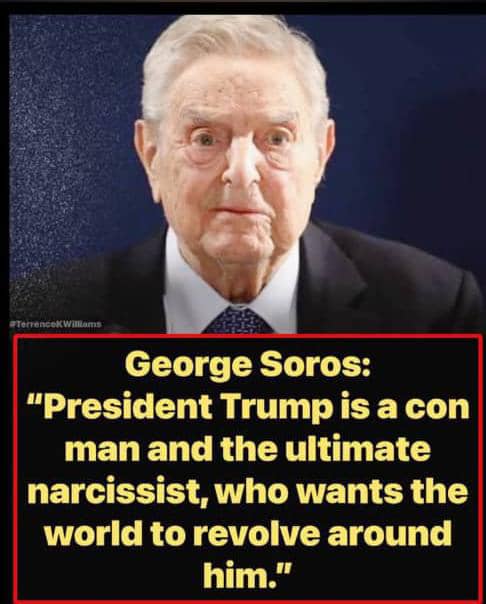
“President Trump is a con man and the ultimate narcissist who wants the world to revolve around him,” Soros declared.
One important detail often disappears when the quote is reposted: Soros made the statement on January 23, 2020, during remarks connected to the World Economic Forum in Davos, Switzerland. It is not a newly delivered 2026 comment, although the renewed confrontation between Trump and the Soros organization has given the old remark fresh relevance.
Soros Turned a Davos Speech Into a Trump Takedown
Davos speeches are usually packed with careful phrases about markets, cooperation and the future of the global economy. Soros’s presentation was different. He discussed authoritarian governments, climate change, technology companies and threats to what he calls “open societies,” but his comments about Trump supplied the sharpest moment.
Soros argued that Trump’s behavior had become more extreme after he reached the White House. He connected that criticism to Trump’s first impeachment, saying the president had exceeded constitutional limits. That was Soros’s interpretation, rather than an established medical judgment or neutral description.
The timing mattered. The House of Representatives had impeached Trump on December 18, 2019, on charges of abuse of power and obstruction of Congress. When Soros spoke in Davos, Trump’s Senate trial was underway. The Senate later acquitted him on both charges on February 5, 2020.
Soros also accused Trump of creating an alternative political reality that his supporters accepted. His argument was straightforward: Trump’s power did not come solely from his personality or wealth, but from his ability to persuade millions of people to view events through his preferred version of the story.
That claim remains political opinion, not settled fact. Trump’s supporters have consistently viewed his confrontational communication style as evidence that he is willing to challenge institutions, political elites and media organizations they distrust. His critics see the same style as self-centered, divisive and dangerous.
The Criticism Went Beyond Trump’s Personality
The “con man” line grabbed headlines, but Soros was also making an economic argument.
He said Trump had managed to “overheat an already buoyant economy,” warning that strong conditions could not be maintained indefinitely. Soros believed Trump’s political fortunes depended partly on whether the economy remained strong through the November 2020 election.
At the same event, Soros described Trump as a climate denier and criticized his approach to environmental policy. He also raised concerns about large technology companies, particularly Facebook, and suggested that the platform and Trump shared political interests ahead of the election. Soros did not present evidence of a formal agreement, and Facebook rejected the suggestion that it was secretly working to secure Trump’s reelection.
His remarks came alongside the announcement of a $1 billion initiative to build an international university network. Soros called the education project one of the most important and enduring undertakings of his life, presenting it as a defense against authoritarianism and attacks on academic freedom.
That larger context explains why the attack on Trump was more than a stray insult. Soros was presenting Trump as part of a worldwide struggle between open democratic systems and leaders he believed were weakening independent institutions.
The Soros Trump Feud Has Grown Even More Personal

Although no verified direct response from Trump to that specific 2020 Davos insult was found in the sources reviewed, Trump has since launched his own attacks against Soros.
On August 27, 2025, Trump called for George Soros and his son Alex Soros to be charged under the federal Racketeer Influenced and Corrupt Organizations Act. He accused them of supporting violent protests and warned, “Be careful, we’re watching you!” Trump did not provide evidence supporting the allegations in that post, according to Reuters.
The Open Society Foundations rejected the accusations. In a later statement responding to reports of possible federal investigations, the organization said its activities were “peaceful and lawful” and declared that it did not fund terrorism or violent protest. It characterized the administration’s actions as politically motivated attempts to intimidate civil society.
That exchange shows why Soros’s years-old quote continues to travel. The hostility was never a one-day Davos story. Soros has spent decades financing liberal, democratic and human-rights causes, making him a powerful symbol for supporters and a frequent target for conservative politicians. Trump, meanwhile, has repeatedly presented Soros as part of an influential political network working against his movement.
Soros’s description of Trump remains exactly what it was in 2020: a fiercely partisan judgment from one powerful billionaire about another. But with Trump back in the White House and his administration clashing openly with Soros-linked institutions, the quote no longer sounds like a forgotten line from an old conference. It sounds like the opening shot in a feud that never really ended.