Monique Worrell’s Park Case Controversy Turns One Florida Prosecution Decision Into a Political Firestorm
The sentence sounded almost tailor-made for outrage: the conduct was wrong, Monique Worrell said, but her office could not prove beyond a reasonable doubt that it was illegal. That was the heart of the explosive Florida fight that followed a case involving Kevin Chapman, 61, who was accused of masturbating on a public park bench near children at Kit Land Nelson Park in Apopka.
Florida Attorney General James Uthmeier blasted Worrell’s office for declining to prosecute, while Worrell pushed back hard, saying the attorney assigned to the case made the decision based on the legal standard prosecutors must meet in court. What followed was not just a debate over one disturbing park allegation. It became another chapter in Florida’s long-running war over crime, prosecutorial discretion, political labels, and public safety.
The Park Allegation That Lit the Fuse
The controversy began with an Aug. 16, 2025, incident at Kit Land Nelson Park in Apopka. Uthmeier’s office said Chapman was arrested after allegedly masturbating on a bench near a splash pad where children were playing. The attorney general’s office said a father and his 2-year-old son witnessed the behavior, and it cited witness statements, video evidence, police reports, the arresting officer, and the park manager as part of the case record.
Uthmeier did not ease into his criticism. He accused Worrell’s office of giving Chapman “a free walk in the park” and said the case should have been brought forward. “The facts of this case are so egregious. It is an open-shut case. Why would you not bring charges?” Uthmeier said. He also pointed to what he described as “video evidence” and “witness testimony,” arguing that “justice needs to be served.”
Florida law does speak directly to lewd or lascivious exhibition involving minors. Under Florida Statute 800.04, a person commits lewd or lascivious exhibition by intentionally masturbating, intentionally exposing genitals in a lewd or lascivious manner, or committing certain sexual acts “in the presence of a victim who is less than 16 years of age.” For an offender 18 or older, the offense is a second-degree felony.
That is why the public reaction was so sharp. To many parents, the common-sense question was simple: if an adult is accused of doing that near children at a splash pad, how is that not a slam-dunk prosecution?
But courtrooms are not comment sections. Prosecutors do not only ask whether something sounds awful. They ask whether every required legal element can be proven beyond a reasonable doubt.
Worrell said the conduct was wrong, but her office saw a proof problem
Worrell’s response was not that the alleged conduct was acceptable. It was that the evidence, after review, did not meet the standard her office believed was needed to prosecute.
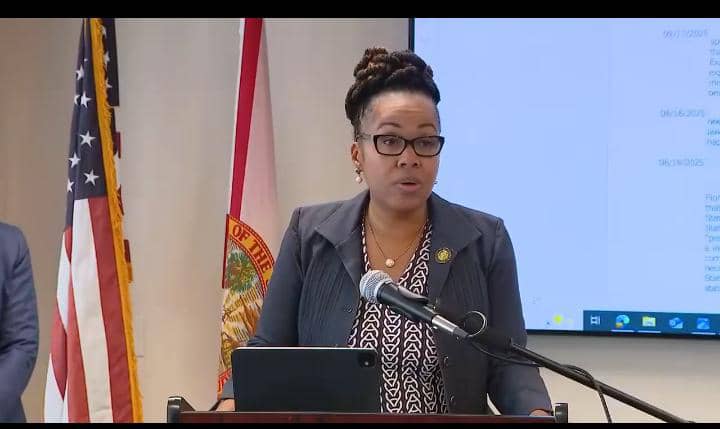
During a news conference, Worrell said the attorney handling the case interviewed the child’s father on Sept. 17. Case notes she presented indicated the father said the child did not see anything and was not aware of what was happening. Based on that, Worrell said the assigned attorney concluded the charge could not be proven beyond a reasonable doubt.
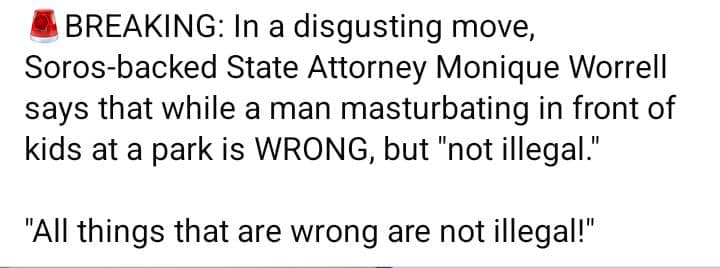
“I am standing before you today telling you that I trust the word of the attorney who was assigned to this case when he said, although those actions were wrong, he could not prove beyond a reasonable doubt that they were illegal, and that is the only standard by which we go forward in prosecution,” Worrell said.
That quote is the center of the storm. Critics heard it as a jaw-dropping dodge. Worrell framed it as Criminal Law 101: prosecutors are not supposed to file charges just because a case is ugly, viral, or politically useful.
She also fired back at Uthmeier personally, calling his comments “factually-inaccurate,” “politically-motivated,” and “dangerous.” In another sharp line, Worrell said, “If he can’t do that, then he really should be quiet because his ignorance is loud.”
The fight widened because Uthmeier also cited a separate case involving Thomas Dolgos, 47, who was accused of possessing and sharing child sexual abuse material. Worrell said that the case had been transferred to the Office of Statewide Prosecution, not simply dropped by her office. “It is dishonest and disingenuous for the attorney general to get up there and say that we dropped the charges in this case,” she said.
Uthmeier, meanwhile, framed both cases as part of a broader failure. “We’re not going to stand by and allow the state attorney to fail to do her job,” he said. “This is systematic abuse. It is gross negligence.”
Why the “Soros-Backed” Label Keeps Following Worrell
Worrell’s critics often describe her as a Soros-backed prosecutor, a label rooted in her 2020 campaign support from criminal justice reform circles. ClickOrlando reported that her campaign received a nearly $60,000 donation for research and polling from Justice and Public Safety PAC, described as a criminal justice reform group largely funded by philanthropist George Soros.
That label matters politically because Worrell has been a recurring target in Florida’s fight over progressive prosecution. Gov. Ron DeSantis suspended her in 2023, accusing her of “neglect” and “incompetence.” Worrell denied the accusations and argued the suspension was political. The Florida Supreme Court later sided with DeSantis on the suspension, but voters sent Worrell back to office in 2024 when she defeated Andrew Bain for the Ninth Judicial Circuit State Attorney seat.
When Worrell returned to the office in January 2025, she said criminal justice is “not black” and “not white,” adding, “The criminal justice system is gray.” She also said prosecutors must consider alternatives to prosecution when appropriate.
That philosophy is exactly what supporters call thoughtful prosecution and critics call dangerous leniency. The Chapman case poured gasoline on that argument.
Uthmeier’s office cast the decision as a public-safety failure. “Central Florida deserves better than a state attorney who prioritizes the guilty over protecting the innocent,” Uthmeier said. Statewide Prosecutor Brad McVay also weighed in, saying Worrell’s “actions, or lack thereof” placed vulnerable people “in danger’s way.” Congresswoman Laurel Lee said, “Every charging decision is also a safety decision.”
Worrell’s side of the argument is less emotionally satisfying but legally important: prosecutors must prove cases, not merely condemn behavior. Her office’s position was not that the alleged act was fine. It was that the available evidence, particularly what the child saw or understood, created a proof problem under the statute.
That leaves the public with an uncomfortable split screen. On one side is a disturbing allegation about a park that many people instinctively believe warrants prosecution. On the other hand, a prosecutor insists that outrage cannot replace legal proof.
And that is why this story hit so hard. It is not just about one man, one park, or one charging memo. It is about the messy place where public anger meets courtroom standards, and in Florida politics, that space is never quiet for long.