Muslim Business Owners Are Talking About Leaving America. The Real Story Is More Complicated
Muslim business owners are threatening to shut down their shops and leave the United States because of Islamophobia.
It is the kind of claim that gets people clicking before they start thinking. One side hears it and says, “Good, let them go.” Another side hears it and says, “How bad has America become if people who built businesses here now feel unwanted?” But when the noise is turned down, the verified story is more careful, and frankly more interesting. There is no clear evidence of a nationwide, organized Muslim business shutdown campaign. What is documented, however, is a rising climate of fear, discrimination, public hostility, and everyday harassment that is forcing some Muslim Americans to ask a painful question: how much can a person endure before the place they invested in stops feeling like home?
That is not a small question. Business owners do not casually walk away from storefronts, payrolls, leases, loyal customers, family savings, and years of sweat. A restaurant, grocery store, clinic, delivery company, repair shop, or catering business is not just a cash register. It is somebody’s American dream with invoices attached. And for many Muslim entrepreneurs, that dream is now bumping into a colder reality.
The viral claim is louder than the verified facts
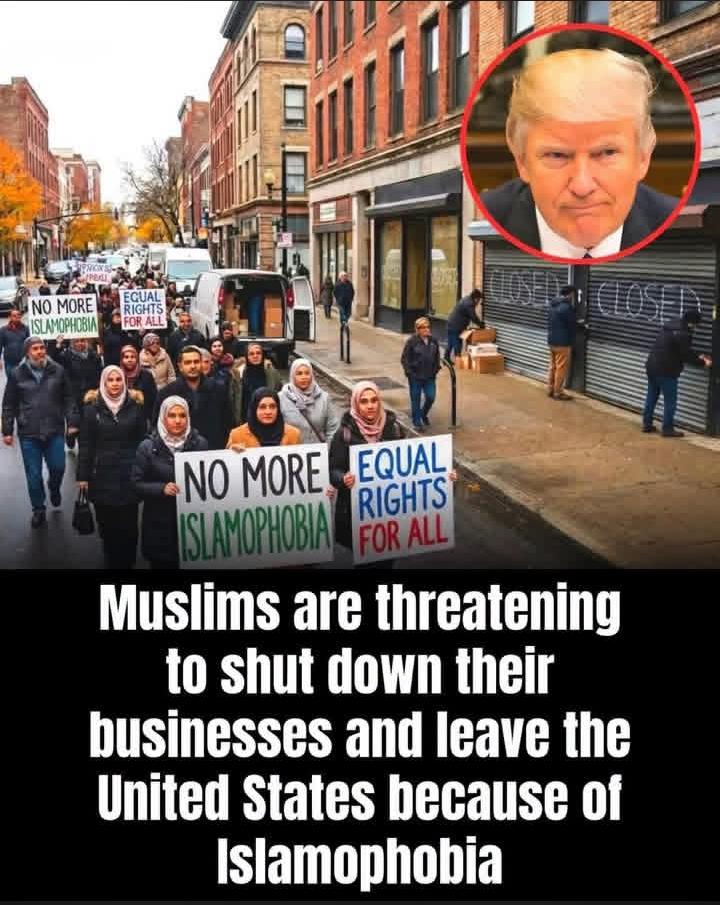
The most important thing to say first is this: the broad claim that “Muslims are threatening to shut down their businesses and leave the United States” should not be treated as a confirmed national movement. Reliable reporting and civil rights data support concerns about Islamophobia, but they do not prove that Muslim business owners across America are coordinating mass closures or departures.
What the evidence does show is a community under strain. The Council on American-Islamic Relations said complaints reported to the organization remained at an all-time high in its 2026 civil rights report. CAIR said it received 8,683 complaints nationwide in 2025, the highest single-year total it has recorded since its first civil rights report was published in 1996. The group also identified Florida, Illinois, Minnesota, Oklahoma, and Texas as states where complaints had increased over the previous three years.
The federal picture is also tense. The Department of Justice said law enforcement agencies reported 11,679 hate crime incidents involving 14,243 victims for calendar year 2024. Religion accounted for 23.5% of victims in single-bias hate crime incidents, making it one of the major bias categories in the FBI’s hate crime data.
Those numbers do not tell us how many Muslim business owners want to leave the country. They do tell us why a Muslim shopkeeper, restaurateur, or founder might feel exhausted when another slur, threat, boycott call, or ugly comment lands in their inbox.
The Institute for Social Policy and Understanding found in 2024 that 74% of Muslims surveyed reported experiencing some level of religious discrimination in the previous year. It also found that Muslims were more likely than Jewish Americans and the general public to report discrimination at work or school from peers and authority figures.
That matters because small businesses run on trust. A customer has to feel safe walking in. An owner has to feel safe opening the door. Employees have to feel safe wearing a hijab, using a Muslim name on a badge, taking time for prayer, or putting halal food on a menu without becoming a target for someone’s political tantrum.
For Muslim entrepreneurs, harassment is not an abstract debate
For some Muslim business owners, Islamophobia is not a cable-news topic. It is a stranger leaning across the table. It is a customer making a comment just loud enough to be heard. It is a vandalized window, a social media pile-on, or the nervous pause before opening the shop after a major international headline involving Muslims.
In 2019, Zareen Khan, owner of Zareen’s restaurants in the Bay Area, described being harassed during a business lunch in Sunnyvale, California. She said a stranger asked where she was from, asked whether she was Muslim, and then whispered “terrorist, terrorist” at her. Khan later wrote that being attacked in a town where she had felt safe “hurt.” Instead of retreating, she pledged donations to the ACLU to support immigrants facing harsher circumstances.
That example is old enough to prove a point: this did not begin yesterday. But the current climate has given the issue fresh urgency. In Texas, Muslim residents told The Guardian that anti-Muslim rhetoric had made everyday life more difficult, with some people saying threats and harassment were no longer unusual. One Muslim attendee at the Texas GOP convention said Muslims there were called terrorists and told to leave the country. His answer was defiant: “This is not the America I believe in,” he said, adding that he was not leaving.
That quote cuts through the lazy version of the story. Many Muslim Americans are not threatening to abandon America. They are demanding that America live up to its own promise.
Naila Syed, a Dallas resident and community advocate, described sitting in a public education hearing while people discussed Muslims as if Muslims were not in the room. Her reaction was simple: “Hello, I’m right here.”
That is the emotional center of this story. Muslim Americans are not symbols. They are business owners, parents, taxpayers, bosses, workers, customers, doctors, cooks, landlords, tenants, students, and neighbors. When public rhetoric turns them into a problem to be solved, the damage does not stay on a debate stage. It walks into schools, restaurants, offices, grocery aisles, and city meetings.
The business risk is real, even without a mass shutdown
A business does not have to close before hate becomes expensive. Fear has a price tag.
If a Muslim-owned restaurant becomes the target of harassment, the owner may need extra security, legal advice, public relations help, or time away from work. If employees feel unsafe, turnover rises. If customers fear being seen entering a Muslim-owned place during a local controversy, sales can dip. If online trolls flood reviews, the business can suffer before the truth catches up. Even when the owner wins public support, the emotional bill still arrives.
There is also a quieter cost: self-censorship. Some owners may avoid posting Eid greetings. Some may remove Arabic calligraphy from a storefront. Some may tell employees not to discuss Gaza, immigration, or politics with customers. Some may stop sponsoring community events because visibility feels risky. That is not freedom in any meaningful sense. That is survival mode wearing a business-casual blazer.
Global leaders have warned that anti-Muslim hostility is rising. In 2025, U.N. Secretary-General António Guterres described a “disturbing rise in anti-Muslim bigotry” and urged online platforms to curb hate speech and harassment. CAIR’s Corey Saylor framed the issue as bigger than one community, saying the right to be different is part of the “operating system of a free country.”
That is why the shutdown claim, even if overstated online, should not be dismissed as pure drama. It is better understood as a warning flare. When entrepreneurs who invested in America start wondering whether America has room for them, that is not only a Muslim issue. It is an American business issue.
The country benefits when immigrant and minority entrepreneurs build restaurants, clinics, tech firms, corner stores, logistics companies, salons, bakeries, and professional services. They create jobs. They rent vacant spaces. They revive commercial corridors. They feed neighborhoods. They pay taxes. They sponsor Little League teams and school fundraisers. They become the familiar face behind the counter that makes a city feel like itself.
So no, the verified story is not that Muslim business owners are suddenly packing up en masse. The verified story is sharper than that: a growing number of Muslim Americans are navigating a public climate where belonging feels conditional, and where running a business can mean carrying the extra burden of proving you are not a threat.
That should bother people across politics. Because once any group of Americans begins to feel that their faith, name, clothing, food, or accent makes their livelihood unsafe, the problem is bigger than one storefront.
It means the “Open” sign is still glowing in the window, but the owner behind it is wondering how long it can stay that way.