New York Man Sues ICE After Agents Show Up Over Scathing Email
David Streever thought he was sending an angry email to the government. Months later, federal officers were at his Rochester, New York, home with a warning notice.
Now, Streever, a U.S. citizen, is suing U.S. Immigration and Customs Enforcement and Department of Homeland Security officials, arguing the visit was not law enforcement; it was intimidation dressed up in federal stationery. The lawsuit was filed Monday in federal court in Washington, D.C., with help from the Foundation for Individual Rights and Expression, better known as FIRE.
Streever’s email, sent in January to then-acting ICE Director Todd Lyons, came after ICE officer Jonathan Ross fatally shot Minneapolis resident Renee Good during an anti-ICE demonstration, according to AP. In the message, Streever called Lyons a “monstrous human being” and said he “will never know peace.”
A Warning Notice Lands At His Door

Streever was not home when federal officers arrived in June. According to AP and the lawsuit, he was traveling in Finland with his daughter when two agents went to his house and gave his wife, the Rev. Hilary Streever, a warning notice saying the email could be treated as a threat.
The notice, in bold, said that Streever “may be in violation of federal law” and stated that ICE’s Office of Professional Responsibility had identified an email to Lyons that it believed might violate Title 18 of the U.S. Code. The notice asked him to “promptly remove and/or discontinue” the conduct, according to the complaint.
Then came the part that turned the story from strange to jaw-dropping: the lawsuit says federal officials also tried to reach Streever at a New York City hotel after he returned from Finland. A hotel clerk reportedly told him an agent had come looking for him, and the complaint says he later received voicemails from people identifying themselves only as Homeland Security Investigations.
FIRE senior attorney Adam Steinbaugh said the email was protected political speech. “This email doesn’t even come close,” he said of the idea that it was a true threat.
Streever, in a statement released by FIRE, said he was upset by the Minnesota shootings and wanted to express outrage. He said he “never dreamed” the email would bring federal officers to his door.
ICE Says Threats Are Taken Seriously
ICE and DHS have pushed back on the idea that the agency is trying to silence critics. AP reported that ICE previously declined to comment on Streever’s warning notice, citing an ongoing investigation. DHS also said any claim that it was trying to “squash” free speech was “categorically FALSE.”
The department’s broader position is that threats and doxxing against officers are serious matters. In a related case involving Syracuse poll worker Paigelynne Gonyea, DHS spokesperson Lauren Bis said Gonyea “committed a federal crime” by posting an ICE officer’s address online and warned that people who dox officers would face consequences.
Gonyea says federal officers confronted her at a polling place during New York’s primaries over a social media post criticizing Ross, the ICE officer who shot Good. A fellow poll worker recorded the encounter, and Gonyea later posted the warning letter online.
That connection matters because Streever’s lawsuit argues his experience was not an isolated misunderstanding. The complaint says the warning notices are part of a broader pattern of federal officials targeting critics of ICE. DHS and ICE have not accepted that framing, and no court has ruled on Streever’s claims.
The Lawsuit Puts Free Speech On The Front Porch
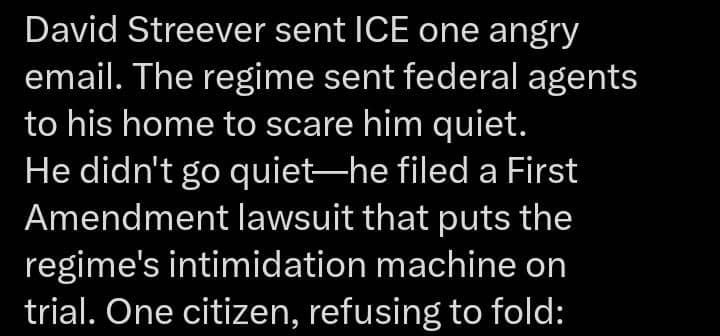
Streever’s lawsuit asks the court to declare that his email was protected by the First Amendment and to block federal officials from taking further action against him over the message. It also seeks to stop officials from relying on the warning notice he received.
The defendants include DHS Secretary Markwayne Mullin in his official capacity, as well as senior ICE and Office of Professional Responsibility officials and agents named in the complaint. FIRE filed the lawsuit on July 6 and then filed a motion for a preliminary injunction the next day.
Nathan Freed Wessler of the ACLU called the episode an “abuse of power,” saying people should not be tracked down for an email expressing opposition to government action.
For now, the case is about one man, one furious email, and one federal warning notice. But the bigger question is much louder: when does an angry message to a public official become a legitimate law enforcement concern, and when does the government’s response become the very thing the First Amendment was built to stop?
Streever says he wants to keep speaking openly about public issues. ICE says threats against officers have consequences. A federal court will now decide whether this warning crossed the constitutional line.