Trump’s Name Comes Down From Kennedy Center After Court Deadline Sparks Washington Showdown
The Kennedy Center became the center of a political and cultural storm this weekend after workers began removing President Donald Trump’s name from the famed Washington, D.C., performing arts landmark. The move followed a court order that said the institution could not be renamed without congressional approval.
The removal came after a tense June 12 deadline, missed legal appeals, scaffolding, bad weather, and public attention outside one of America’s most symbolic arts institutions. What looked like a dispute over letters on a building quickly became a larger fight over power, legacy, law, and who gets to shape the memory of national spaces.
A Late Night Deadline Turns Into a Public Spectacle

The court ordered Trump’s name removed from the Kennedy Center’s building, website, and official materials by late Friday, June 12, 2026. According to Reuters, work began around 1:20 a.m. Saturday, after the Department of Justice said the government would miss the deadline.
Crews had already placed scaffolding near the building as the clock moved toward midnight. The delay was blamed partly on thunderstorms, with government lawyers asking for more time because of safety concerns for workers. But the court did not allow the delay to stop the removal.
By the early morning hours, the name that had gone up less than six months earlier was being taken down. For supporters of the original Kennedy Center name, it was a symbolic correction. For Trump allies, it was another legal fight in a broader battle over control of Washington’s cultural institutions.
Why the Court Said the Name Could Not Stay
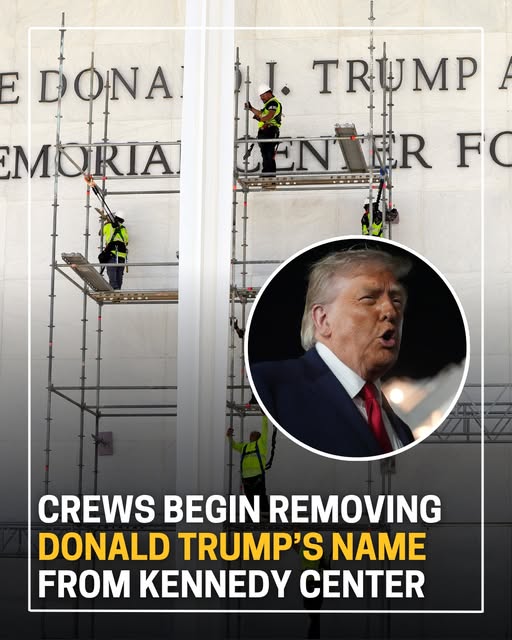
The legal issue was direct: who has the authority to rename the Kennedy Center? U.S. District Judge Christopher Cooper ruled that only Congress could change the name of the federally designated institution.
The law matters here because the Kennedy Center is not just a private theater. Federal law names the building the John F. Kennedy Center for the Performing Arts. That legal foundation gave opponents of the Trump name change a strong argument that the board could not simply vote to add a president’s name to the landmark.
The case was brought by Democratic Rep. Joyce Beatty of Ohio, who challenged the board’s authority. The judge’s order required Trump’s name to be removed not only from the physical facade but also from websites, documents, promotional material, and other official uses.
How Trump’s Name Got There in the First Place
The controversy began in December 2025, when the Kennedy Center board voted to rename the institution as the Donald J. Trump and John F. Kennedy Memorial Center for the Performing Arts. Trump chaired the board, and Reuters reported that workers began putting his name on the building the next day.
That decision immediately drew criticism from Democrats, Kennedy family members, historians, and legal observers. Critics argued that the center was created by Congress as a living memorial to President John F. Kennedy, not as a flexible branding space for whichever political faction controlled the board.
Supporters of the change said Trump deserved recognition for his efforts to reshape and revitalize the center. But the court focused less on political praise and more on legal authority. In simple terms, the judge said the board had crossed a line Congress had already drawn.
A Memorial With Deep National Meaning
The Kennedy Center carries a history that makes this dispute especially emotional. President Lyndon B. Johnson signed the bill renaming the National Cultural Center for John F. Kennedy on January 23, 1964, just two months after Kennedy was assassinated.
Johnson described the center as more than a Washington building. It was meant to honor Kennedy’s love of culture, language, history, and public life. Over time, the Kennedy Center became a national stage for music, theater, dance, opera, comedy, and public ceremony.
That history is why the name fight carried such force. For many Americans, the Kennedy Center name is not just a label. It represents grief, memory, national aspiration, and the idea that public art can outlive political conflict.
The Broader Battle Over Washington’s Image
The Kennedy Center fight also fits into a larger debate over how Trump has sought to reshape Washington during his second term. Reuters reported that Trump had announced a two-year closure of the Kennedy Center for major renovations and had also pushed broader changes to the capital’s monumental core.
That broader context made the name removal feel bigger than one building. It became a test of whether federal cultural spaces can be dramatically altered by executive influence, board appointments, or political pressure.
To critics, the court ruling was a guardrail. It reminded the administration that even powerful presidents must follow laws created by Congress. To Trump supporters, the ruling looked like another example of courts blocking a leader they believe is trying to restore major institutions.
What Happens Next
The Kennedy Center can still pursue appeals, and the legal fight may not be fully over. But for now, the most visible part of the dispute has changed. Trump’s name has been removed, and the original Kennedy Center identity has been restored for official use.
The case leaves behind a sharp question: who owns the meaning of America’s public landmarks? Presidents may influence them, boards may manage them, and donors may support them. But when Congress names a national memorial, the courts have now made clear that changing it requires more than political will.
The Kennedy Center will continue hosting performances, ceremonies, and public debates. Yet this episode has already become part of its history. A building created to honor one president became the stage for another president’s fight over legacy, and, in the end, the law decided which name would stay on the wall.