8 Most Bizarre Buildings Around the World
Some buildings do more than hold people, offices, shops, or hotel rooms. They stop traffic, confuse the eye, spark arguments, and make visitors wonder how anyone convinced a construction crew to build them in the first place. Around the world, architects have turned concrete, steel, glass, wood, and stone into baskets, bubbles, dancing towers, crooked walls, upside-down homes, and forest-covered spirals.
These bizarre buildings are not strange by accident. Many were built to make a point, sell a brand, challenge rigid design rules, or turn ordinary space into a full-body experience. We often remember them because they break the silent agreement most buildings follow: to stand straight, behave politely, and blend into the street.
Habitat 67 in Montreal Makes Apartments Look Like Stacked Blocks
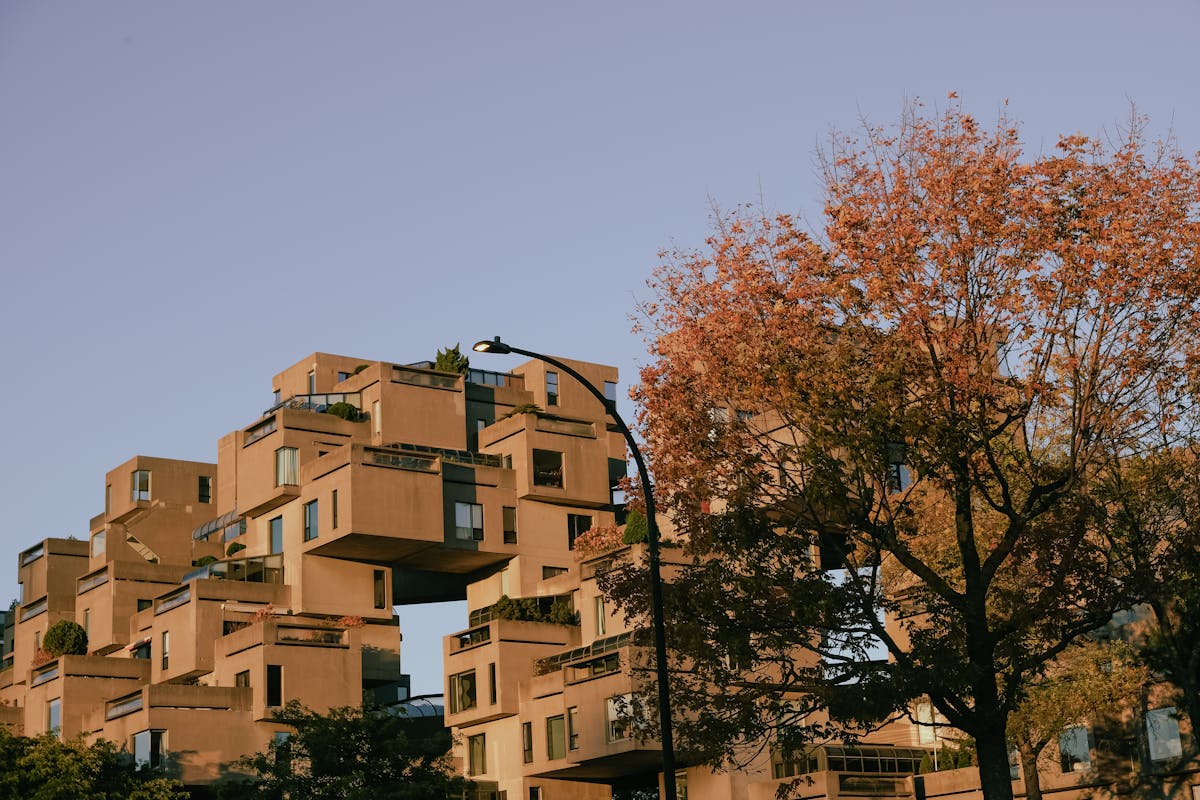
Habitat 67 remains one of the most influential strange buildings in the world because its weirdness had a social purpose. Designed by Moshe Safdie for Expo 67 in Montreal, the project tried to rethink apartment living by combining urban density with the privacy, terraces, and variety associated with suburban homes. The result looks like a giant stack of concrete blocks arranged with surprising rhythm and order.
The structure was built from 354 identical prefabricated concrete modules, arranged into different combinations to create 158 residential units in the original design. Its visual punch comes from repetition without monotony. From a distance, Habitat 67 looks like a puzzle frozen in place, but up close, it reveals balconies, pedestrian paths, terraces, and private outdoor spaces woven into the modular grid.
Casa do Penedo in Portugal Looks Carved Out of a Fairy Tale
Casa do Penedo, also known as the Stone House or House of the Rock, sits between Celorico de Basto and Fafe in northern Portugal. The home is famous because it was built from four large boulders that serve as its foundation, walls, and ceiling. It looks less like a house placed on land and more like a secret shelter that the land reluctantly allowed humans to occupy.
Construction began in 1972 and finished in 1974, and the building was first used as a holiday retreat before gaining international attention as a small museum. Its bizarre charm comes from the clash between primitive appearance and human intention. From the outside, it resembles a prehistoric cartoon home; from a design perspective, it is a clever example of architecture that uses existing natural mass rather than fighting it.
Dancing House in Prague Turns Motion Into Concrete

The Dancing House in Prague looks less like a building and more like two figures caught mid-step. One tower curves in glass, the other bends in pale concrete, creating the impression of a pair of dancers leaning into movement. This is why the building is often nicknamed “Ginger and Fred,” after the famous dance duo Fred Astaire and Ginger Rogers.
The building sits on Rašínovo nábřeží along the Vltava River, a setting that makes its modern shape even more dramatic, as Prague is famous for its historic Gothic, Baroque, and Art Nouveau architecture. Completed in 1996, it was designed by Croatian-Czech architect Vlado Milunić with Frank Gehry. What makes it bizarre is not just the curve, but the confidence of placing such a restless modern object in a city known for architectural restraint.
Longaberger Basket Building in Ohio Made Branding Massive
The Longaberger Basket Building in Newark, Ohio, may be one of the boldest acts of corporate architecture ever built. Instead of placing a logo on a normal headquarters, the company turned the headquarters into the product itself. The seven-story, 180,000-square-foot building was designed to resemble one of Longaberger’s signature baskets, complete with enormous handles.
The building opened in 1997 and became instantly recognizable for treating a humble household object as monumental architecture. Its basket handles weigh almost 150 tons and can be heated in cold weather to prevent ice from falling onto the glass roof. The company later left the building, and it was sold for $1.2 million after years of uncertainty, but the structure remains a landmark because no ordinary office tower could have created such a memory.
Upside Down House in Poland Turns Disorientation Into Politics
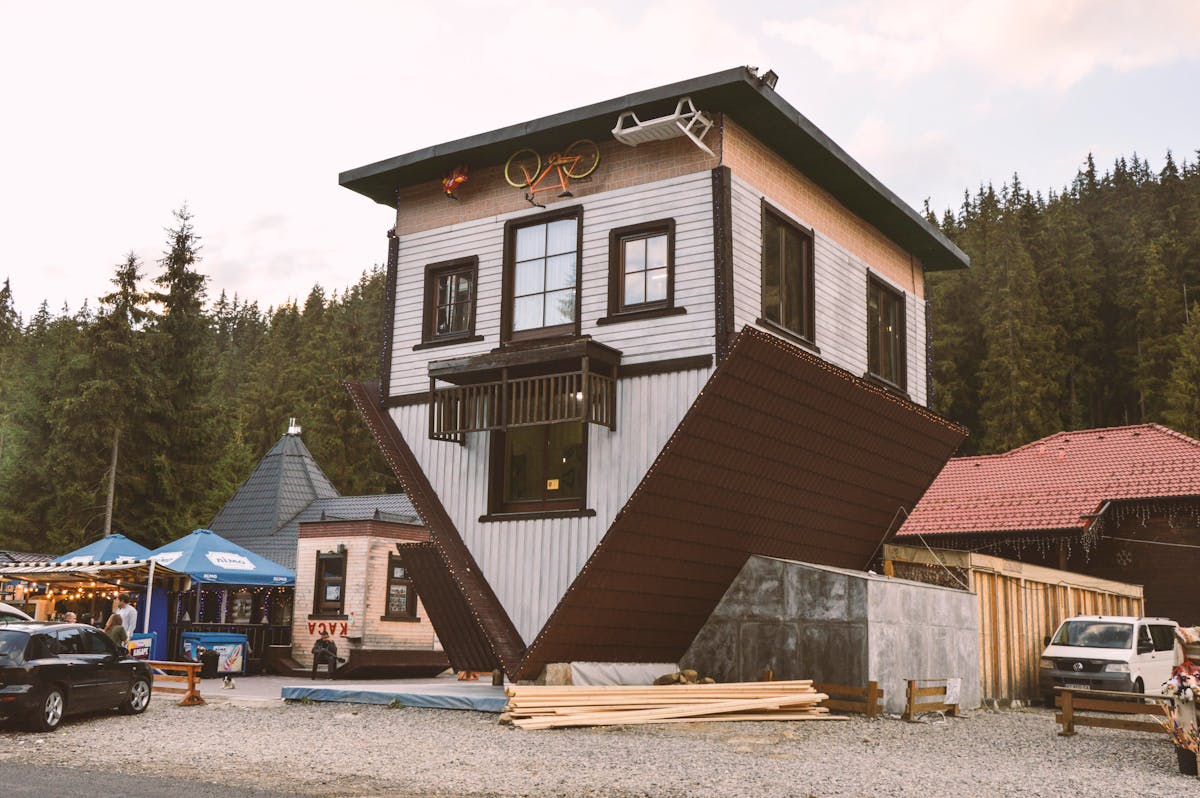
The Upside Down House in Szymbark, Poland, is strange before visitors even step inside. The roof sits on the ground, the foundation points upward, and the interior forces people to experience space in reverse. Completed in 2007, the house was designed by businessman Daniel Czapiewski as a statement about uncertainty in post Communist Poland.
Its power comes from physical discomfort. Visitors do not just look at a political symbol; they walk through one. Atlas Obscura describes the structure as a trippy home that highlights the symbolic inversions of communist rule by turning a house on its head. That makes it one of the rare bizarre buildings where the joke, the attraction, and the historical commentary all depend on the same architectural move.
Crazy House in Vietnam Feels Like Walking Through a Dream
The Hang Nga Guesthouse in Da Lat, Vietnam, better known as Crazy House, is one of the clearest examples of architecture as fantasy. The official site describes it as one of the most unusual architectural structures in Da Lat and identifies architect Đặng Việt Nga as its designer. The building uses tree-like forms, winding paths, sculptural surfaces, and themed spaces that feel closer to a dream forest than a conventional guesthouse.
Crazy House stands out because it invites visitors to move through the architecture emotionally rather than simply using it. Its paths twist, its surfaces curve, and its rooms feel like pieces of an imaginary ecosystem. Design coverage lists the project as Biệt thự Hằng Nga, located at 03 Huỳnh Thúc Kháng in Da Lat, with a design year of 1990 and an ongoing project status.
Half House in Toronto Looks Like a Building Cut by a Knife
Toronto’s Half House at 54 1/2 St. Patrick Street is bizarre in a quieter way than the others. It does not twist, dance, melt, or flip upside down. It simply looks as though one side of a row house disappeared. The home dates back to the late nineteenth century and was once one of six structurally connected houses on what was then called Dummer Street.
Its oddness came from demolition, survival, and stubborn urban change. As nearby properties were removed or altered, part of the original row remained, creating the visual illusion of a house sliced in half. Unlike many bizarre buildings created by architects chasing spectacle, Half House became strange through real estate pressure and, by accident, preservation.
Crooked House in Sopot Makes the Street Look Glitched
Krzywy Domek, the Crooked House in Sopot, Poland, looks like someone grabbed a normal building and gently warped it in a digital editing program. Built in 2004, the roughly 4,000-square-meter structure is part of the Rezydent shopping center. Its walls bend, its roofline dips and swells, and its windows seem to wobble inside the façade.
The building was designed by Szotyńscy and Zaleski, who drew inspiration from fairy tale illustrations by Jan Marcin Szancer and Per Dahlberg. That origin story matters because the building looks deliberately storybook-like rather than randomly distorted. It is bizarre in a playful way, turning a commercial building into a tourist photo magnet without losing its practical use as a place for shops, restaurants, and offices.
Conclusion
Bizarre buildings last because they give people a reason to look twice. They interrupt the ordinary rhythm of cities and landscapes, then reward curiosity with stories about ambition, politics, memory, nature, commerce, or pure imagination. A basket can become a headquarters, a house can stand upside down, and an apartment complex can look like a concrete puzzle without losing its purpose.
The real lesson is simple. Strange architecture is not always a gimmick. At its best, it shows how buildings can hold more than people; they can hold arguments, dreams, jokes, cultural shifts, and bold ideas that ordinary walls would never express.