Supreme Court deals GOP a Setback as States Receive Power to Count Late-Arriving Mail Ballots.
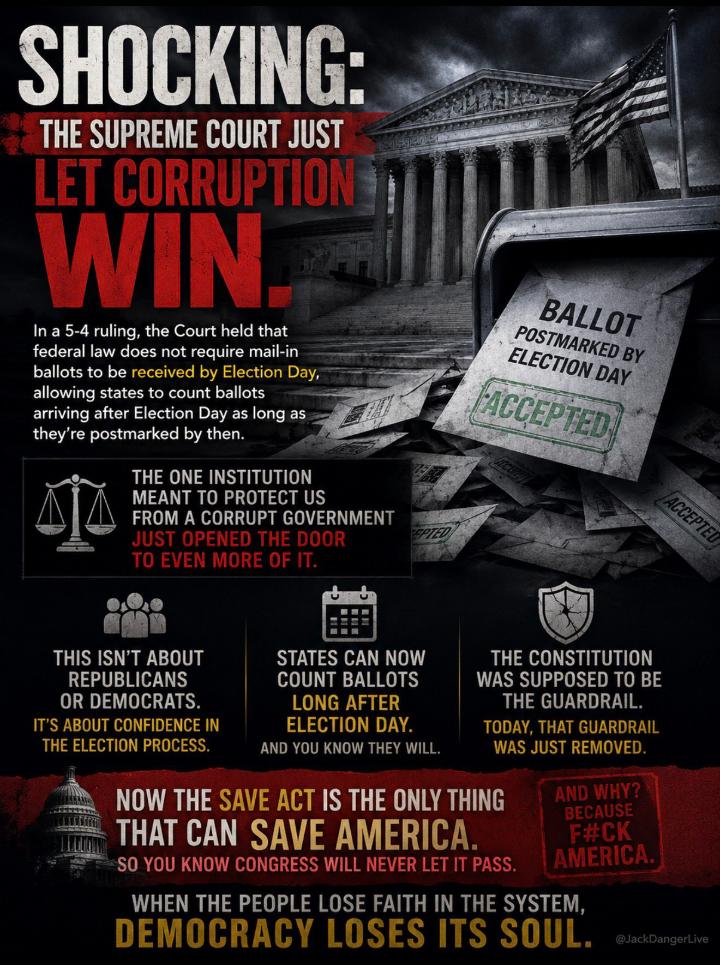
The Supreme Court on Monday handed states a major win in the long-running fight over mail voting, ruling that ballots cast by Election Day can still be counted even if they arrive afterward.
The 5-4 decision keeps Mississippi’s mail ballot grace period in place and protects similar rules used in several other states. For voters, the message is simple: if a ballot is properly cast on time, a delay in the mail does not automatically erase it.
The case, known as Watson v. Republican National Committee, centered on a Mississippi law that allows mail ballots to be counted if they are postmarked by Election Day and received within five business days. Republican challengers argued that federal law requires ballots to be both cast and received by Election Day. The Court disagreed.
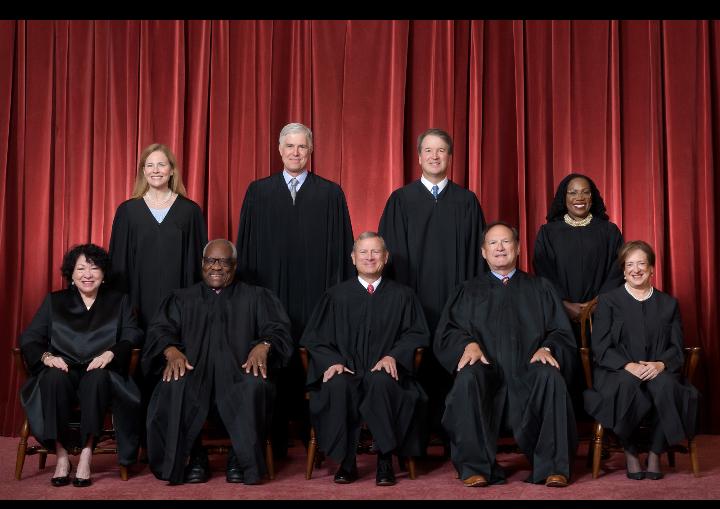
Justice Amy Coney Barrett wrote the majority opinion, joined by Chief Justice John Roberts and the Court’s three liberal justices. Together, they concluded that federal election statutes set the voting deadline, not the final deadline for election offices to physically receive every ballot.
That distinction may sound technical, but it carries enormous consequences. Millions of Americans vote by mail, including older voters, people with disabilities, students, military voters, overseas citizens, and residents in places where mail service can be unpredictable. A rule requiring every ballot to arrive by Election Day could have forced states to throw out votes that were legally cast on time.
The Court says Election Day means the day voters decide.

At the heart of the ruling was a basic question: when does voting happen?
The challengers argued that an election is not complete until officials have received the ballot. The majority took a different view. Barrett wrote that voters make their choice when they cast their ballots, as long as state law requires that choice to be made by Election Day.
That reasoning preserved Mississippi’s law and reversed a ruling by the 5th U.S. Circuit Court of Appeals, which had found the state’s grace period unlawful.
The decision does not mean voters can cast ballots after Election Day. They cannot. Ballots still must be marked, submitted, or postmarked by the legal deadline. The ruling says states may give election officials extra time to receive and count ballots that were already cast on time.
That point matters because mail voting depends on systems outside the voter’s control. Once a voter drops a ballot in the mail, delivery speed depends on postal processing, distance, weather, staffing, and local logistics. The Court’s ruling leaves room for states to recognize that reality.
A major election-year decision before the midterms
The timing of the decision makes it even more significant. The ruling comes just months before the November 2026 midterm elections, when control of Congress will be at stake.
Had the Court sided with the Republican National Committee, election officials in multiple states could have been forced to quickly rewrite ballot rules. That would have created confusion for voters, campaigns, clerks, and local election offices already preparing for a high-turnout election season.
Instead, the Court kept the current system largely intact. States that already allow late-arriving ballots under specific conditions can continue doing so, unless Congress passes a new federal law or state legislatures change their own rules.
That does not end the political fight. President Donald Trump, who has repeatedly criticized mail voting, responded by again urging Congress to pass stricter federal election rules. His allies argue that ballots should be in election officials’ hands by the time polls close.
Voting-rights advocates see the ruling differently. They argue that the decision protects voters from being punished for postal delays, especially when their ballots were completed and mailed on time.
Mississippi’s law became a national test case.
The case began in Mississippi, but its impact reaches far beyond one state.
Mississippi allows only certain voters to cast absentee ballots by mail, including seniors, people with disabilities, and voters who are away from home. Under the law challenged in this case, those ballots may be counted if they are postmarked by Election Day and arrive within five business days.
Republican groups challenged that rule in 2024, arguing that federal laws establishing a uniform Election Day for presidential and congressional races should override the state’s later receipt deadline.
A federal district court initially upheld the Mississippi law. The 5th Circuit then ruled against it. Monday’s Supreme Court decision reversed that lower court ruling and gave Mississippi a clear victory.
The decision also protects states that have built election systems around similar deadlines. Some states allow all eligible mail ballots to arrive after Election Day if they are postmarked on time. Others offer that protection only for military and overseas voters.
Either way, the Court’s ruling makes clear that Congress did not impose a nationwide receipt deadline when it created a uniform Election Day.
The dissent warns that the ruling weakens Election Day.
The four dissenting justices, Samuel Alito, Clarence Thomas, Neil Gorsuch, and Brett Kavanaugh, saw the issue differently.
They argued that allowing ballots to arrive after Election Day weakens the meaning of a national election date. In their view, the election should be complete when Election Day ends, not days later when additional mail ballots may still be arriving.
That concern has been a major Republican argument in recent years. Critics say late-arriving ballots can slow the release of results, fuel public suspicion, and leave close races unsettled for days.
Supporters counter that counting legally cast ballots is not the same as extending voting. Election offices routinely count ballots after Election Day, including absentee ballots, provisional ballots, and ballots requiring signature verification. In many states, official results are not certified for days or weeks.
The majority’s decision leaned into that practical reality. Election Day is the deadline for voters to act. Counting, verifying, and receiving ballots can continue under state rules.
The ruling keeps power with states for now
The biggest takeaway from the decision is that the Supreme Court declined to impose a single national rule on ballot receipt deadlines.
That leaves the matter where it has traditionally been: mostly in the hands of states and Congress. States can decide whether to keep grace periods, shorten them, or eliminate them. Congress can also act if lawmakers want one federal standard.
For now, voters in states with grace-period laws will not see those protections suddenly disappear. Election officials will not have to rebuild their systems in the middle of an election year. And campaigns will continue operating under familiar rules.
The ruling also underscores a larger tension in American elections. One side argues that tighter deadlines are necessary to preserve confidence. The other argues that access matters too, especially when voters did everything required of them before the deadline.
The Supreme Court did not settle that political debate. But it did settle the legal question in this case: federal law does not prevent states from counting mail ballots cast by Election Day and received later.
That makes Monday’s ruling one of the most important voting decisions ahead of the 2026 midterms, not because it creates a new voting system, but because it keeps an existing one from being dismantled.