McConnell Remains Engaged With Republican Leaders as Uncertainty Continues Surrounding His Senate Comeback
In Washington, silence rarely stays empty for long. When a powerful senator disappears from the Capitol for weeks, unanswered questions begin to gather like storm clouds over the marble corridors of power. That is now the case for Sen. Mitch McConnell, the 84-year-old Kentucky Republican whose long hospital stay has become more than a private health matter. It has turned into a political test for Senate GOP leaders, a transparency issue for his office, and a reminder that even the most disciplined figures in American politics cannot completely control the public conversation.
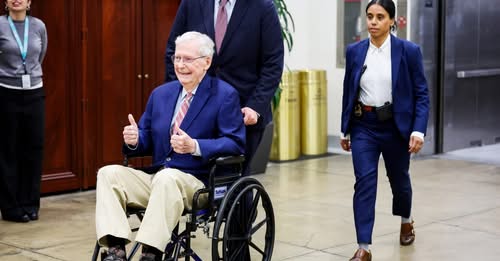
McConnell has been hospitalized since June 14, according to his office, which has offered only limited updates about his condition. His team has said he is recovering, improving, and working with staff on Kentucky and Senate matters, but it has not publicly disclosed the reason for his hospitalization or whether he will return when the Senate resumes session.
GOP Leaders Say McConnell Is Engaged
As speculation grew, Senate Majority Leader John Thune and Senate Republican Whip John Barrasso stepped forward with carefully worded reassurance. CBS News reported that Thune spoke with McConnell by phone on Monday and that the discussion was described as lengthy and substantive, covering issues including national security. Barrasso also reportedly spoke with McConnell by phone for about 20 minutes on Tuesday.
The message from Republican leadership was clear: McConnell is not politically absent, even if he remains physically away from the Senate floor. Barrasso’s spokeswoman said McConnell was fully engaged and eager to return to the Senate, while earlier comments from Thune described him as alert to what was happening on Capitol Hill.
That reassurance may calm some allies, but it does not erase the central mystery. McConnell’s office has not explained what sent him to the hospital, what treatment he is receiving, or when the public might hear directly from him.
The Silence Has Fueled Questions
The longer the silence stretches, the more attention it draws. For decades, McConnell built a reputation as one of the Senate’s most strategic and controlled operators. He rarely wasted words. He moved with calculation. He understood timing better than nearly anyone in Washington. Now, however, the lack of detail around his health has created a vacuum that others are rushing to fill.
CBS News reported that emergency medical personnel responded on June 14 to an unconscious person at McConnell’s home, according to a public EMS dispatch call it reviewed. The call reportedly referenced cardiac arrest and CPR, though CBS noted that McConnell’s name was not mentioned in the call and that it had not confirmed the identity of the unconscious person. McConnell’s staff has not confirmed that the dispatch call involved the senator.
That distinction matters. Responsible reporting cannot turn an unconfirmed emergency call into a confirmed medical diagnosis. Still, the existence of such reports, combined with weeks of limited official information, has intensified public scrutiny.
A Political Giant Nearing the End of His Term
McConnell is not just another senator missing votes. He is the longest-serving Senate party leader in American history, a figure who shaped Republican judicial strategy, party discipline, and the Senate’s balance of power for nearly two decades. AP reported that he served as Republican leader from 2007 until last year and remains active as a rank-and-file senator while finishing his final term.
He has already announced that he will not seek another term, meaning his Senate career will end in January. That planned exit gives the current moment a more dramatic edge. This is not simply about whether McConnell can return for the next vote. It is about how one of the most consequential Republican leaders of the modern era leaves public life.
Health Concerns Have Followed Him for Years
The current hospitalization comes after several highly visible health episodes. AP reported that McConnell was hospitalized with a concussion in 2023 after falling at a Washington hotel, later froze during two news conferences that year, and sprained his wrist in another fall while leaving a GOP luncheon. He also had polio as a child and has long acknowledged difficulty walking and climbing stairs.
Reuters reported that he was also hospitalized for eight days in February after experiencing flu-like symptoms. When he was hospitalized on June 14, his spokesperson said only that he was receiving excellent care and did not explain why he had been admitted. Those earlier episodes form the backdrop for the current concern. They do not answer what is happening now, but they explain why every update is being parsed so closely.
Why the Story Matters Beyond McConnell
The Senate is a body where attendance and timing matter, and a single missing vote can shift the pressure within a narrow majority. Even when a senator is no longer in leadership, experience and influence still count. McConnell remains a senior Republican voice on national security, foreign policy, and the party’s future direction.
For Thune and Barrasso, the moment is delicate. They must show respect for McConnell’s privacy while also reassuring colleagues, voters, and reporters that the Senate is not being left in the dark. Too much detail could look intrusive. Too little detail invites suspicion. That is the narrow road GOP leaders are now trying to walk.