Medvedev’s Nuclear Warning to America Sparked Fresh Fears—Here’s Why It Still Matters
A warning from Dmitry Medvedev, Russia’s former president and one of the Kremlin’s most confrontational voices, reignited fears that the war in Ukraine could move beyond conventional warfare. In November 2024, Medvedev said Russia could treat the transfer of Western nuclear weapons to Ukraine as a direct attack on the Russian state. Such a move, he argued, could provide Moscow with grounds for a nuclear response under its updated military doctrine.
However, there was an important distinction behind the alarming headlines. The United States had not announced plans to deploy nuclear weapons in Ukraine. Medvedev was reacting to reports that some Western officials had discussed whether returning nuclear weapons to Kyiv could strengthen Ukraine’s security before President Joe Biden left office. What made the warning so unsettling was not only the mention of nuclear retaliation. It was the suggestion that Russia might regard even discussion of a transfer as preparation for nuclear conflict.
What Triggered Medvedev’s Nuclear Warning to the United States
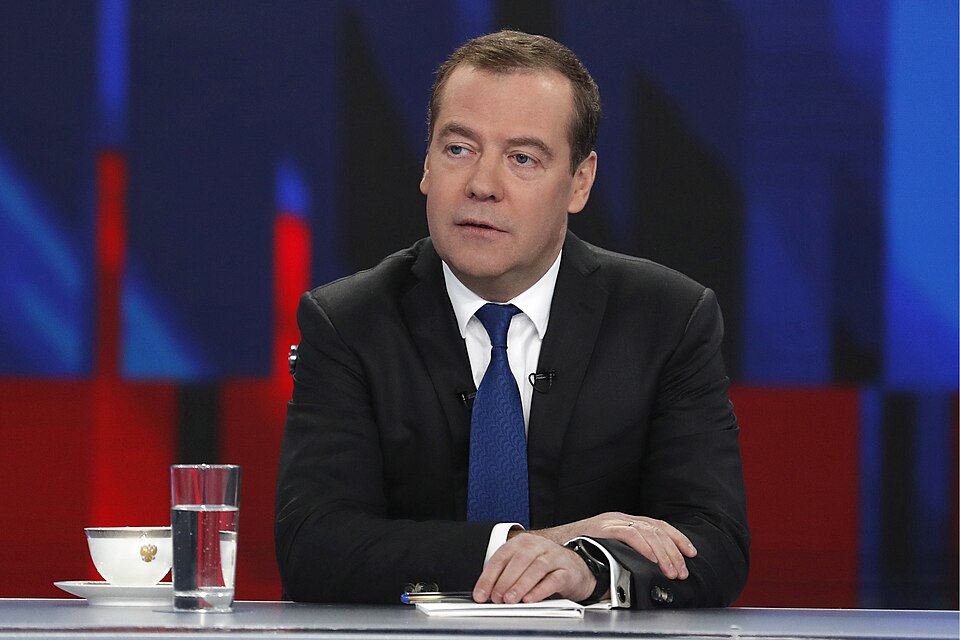
Government.ru, CC BY 4.0, via Wikimedia Commons
The controversy emerged during an especially tense period in the Russia-Ukraine war. Ukraine had received permission to use American-supplied Army Tactical Missile Systems, commonly known as ATACMS, against certain targets inside Russian territory. Ukraine subsequently fired the longer-range missiles into Russia for the first time, striking an ammunition facility in the Bryansk region. The attack marked an expansion of how American weapons could be used and created a new source of tension between Washington and Moscow. Around the same period, reports suggested that some Western officials had considered several possible ways to strengthen Ukraine before the incoming U.S. administration took office. One option reportedly raised during those discussions involved providing Ukraine with nuclear weapons.
There was no public indication that the Biden administration had approved such a proposal or was preparing to place American nuclear weapons on Ukrainian territory. The idea remained part of a reported discussion rather than an announced policy. Medvedev nevertheless responded as though the suggestion itself represented a major escalation. He argued that an actual transfer could be interpreted as an attack on Russia and said even threatening such a transfer might be viewed as preparation for nuclear war. As we separate the confirmed facts from the rhetoric, we can see why precision matters. The dispute was not about nuclear weapons already moving toward Ukraine. It was about how Moscow chose to respond to a proposal reportedly raised behind closed doors.
Russia Had Just Lowered Its Nuclear Threshold
Medvedev’s warning carried additional weight because Russia had recently revised its official nuclear doctrine. On November 19, 2024, President Vladimir Putin approved changes expanding the circumstances under which Russia could consider using nuclear weapons. The updated policy stated that an attack by a non-nuclear country supported by a nuclear power could be treated as a joint attack against Russia. The revised doctrine also allowed Moscow to consider a nuclear response to certain large conventional attacks that threatened Russia’s sovereignty or territorial integrity. It broadened the language surrounding missiles, aircraft, drones, and other weapons crossing Russian borders. The timing was impossible to overlook. Putin signed the changes on the same day Ukraine was reported to have used American-supplied ATACMS missiles inside Russia.
Kremlin spokesman Dmitry Peskov said Ukrainian strikes involving Western long-range weapons could potentially fall under the revised doctrine. Medvedev went further, suggesting that attacks involving NATO-supplied missiles could be classified as attacks by NATO countries themselves. That interpretation did not mean a Russian nuclear strike had become automatic. Nuclear doctrines are designed partly to preserve uncertainty, allowing governments to warn adversaries without committing themselves to a specific response. Still, the revised wording appeared to give Moscow greater freedom to describe Western-supported conventional attacks as potential nuclear triggers. Analysts at the Carnegie Endowment noted that the new doctrine introduced broader conditions than Russia’s earlier policy, including scenarios involving threats to sovereignty rather than only threats to the state’s existence.
Why Ukraine’s Nuclear History Makes the Threat More Powerful
The possibility of nuclear weapons returning to Ukraine carries enormous historical significance. When the Soviet Union collapsed in 1991, Ukraine inherited a huge nuclear arsenal stationed on its territory. It included approximately 1,900 strategic nuclear warheads, although the command, maintenance and operational arrangements surrounding those weapons remained closely connected to Russia and the former Soviet military system. Ukraine eventually agreed to surrender the warheads and join the Nuclear Non-Proliferation Treaty as a non-nuclear state. Under agreements reached during the 1990s, the weapons were transferred to Russia for dismantling. In return, Ukraine received economic assistance, compensation, and security assurances. The United States, Russia and the United Kingdom signed the Budapest Memorandum in December 1994, promising to respect Ukraine’s sovereignty, independence and existing borders.
Ukraine transferred its final nuclear warhead to Russia in 1996. Its last strategic nuclear delivery vehicle was eliminated in 2001. Russia’s annexation of Crimea in 2014 and its full-scale invasion of Ukraine in 2022 transformed that disarmament decision into one of the most controversial nuclear security debates of the modern era. For many Ukrainians and their supporters, Russia’s invasion showed that diplomatic assurances could fail when confronted by military force. For nuclear nonproliferation advocates, however, rearming Ukraine with nuclear weapons would create its own severe risks and could weaken efforts to discourage other countries from pursuing atomic arsenals. This history explains why any suggestion of returning nuclear weapons to Ukraine immediately attracts global attention. It raises difficult questions about deterrence, broken security assurances, and whether vulnerable countries can rely on international agreements after giving up powerful weapons.
Medvedev’s Words Fit a Wider Pattern of Nuclear Pressure
The November warning was not an isolated remark. Earlier that month, Medvedev told the United States that it should take Russia’s nuclear statements seriously. He said American officials were mistaken if they assumed Russia would never cross the line and use nuclear weapons when it believed its existence was threatened. In May 2024, he had also said Russia was not bluffing when discussing the possibility of using tactical nuclear weapons. He warned that the confrontation between Moscow and the West was developing toward an increasingly dangerous outcome. Medvedev served as Russia’s president from 2008 to 2012 and later became deputy chairman of the country’s Security Council. Once presented as a relatively moderate modernizer, he emerged after the invasion of Ukraine as one of the Kremlin’s most aggressive public messengers.
His statements do not automatically announce Putin’s decisions. They can, however, help Moscow communicate its most extreme possible responses while leaving the Russian president room to appear more restrained. As we examine this pattern, we can see how nuclear rhetoric functions as more than a military warning. It can also be used to frighten Western governments, influence public debate, discourage weapons deliveries and create divisions among Ukraine’s supporters.
Was a Russian Nuclear Strike Considered Likely?
Despite the escalation in rhetoric, American intelligence assessments reportedly concluded at the time that a Russian nuclear attack remained unlikely. U.S. officials familiar with intelligence reporting said Washington’s decision to permit limited Ukrainian strikes deeper inside Russia had not significantly increased the likelihood that Moscow would use nuclear weapons. The United States also did not immediately change its own nuclear posture in response to Russia’s revised doctrine.
That assessment did not mean the risk could be ignored. A nuclear confrontation can become more dangerous due to miscalculation, misinterpreted signals, or pressure from rapidly evolving battlefield events. NATO has consistently described Russia’s nuclear rhetoric as dangerous and irresponsible. The alliance has also warned that any Russian use of nuclear weapons would fundamentally alter the conflict and bring severe consequences for Moscow. The challenge for Washington and its allies was therefore to continue supporting Ukraine without allowing Moscow’s threats to dictate every decision. At the same time, Western leaders needed to avoid actions that could unintentionally create a direct military confrontation between nuclear powers.
The Real Danger Was the Expanding Meaning of an “Attack”
Medvedev’s warning generated fear because it appeared to widen Russia’s definition of aggression. Under his interpretation, supplying nuclear weapons to Ukraine could become equivalent to attacking Russia. Threatening to supply them could be described as preparing for nuclear conflict. Ukrainian strikes using Western missiles could also be framed as attacks carried out jointly by Ukraine and NATO countries. That language gives Moscow considerable flexibility. Almost any major increase in Western military support could be presented to Russian audiences as evidence that Russia is fighting not only Ukraine but the entire Western alliance.
We should not treat every statement from Medvedev as proof that nuclear war is imminent. Yet dismissing the warnings entirely would also be dangerous, especially when they coincide with changes in military doctrine, missile deployments, and battlefield escalation. The most troubling part of the episode was not an announced American plan to place nuclear weapons in Ukraine, because no such plan had been publicly approved. It was the Kremlin’s willingness to describe an unconfirmed proposal as a possible trigger for nuclear retaliation. That distinction captures the broader danger surrounding the war. The United States and Russia were not openly preparing for nuclear conflict, but the space between military assistance, political signaling, and direct confrontation was becoming increasingly difficult to define. Medvedev’s warning was designed to make Washington hesitate. Whether it was a genuine statement of policy, an attempt at intimidation, or a mixture of both, it showed how quickly the language of nuclear war had returned to the center of European security.