Spain’s 2026 World Cup Triumph Was the Final Proof of a Soccer System Built to Rule
Spain did not steal the 2026 World Cup in one dramatic moment. It collected a prize that years of planning, player development, and tactical discipline had made increasingly difficult to deny.
Ferran Torres’ 106th-minute goal delivered a 1-0 extra-time victory over Argentina at MetLife Stadium, securing Spain’s second men’s world title and ending the defending champions’ attempt to win consecutive crowns.
The winning strike supplied the explosion, but the deeper story had been unfolding long before the final. When we examine Spain’s rise from the 2023 UEFA Nations League to Euro 2024 and now the 2026 World Cup, we see more than a gifted generation.
We see a national soccer structure that repeatedly turns technical education, positional intelligence, and collective trust into trophies.
Ferran Torres Finished What Spain Had Controlled
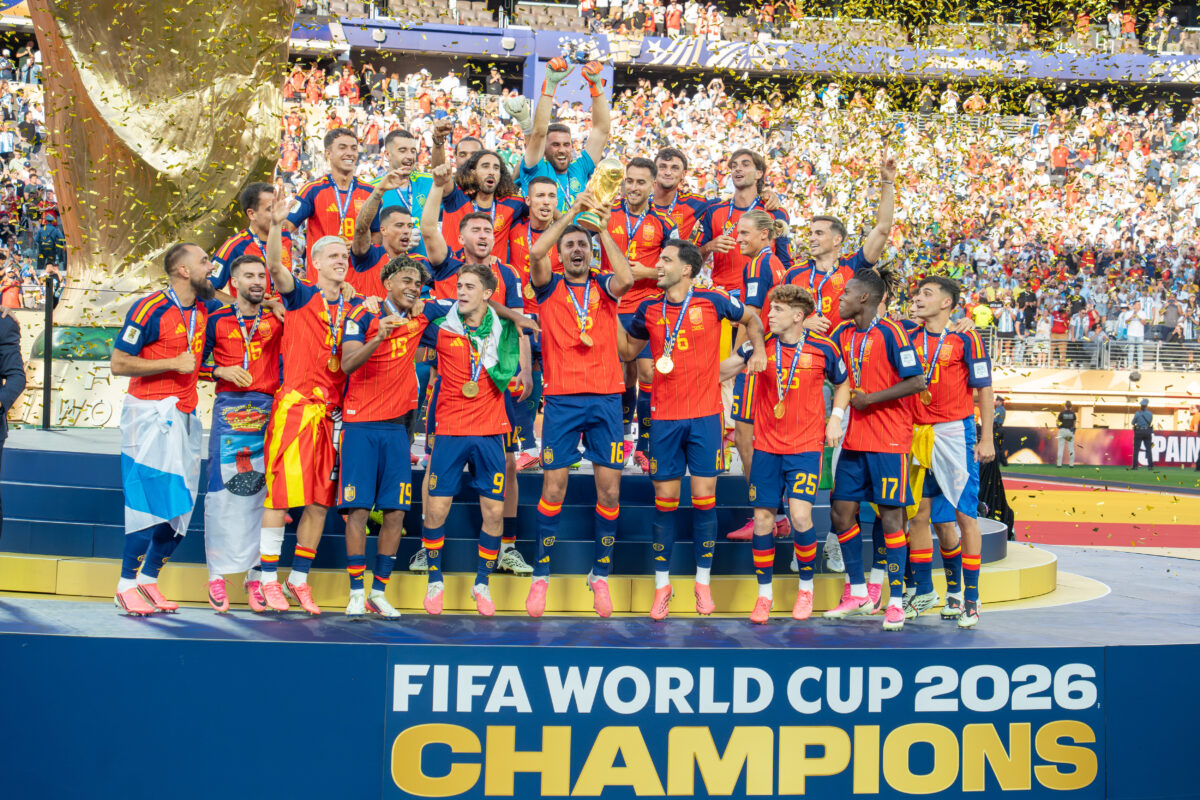
The final remained scoreless for 105 minutes, yet it rarely felt balanced. Spain dictated where the match was played, moved Argentina’s defensive block from side to side and patiently searched for a clean opening.
Emiliano Martínez repeatedly protected Argentina, but Torres finally converted Spain’s 20th attempt after entering as a substitute in the 62nd minute. Nico Williams kept a long ball alive and directed it toward Torres, who struck powerfully with his left foot.
The goal also carried remarkable historical symmetry. Spain’s first World Cup title came in 2010 through Andrés Iniesta’s extra-time winner in a 1-0 final against the Netherlands. Sixteen years later, another tense championship match required another late Spanish intervention.
This victory, however, did not look like the final achievement of a fading golden age. It felt like the beginning of another one.
Argentina’s resistance deserved respect. Enzo Fernández’s late second yellow card reduced Lionel Scaloni’s team to 10 men, while Martínez recorded 11 saves to keep the match alive. Yet survival was not the same as control. Spain kept asking the decisive questions until Argentina finally ran out of answers.
Spain’s Defense Made Possession a Weapon
Possession is normally described as an attacking principle, but Spain used it as its first defensive layer. By circulating the ball cleanly, the champions denied Argentina the transitions in which Lionel Messi, Julián Álvarez and the supporting midfield could become dangerous.
Argentina spent long stretches chasing rather than creating. Messi was often isolated from the ball, while Spain’s midfield controlled the spaces through which Argentina normally builds its most dangerous attacks.
That control was reinforced by an exceptionally composed defense. FIFA awarded Unai Simón the Golden Glove after seven clean sheets in eight matches.
Pau Cubarsí received the Young Player Award, while Rodri won the Golden Ball as the tournament’s outstanding player.
Spain did not simply produce the strongest collective unit. It also produced the competition’s best goalkeeper, young player and overall performer.
Rodri’s influence explains how the system remained connected. FIFA recorded 790 completed passes for the midfielder, a tournament record that represented far more than safe circulation.
He controlled the tempo, protected the center, and gave Spain a dependable route from defense into attack.
La Roja Evolved Beyond Traditional Tiki-Taka
Spain’s identity still values the ball, but this team was not a museum copy of the celebrated 2008-2012 side.
The modern version is played with greater width, faster changes of direction, and more direct running. Lamine Yamal could isolate a defender on one side, while Nico Williams could attack open space on the other. Central control no longer meant slow control.
That evolution mattered because possession without penetration can become predictable. Luis de la Fuente preserved Spain’s technical foundation while allowing his creative players to accelerate when openings appeared.
Fullbacks advanced aggressively. Midfielders exchanged positions. Wingers stretched defenses. Substitutes changed the speed of the match without disrupting the team’s tactical structure.
We therefore should not reduce this championship to “tiki-taka.” Spain won through a more complete model: patient when patience was useful, aggressive when space appeared, and disciplined immediately after losing possession.
The result was soccer that appeared elegant without becoming fragile.
Luis de la Fuente Turned Continuity Into Competitive Strength
De la Fuente’s importance extends far beyond his substitutions during the final.
Before taking charge of the senior national team, he guided Spain to European titles at under-19 and under-21 levels.
That experience gave him firsthand knowledge of the federation’s development system and of many of the players who later progressed to senior international soccer.
This continuity helped Spain avoid the identity crisis that often follows a generational change. The names changed, but the expectations remained recognizable.
Players entered the senior team already familiar with Spain’s technical standards, positional demands and collective responsibilities. They did not need to learn an entirely new soccer language after receiving a call-up.
The Royal Spanish Football Federation has continued to invest in coordinated talent identification, coaching education, and stronger links among regional federations, youth teams, and the senior setup.
Spain’s success is therefore not based on waiting for a miraculous generation. It is based on making elite player development repeatable.
Spain’s Trophy Run Reveals a Lasting Power Shift
Spain’s 2026 World Cup title belongs inside a much wider sequence.
The senior men won the 2023 Nations League and Euro 2024 before going on to conquer the World Cup. Spain’s Olympic men’s team captured gold in Paris after defeating host nation France 5-3 following extra time.
The women became world champions in 2023, while Spanish youth teams continued producing players capable of succeeding at the highest level.
UEFA reported that Spanish national teams won five international tournaments during 2024 alone. That breadth of success matters. When trophies appear across genders, competitions, and age groups, we are no longer discussing one exceptional squad. We are looking at a national soccer ecosystem.
Clubs develop technically secure players. Youth national teams teach a shared playing language. Senior coaches inherit footballers who understand how to solve difficult matches collectively.
Messi and Yamal Represented a Generational Crossing
The final’s emotional contrast was impossible to ignore. Messi, 39, stood before Argentina’s supporters after the defeat, while 19-year-old Yamal celebrated his first World Cup championship.
The two players later embraced on the field, producing an image that felt like a symbolic crossing between soccer generations.
Messi has not formally confirmed the end of his international career, but the final was widely expected to be his last World Cup appearance.
Argentina’s defeat should not erase its achievement. Reaching another final after winning the 2022 tournament confirmed the resilience of Scaloni’s team.
Argentina repeatedly survived difficult knockout matches and showed why it remained one of international soccer’s most formidable competitors.
Spain, however, exposed the limits of relying on endurance against an opponent capable of controlling possession, territory, and tempo for nearly two hours.
Spain Won More Than a World Cup Final
We can describe the championship through Torres’ finish, Simón’s clean sheets, Cubarsí’s maturity, Yamal’s fearlessness and Rodri’s control.
The most important fact is that none of those elements existed alone. Spain created an environment in which different generations and player profiles could operate within a single coherent idea.
That is why Spain’s 2026 World Cup triumph feels less like a surprise than a confirmation. The country had already announced its return through European titles, Olympic success, youth development and dominance across the women’s game.
The victory over Argentina simply placed the largest trophy beside the evidence.
Spain became world champions because they were the best team in the tournament. More significantly, they may remain the national team others must study because their greatest advantage is not one star, one match, or one generation. It is a system designed to keep producing all three.