Mikie Sherrill Takes Aim at Trump’s Election Claims: “Zero Credibility” on Integrity Debate
The fight over election integrity has returned to the national spotlight after a voter registration controversy in New Jersey gave Trump and his allies fresh ammunition to argue that election systems need stronger safeguards. Sherrill, however, says the issue has been used to promote broader claims that do not match the available facts.
“Let me be clear: Donald Trump has zero credibility on the issue of election integrity,” Sherrill said while addressing the controversy. She accused Trump of spending years promoting “bizarre conspiracy theories about fraud with no evidence.”
The clash highlights a familiar divide in American politics: Republicans who argue election systems need tougher protections and Democrats who warn that unsupported fraud claims can weaken public trust in legitimate election results.
New Jersey voter registration error sparks a national political battle
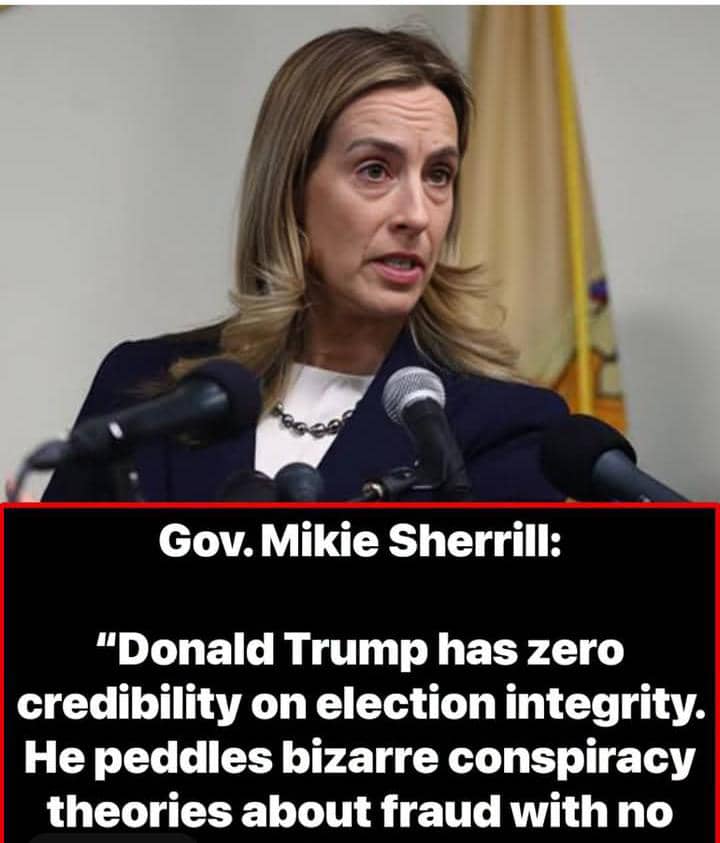
The latest dispute began after New Jersey officials revealed that thousands of people who were not U.S. citizens were mistakenly added to voter rolls because of a software problem involving the state’s motor vehicle system. Gov. Sherrill said about 6,600 non-citizens were incorrectly registered between 2023 and 2024, and fewer than 400 cast ballots.
Sherrill acknowledged the seriousness of the mistake and said her administration was taking steps to correct the problem. She also said the issue occurred before she took office and that officials were working to remove affected individuals from voter rolls.
The incident immediately became part of the larger national argument over election security. Trump and his supporters pointed to the New Jersey situation as evidence that concerns about voter rolls should receive more attention.
However, election experts and critics of Trump’s claims argued that the New Jersey case involved an administrative error rather than proof of a widespread coordinated effort to manipulate elections. Reports noted that the number of affected votes represented a tiny fraction of ballots cast in the state.
Sherrill did not deny that the error was a problem. Instead, she argued that acknowledging and fixing mistakes is different from using isolated failures to support broader claims of massive election fraud.
Trump’s election integrity message remains deeply controversial
Trump has repeatedly questioned the security of U.S. elections, particularly after his 2020 defeat. He has continued to argue that serious problems exist within the election system, although election officials and courts have rejected claims that widespread fraud changed the outcome of that race.
During a recent election security speech, Trump raised concerns about vulnerabilities in voting systems but did not provide evidence of widespread fraud occurring. Fact-checkers noted that many of his previous claims about the 2020 election have not been supported by evidence.
Trump’s supporters argue that even a small number of improper registrations or questionable ballots justify stronger rules. They have pushed for measures such as additional voter verification requirements and tighter controls on voter rolls.
Democrats, including Sherrill, argue that election security and election access must exist together. They say officials should correct genuine problems without creating fear through claims they believe exaggerate the scale of the issue.
Sherrill has previously criticized Trump’s approach to voting issues. In a statement about mail ballots, she argued that New Jersey’s voting system is secure and said attacks on election methods were politically motivated rather than focused on improving elections.
A familiar fight over trust, evidence and American elections

The disagreement between Sherrill and Trump reflects a larger national debate over what election integrity actually means.
For Trump and many Republicans, election integrity means stricter verification systems and stronger safeguards against possible illegal voting. They argue that public confidence depends on making sure every ballot is cast by an eligible voter.
For Sherrill and many Democrats, election integrity also depends on protecting voters from misinformation and ensuring that people trust accurate election results. They argue that unsupported claims can damage confidence in democratic institutions.
The New Jersey controversy has complicated the debate because it involves a real administrative failure, but officials disagree sharply over what that failure proves.
Sherrill has used the moment to argue that transparency and accountability are the proper response to election problems, not sweeping accusations. She has emphasized that mistakes can happen in any large government system and that fixing them is part of maintaining public confidence.
Trump’s allies, meanwhile, continue to argue that the episode shows why election systems require constant scrutiny.
As the country moves closer to future elections, the battle over election integrity is unlikely to disappear. The central question remains the same: how can Americans strengthen their voting systems while ensuring political disagreements do not replace facts?
For Sherrill, the answer is clear: investigate problems, correct mistakes and rely on evidence rather than claims that cannot be proven.