JD Vance Says Fraudsters Got Rich While American Moms and Babies Lost Access to Health Care

A fraudulent medical claim may look like another number buried in a government database. For a pregnant woman who needs prenatal support or a newborn requiring specialized care, however, stolen money can have a far more personal meaning.
Vice President JD Vance placed those families at the center of the Trump administration’s fraud crackdown during a July 31 Cabinet meeting at Camp David. He said people had enriched themselves through false companies and services while mothers and babies lost access to care.
“We’ve seen moms and babies unable to access the health care that they need because the fraudsters have gotten rich,” Vance said. “That is a disgrace.”
Vance says fraud creates two victims
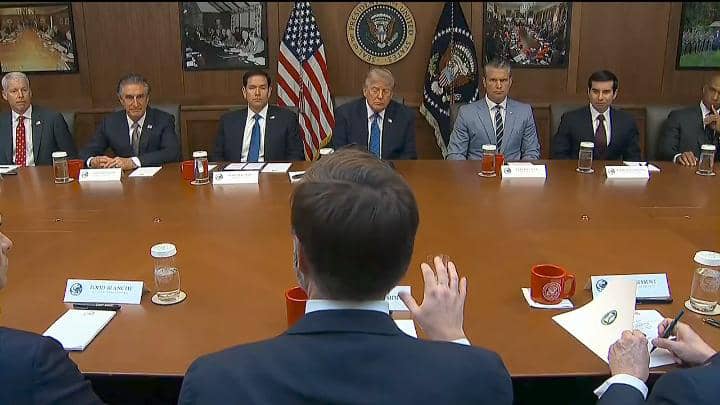
Vance said the administration’s Task Force to Eliminate Fraud had identified $230 billion in fraudulent payments and stopped $56 billion before the money left federal programs. The White House also announced 17 new enforcement actions involving more than $350 million in intended losses.
The vice president argued that government fraud creates two groups of victims. Taxpayers lose money, while qualified Americans risk losing the services that money should provide.
During his remarks, Vance described a Medicaid-administered program that helps low-income mothers and babies obtain neonatal care. He said people had created false companies, claimed to provide services and collected public money until the program ran short of funds.
“If we see a baby and we see a young mother that requires help, we help our fellow Americans,” Vance said, according to a transcript of the Cabinet meeting. “That’s a good thing; it’s something that we should be proud of.”
Vance did not identify the program during the meeting. He also did not specify how much money it lost, name the people accused of defrauding it or disclose how many families could not obtain care.
Those omissions matter because they limit how much of his statement can be independently confirmed. The official White House account supports the administration’s broader financial announcement, but it does not provide a complete breakdown of the maternal health program described by Vance.
A Wisconsin prosecution shows how fraud can reach the delivery room
A completed Wisconsin prosecution offers a documented example of how Medicaid fraud can reduce services intended for mothers and babies.
In March 2026, a federal judge sentenced Milwaukee business owner Markita Barnes to 121 months in prison for stealing $2,361,799 from a Medicaid program created to help at-risk pregnant women and mothers with young children.
Barnes owned Here for You Prenatal Care Coordination Services. According to the U.S. Attorney’s Office for the Eastern District of Wisconsin, a federal jury convicted her of health care fraud, making false statements, paying kickbacks, money laundering, obstruction and aggravated identity theft.
Prosecutors said Barnes paid women to register with her company and then used their Medicaid information to bill for services that her business had not delivered. The court ordered her to repay Medicaid and forfeit the same amount she stole.
Chief U.S. District Judge Pamela Pepper said widespread fraud surrounding the benefit had damaged public trust and affected its availability. According to the Justice Department’s account of her sentencing remarks, Wisconsin scaled back the program so extensively that it became largely unavailable to some women who genuinely needed it.
First Assistant U.S. Attorney Brad Schimel said Barnes “stole limited public resources that were intended for our neighbors most in need of public assistance.”
That consequence carries particular weight because Medicaid supports a substantial share of American maternity care. The Centers for Medicare & Medicaid Services reports that Medicaid finances approximately 41% of all births in the United States.
The program plays an even greater role in rural communities, where hospitals often face staffing shortages and maternity-unit closures. When someone bills Medicaid for care that never occurred, the theft does not automatically cancel a particular patient’s appointment. It can, however, weaken programs with limited resources and create pressure for tighter eligibility rules, reduced benefits and additional scrutiny of legitimate providers.
Big enforcement numbers still require clear definitions
The Justice Department’s latest enforcement campaign covers more than maternal health care. Federal officials announced 17 cases across Alabama, Florida, Georgia, Louisiana, Mississippi, North Carolina and South Carolina.
According to the Justice Department, the cases involve more than $350 million in intended losses connected to SNAP benefits, housing assistance, Small Business Administration loans and tax programs.
One prosecution involves an alleged Florida operation connected to nearly $20 million in fraudulent electronic food-benefit transactions. Another involves allegations that a tax preparer filed false claims for energy-related tax credits.
“Defeating the fraud epidemic in our country requires all-hands-on-deck,” Assistant Attorney General Colin McDonald said while announcing the federal-state enforcement effort.
The defendants in those newly announced cases remain presumed innocent unless the government proves its allegations in court. Intended loss also does not necessarily equal money that the government paid or permanently lost.
The $350 million connected to named Justice Department cases should not be treated as interchangeable with the $230 billion cited by Vance. The administration has not released a complete public accounting showing how much of the larger figure represents proven criminal fraud, suspected fraud, administrative waste or improper payments.
An improper payment is not automatically a crime. The Government Accountability Office explains that improper payments can include incorrect amounts, eligibility mistakes and insufficient documentation. Fraud requires intentional deception.
That difference is visible in Medicaid’s own figures. CMS estimated that Medicaid recorded $37.39 billion in improper payments during fiscal 2025. However, the agency said 77.17% resulted from insufficient documentation, which generally does not indicate fraud or abuse.
More transparency around the $230 billion figure would strengthen the administration’s case. Taxpayers deserve to know which programs lost money, how officials calculated the total, how much the government stopped and what portion authorities can recover.
The numbers may dominate the headlines, but they are not the final measure of success. The real test will come in waiting rooms, community clinics and maternity wards. If the crackdown works, public money will reach the pregnant woman seeking support and the baby whose first days depend on timely care, rather than the person who saw their vulnerability as a business opportunity.