Trump Says He Deserves ‘150%’ Approval on the Economy as Voters Put Cost of Living at Center of 2026 Midterms
There may be no economic indicator more powerful in an election year than a grocery receipt.
President Donald Trump can point to factories, artificial intelligence investments and construction projects. Economists can debate GDP growth to the decimal point. But millions of voters will make their own judgment while filling a gas tank, opening an electric bill or watching another paycheck disappear into everyday expenses. That is what makes Trump’s latest economic boast politically significant.
During a Friday interview with Punchbowl News, Trump said his approval rating on the economy should be “150%, not 100%,” before declaring, “This is the golden age of America.”
The remark was classic Trump hyperbole, but beneath it sits a serious challenge for Republicans heading toward the November 3 midterms. Trump is asking voters to judge the economy by what America is building. Many voters appear determined to judge it by what America costs.
Trump Sees a Building Boom. Voters See Their Bills

Trump’s case is not entirely disconnected from the economic numbers.
The Bureau of Economic Analysis reported that real final sales to private domestic purchasers, a measure combining consumer spending with private fixed investment, increased at a strong 3.9% annualized rate in the second quarter of 2026. Business investment was supported by spending on industrial equipment, transportation equipment, information-processing technology, software and research and development.
That gives the president something substantial to point toward when he talks about unprecedented investment. The complication comes when we widen the camera.
Overall real GDP grew at an annualized rate of just 1.5% in the second quarter, down from 2.1% in the first. Consumer spending increased, and investment contributed to growth, but government spending declined while investment and export growth slowed.
So America is not facing an economic collapse. But the numbers also paint a more restrained picture than the phrase “golden age” suggests.
The economy is expanding. Certain areas of investment are booming. Yet the benefits are not landing evenly enough to make the national mood feel like a victory celebration.
The Most Important Economic Number May Be $4.06

Trump’s biggest political problem may be displayed in giant illuminated numbers beside highways across America.
AAA reported Thursday that the national average for regular gasoline had fallen three cents to $4.06 a gallon. That is an improvement from some of the painful peaks seen earlier this year, but it remains a psychologically important threshold for consumers.
Gasoline has an unusual power over public perceptions of the economy because voters do not need economists to explain it. Drivers see the price every day.
Gasoline is only part of the affordability squeeze. The Consumer Price Index was 3.5% higher in June than a year earlier, according to the Bureau of Labor Statistics. Energy prices were up 15.7% over that period, while gasoline prices were 26.7% higher. Food prices increased 3%. That creates an awkward split-screen for the White House.
One screen shows cranes, factories, data centers and billions of dollars in investment. The other shows a parent watching the gas pump cross $60 before the tank is full. Both are part of the same economy. Only one follows voters home every evening.
July’s Jobs Report Complicates the ‘Golden Age’ Message
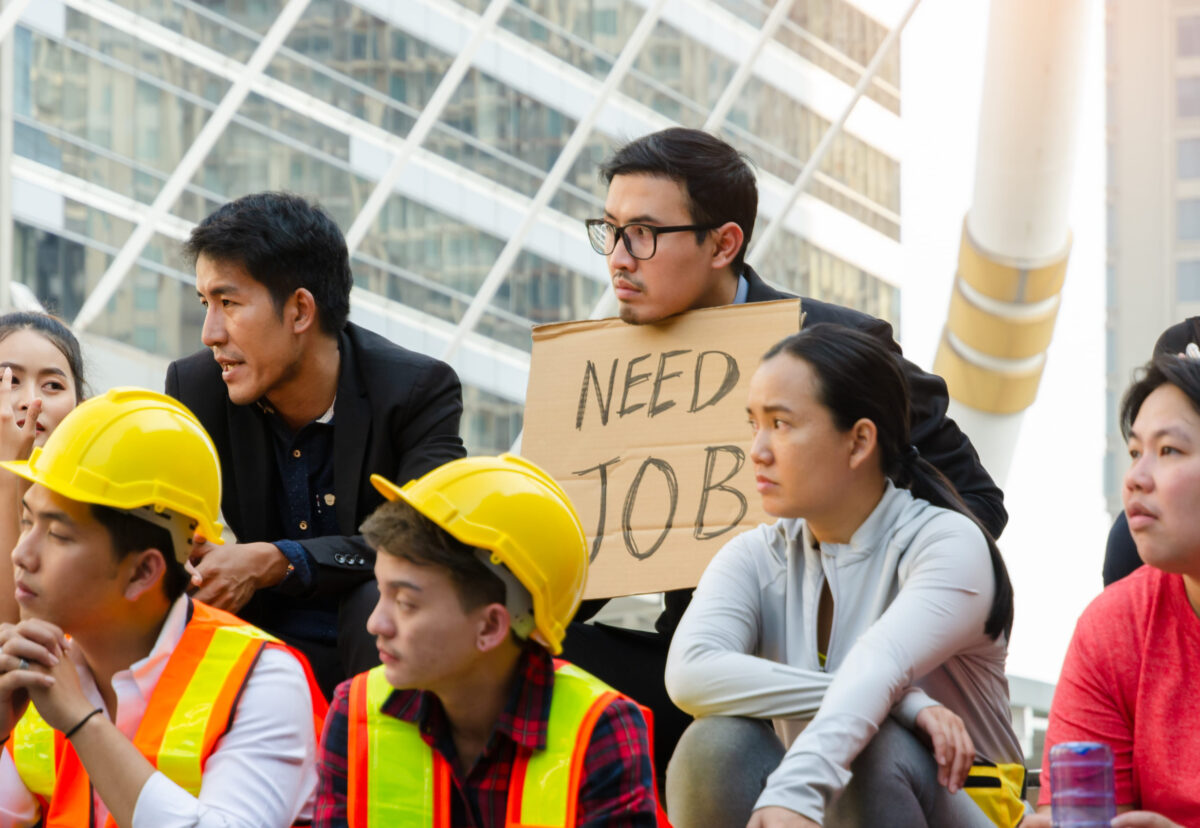
The latest employment report added another layer of uncertainty.
U.S. nonfarm payroll employment declined by 23,000 jobs in July, while unemployment held relatively steady at 4.1%, the Labor Department reported Friday. Retail trade lost 19,000 jobs, local government education lost 50,000, and financial activities continued trending downward. Health care remained a source of job growth.
Perhaps more troubling politically, the labor-force participation rate stood at 61.4%, down 0.7 percentage point since January. Again, this is not a picture of mass unemployment. A 4.1% jobless rate remains historically modest. But elections rarely turn on whether economic conditions meet the technical definition of a crisis. They turn on direction.
Is finding a better job becoming easier or harder? Is a paycheck stretching further or shrinking faster? Does the future feel more secure than it did six months ago?
Those questions may matter more in November than any ribbon-cutting ceremony.
A Remarkable Poll Shift Should Worry Republicans
The clearest warning for Trump may come from an issue Republicans have traditionally considered home turf.
A Reuters/Ipsos poll found that 37% of registered voters said Democrats had the better economic approach, compared with 36% who chose Republicans. Reuters reported that it was the first time in roughly a decade that Democrats had held an advantage on the economy in its polling. A one-point difference is hardly a landslide.
The significance is that Democrats do not necessarily need a landslide.
If Republicans lose their traditional advantage on economic competence and the contest becomes essentially even, the electoral map becomes more uncomfortable for GOP candidates trying to defend narrow congressional majorities.
It also suggests Trump’s problem is not simply persuading Americans that the economy is growing.
He must persuade them that growth is improving their lives.
The 2026 Midterms Could Become a Battle Over Two Different Economies

This may ultimately be the defining economic argument of the 2026 campaign.
Trump is describing the economy from the construction site outward. He sees investment, equipment purchases, technology expansion, and businesses putting money into future growth.
Voters often see the economy from the kitchen table inward. They see the gasoline charge. The insurance premium. The restaurant bill. The grocery total. The monthly payment that once felt manageable but now requires another small sacrifice somewhere else.
Neither perspective completely describes a $30 trillion-plus national economy. But only one perspective fills out a ballot.
Trump’s “150%” remark will attract attention because of its impossible mathematics. The more consequential statement may be his insistence that America has entered a golden age.
That gives voters a remarkably simple question to answer for themselves. If this is the golden age, does it feel golden from where they are sitting?
On November 3, Republicans may discover that the answer matters far more than the economic label.