9 Old-School Kitchen Tools From Grandma’s Drawer That Still Earn Their Space
Open an older kitchen drawer, and you may find tools that look surprisingly simple compared with today’s electric gadgets. There might be a hand-cranked egg beater, a sturdy potato masher, or a metal flour sifter that has been around longer than some of the appliances on the counter.
It is easy to assume these utensils survived only because someone was sentimental about them. In many cases, though, they remain genuinely useful.
Museum collections show that versions of these everyday tools have been working in American kitchens for generations. Some require no electricity, some are easier to clean than an appliance, and several do one specific job remarkably well.
Before clearing out that crowded utensil drawer, take another look at these nine old-school kitchen workhorses.
The Hand-Crank Egg Beater
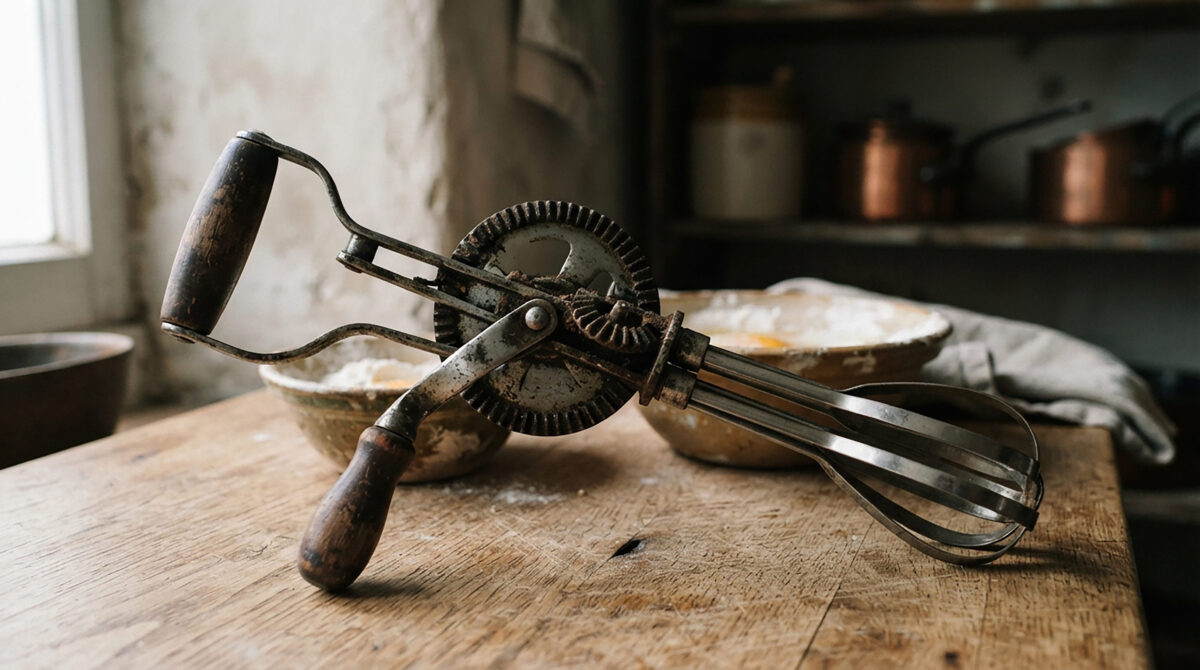
Long before electric hand mixers became commonplace, cooks whipped eggs, cream, and batters with a rotary egg beater.
The Smithsonian has a manual rotary egg beater made around 1903 with gears operated by a hand crank. Its design used a large drive wheel to turn the beaters below, showing how established the basic mechanism was more than a century ago.
The appeal is still easy to understand. A manual egg beater needs no outlet, takes up relatively little storage space, and gives the cook direct control over speed. It will not replace an electric mixer for every baking project, but for beating a few eggs or handling a small mixing job, the old crank design remains perfectly capable.
The Potato Masher
A potato masher may be one of the least complicated tools in the kitchen, and that simplicity is exactly why it keeps surviving.
The Smithsonian holds wooden potato mashers dating to the 19th century, including one from around 1850 and another dated to about 1824. Later designs shifted toward metal wires, grids, and more comfortable handles.
Unlike a food processor, a hand masher lets you decide exactly how smooth or rustic you want potatoes. No blades, electrical cords, or extra bowls to wash. It also works for other soft foods, depending on the recipe.
For a job that mostly requires controlled pressure, technology has not found much to improve.
The Flour Sifter
That cylindrical metal sifter with a crank or squeeze handle might seem like a relic from serious Sunday baking, but its history runs deep.
The Smithsonian documents a flour sifter connected with inventor Jacob M. Hunter, whose flour-sifter patent was issued in 1879. The museum’s example dates to around 1900. It also holds early-20th-century household flour sifters.
A sifter breaks up lumps and distributes dry ingredients through a fine screen. Whether a recipe requires sifting depends on the recipe, so you don’t need to sift every time flour appears on an ingredient list.
Still, when a baking recipe calls for sifted ingredients, the old-fashioned hand sifter handles the assignment without needing another appliance.
The Rolling Pin

Few tools have remained as recognizable as the rolling pin.
The Smithsonian has a wooden rolling pin from Maryland dated to the 18th or early 19th century, along with later American examples from the early 20th century.
Its usefulness has barely changed. Rolling pins spread and shape dough through direct pressure, giving the baker immediate feedback through the hands.
Styles include handled pins and simple dowel or tapered designs. King Arthur Baking notes that tapered French rolling pins can offer increased control as pressure is applied.
No motor is necessary. For pie crusts, cookies, biscuits, and other rolled doughs, this old kitchen standard remains hard to retire.
The Lemon Reamer
Before countertop citrus presses and electric juicers, a small ridged reamer could handle a lemon with little fuss.
The Smithsonian has a wooden lemon reamer dated roughly between 1780 and 1850, demonstrating just how old this straightforward kitchen idea is.
The design is simple. The pointed, ridged end presses into a cut citrus half and twists to release juice. That makes the reamer especially practical when a recipe needs only a lemon or lime, not an entire pitcher of juice.
It is small, easy to store, and has virtually nothing mechanical to fail. Sometimes a specialized hand tool is still the fastest option.
Related article: kitchen-items-to-declutter-today-before-they-take-over-your-home/
The Pastry Blender
A pastry blender looks almost too basic to deserve drawer space. For bakers, however, those curved metal wires or blades serve a specific purpose.
King Arthur Baking explains that a pastry blender helps cut cold fat into flour while limiting direct contact with warm hands. Keeping ingredients cold is important when making flaky pie dough.
That’s why this tool still makes sense even in a kitchen with a food processor.
A pastry blender offers direct control over the mixture, requires no electricity, and lets you avoid pulling out a larger machine for one step of a recipe. If biscuits, scones, or pie crust regularly appear in your kitchen, Grandma’s pastry blender may still deserve its spot.
The Bench Scraper
It is little more than a broad, flat blade with a handle, but a bench scraper can quietly become one of the busiest tools in a kitchen.
King Arthur Baking recommends bench knives for dividing bread dough, portioning rolls, cutting baked goods, and scraping dried flour or dough from a work surface.
That versatility is the reason the tool still feels current. It can gather chopped ingredients from a cutting board, help portion dough, and clean up a flour-covered counter without adding another electric gadget to the kitchen.
Few utensils earn storage space by doing so many small jobs well.
The Metal Grater
The humble kitchen grater has been around in various forms for centuries.
The Smithsonian’s collections include an American iron-and-wood potato grater dated between 1800 and 1875, as well as a tin-plated iron grater from about 1890 to 1910. Graters also appear among the utensils preserved from Julia Child’s kitchen.
Modern graters may use stainless steel and more comfortable handles, but the basic principle is unchanged.
For cheese, vegetables, citrus zest, or other suitable ingredients, a hand grater is quick to grab and easy to use. It also gives the cook more control over the amount being prepared than a larger food-processing appliance may offer.
The Manual Can Opener
The manual can opener is another tool that survived the arrival of an electric replacement.
The Smithsonian holds numerous early can openers, including an American example from around 1890 and a patent model associated with an 1887 patent. The museum also notes that electric can openers became a symbol of modern kitchen convenience by the late 1950s.
Yet the hand-operated version never disappeared.
A manual opener is compact, requires no electricity, and can remain useful during a power outage. The cutting mechanism should, of course, be kept clean and replaced if it’s damaged or no longer working properly.
Grandma’s Drawer May Have Been Onto Something
Not every vintage kitchen gadget deserves permanent storage. Some were awkward even when new, and damaged utensils shouldn’t be kept simply because they are old.
But the best old-school tools share a common advantage: they solve straightforward problems with remarkably little complication.
A rolling pin rolls. A masher mashes. A sifter sifts. A bench scraper cuts, gathers, and cleans. None needs software, charging cables, or a cabinet full of attachments.
That is why so many of these tools have survived generation after generation. Grandma may not have called it minimalist kitchen design, but she knew a useful tool when she saw one.
Other articles you may like:
– the-fall-2026-kitchen-changes-that-can-make-your-home-feel-warmer-without-a-full-remodel/
– 9-kitchen-trends-making-homes-feel-more-personal-and-less-showroom-perfect/
– kitchen-color-schemes-that-never-go-out-of-style/