9 Candy Bars From the ’70s People Still Talk About
Some candy bars are remembered for their flavor. Others earned a place in candy history because of their unusual shapes, clever names, or packaging that was almost as interesting as the candy inside.
The 1970s offered a little of everything. There was an eight-inch caramel bar with a ruler on its wrapper, a baseball-themed candy named after a Yankees superstar, and a chocolate treat with a name that sounded like someone couldn’t think of anything better.
Not every candy on this list was invented during the decade. Some were already established favorites, while others were newcomers. A few disappeared, several changed recipes, and others are still around today.
Here are nine candy bars that help tell the story of America’s 1970s candy scene.
Marathon
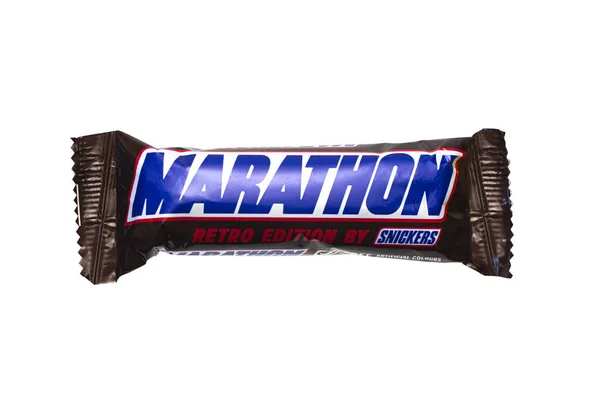
Marathon wasn’t interested in looking like an ordinary candy bar. Introduced by Mars in 1973, it featured a long braid of caramel covered in chocolate, measuring approximately eight inches.
Even the wrapper got involved in the presentation. Ruler markings emphasized the candy’s length, making its size part of the attraction.
Unfortunately, Marathon didn’t last nearly as long as its appearance suggested. Mars discontinued the American version in 1981, although the exact reason remains unclear.
And despite the shared name, this Marathon was unrelated to the British Marathon, the former U.K. name for Snickers.
Reggie!
How do you make a candy bar stand out? Name it after a baseball superstar, put his face on the wrapper, and give it a shape that isn’t even a bar.
Introduced in 1978 by Curtiss Candy Company, Reggie! celebrated New York Yankees star Reggie Jackson. The candy was a round patty containing peanuts and caramel, covered in chocolate.
Its most memorable moment came on April 13, 1978, when fans received the candy at Yankee Stadium. As the Society for American Baseball Research recounts, after Jackson hit a first-inning home run, fans threw bars onto the field.
The original Reggie! was pulled from the market in 1981, but its unusual baseball connection remains a fascinating piece of candy history.
Whatchamacallit
Some candy names tell you exactly what you’re buying. Whatchamacallit takes the opposite approach.
Hershey introduced this memorably named bar in 1978. The original version featured peanut butter crisp covered with a thin layer of chocolate.
Here’s something that might surprise anyone familiar with the modern candy: the original didn’t contain caramel.
According to Hershey’s official Whatchamacallit history, that ingredient arrived with a 1987 recipe change, when Hershey introduced a combination of caramel, peanut-flavored crisp, and chocolatey coating.
Whatchamacallit remains part of Hershey’s lineup today. The name survived, but the candy inside isn’t quite the same as the one introduced in the late ’70s.
Related: 10 Things Baby Boomers Remember That Younger Generations Will Never Experience
4$100,000 Bar, Now Known as 100 Grand
Before there was 100 Grand, there was the $100,000 Bar. That’s right, the candy once advertised its imaginary fortune with a dollar sign and a whole lot of zeros.
The bar combined chocolate, caramel, and crisped rice, creating a contrast between chewy filling and crunchy pieces.
It actually originated in the 1960s, although historical accounts disagree on the exact year, placing its introduction somewhere between 1964 and 1966.
During the 1970s, shoppers knew it as the $100,000 Bar.
The modern 100 Grand name is shorter, but there’s something wonderfully extravagant about a candy wrapper that spells out the entire amount.
Hershey’s Special Dark
Not every memorable candy from the 1970s needed a celebrity endorsement, an unusual shape, or a name that demanded attention.
Sometimes, the change was simply in the chocolate. According to Hershey Community Archives, the company discontinued its Semi-Sweet Bar on October 18, 1971, replacing it with Special Dark sweet chocolate.
This wasn’t Hershey’s first experience with darker chocolate. Rather, it marked a specific change in the company’s candy lineup.
While other manufacturers experimented with attention-grabbing presentations, Special Dark offered something more straightforward: a distinct chocolate option under a familiar brand name.
Kit Kat
Few candy designs are as immediately recognizable as Kit Kat’s four chocolate-covered wafer fingers. Instead of one solid piece, the standard bar separates into individual sections, with crisp wafer layers hiding beneath the chocolate coating.
Kit Kat wasn’t invented in the 1970s, but the decade represents an important chapter in its American history. In 1970, Hershey established a U.S. licensing agreement with Rowntree’s, Kit Kat’s original manufacturer. Hershey continues to license the candy’s manufacture and distribution in America.
One familiar piece of Kit Kat history came later: the famous American “Gimme a Break” advertising jingle dates to 1986, not the 1970s.
Twix
Twix brought something different to the chocolate-bar lineup: a cookie base topped with caramel and wrapped in chocolate.
That combination gave it a distinctive construction compared with conventional solid chocolate bars or candies built around nuts and crisped rice.
Although Twix originated in Britain in 1967, it reached American candy aisles during the late 1970s. The exact American introduction date is disputed. Some historical accounts point to 1979, while another distinguishes an initial 1976 introduction from a return in 1979.
Either way, Twix belongs among the decade’s later arrivals rather than the candies that had been present throughout the entire 1970s.
Related: Things Baby Boomers Should Never Feel Sorry About
Sky Bar
Why settle for one filling when a chocolate bar can offer four? That was the unusual appeal of Sky Bar, introduced by Necco in 1938. The candy divided one chocolate bar into four separately filled sections.
Today’s version features caramel, vanilla, peanut, and fudge fillings, although those shouldn’t automatically be assumed to represent every historical recipe.
Sky Bar was already an established candy by the 1970s, particularly associated with New England. Its story nearly ended decades later when Necco closed in 2018, stopping production.
Louise Mawhinney subsequently acquired the brand and recipe, and production resumed in November 2019. Sky Bar continues to be produced in Sudbury, Massachusetts.
Chunky
Chunky certainly lived up to its name. Instead of the familiar long rectangle, this candy came in a thick, truncated-pyramid shape, scored into four sections.
Introduced by New York candy maker Philip Silvershein in the late 1930s, Chunky originally combined milk chocolate, raisins, cashews, and Brazil nuts. That original combination is especially important when discussing the candy as it existed during the 1970s.
In 1984, Nestlé assumed rights to the brand and changed the recipe to milk chocolate, raisins, and peanuts. That later combination remains associated with the present-day version.
Chunky’s appearance has always been a major part of its identity. Even alongside more conventionally shaped chocolate bars, it looks unmistakably different.
The candy bars of the 1970s weren’t all created equal, and that’s part of what makes looking back at them interesting.
Marathon had its ruler, Reggie! had its baseball connection, and Sky Bar squeezed four fillings into one unusual design. Others survived through new names, different recipes, or familiar shapes.
Some vanished, while others continued changing with the times. Either way, a distinctive wrapper or oddly shaped piece of chocolate can be surprisingly hard to forget.