Abdul El-Sayed Defeats Haley Stevens in Michigan Senate Primary, Setting Up High-Stakes November Battle
Abdul El-Sayed has captured Michigan’s Democratic nomination for the U.S. Senate, narrowly defeating Rep. Haley Stevens in a fiercely contested primary that exposed deep divisions over money, ideology and the party’s path back to power. The Associated Press projected El-Sayed as the winner Wednesday morning after Stevens called him to concede. The latest results showed El-Sayed with roughly 741,000 votes, compared with about 726,000 for Stevens, a margin of fewer than 15,000 votes from more than 1.5 million ballots cast. Former state Sen. Mallory McMorrow, who ended her campaign before Election Day, still collected more than 61,000 votes.
El-Sayed, a physician and former Detroit health director, now advances to the November general election against Republican Mike Rogers. The race will determine who replaces retiring Democratic Sen. Gary Peters and could help decide which party controls the Senate.
A Progressive Victory Against the Party Establishment
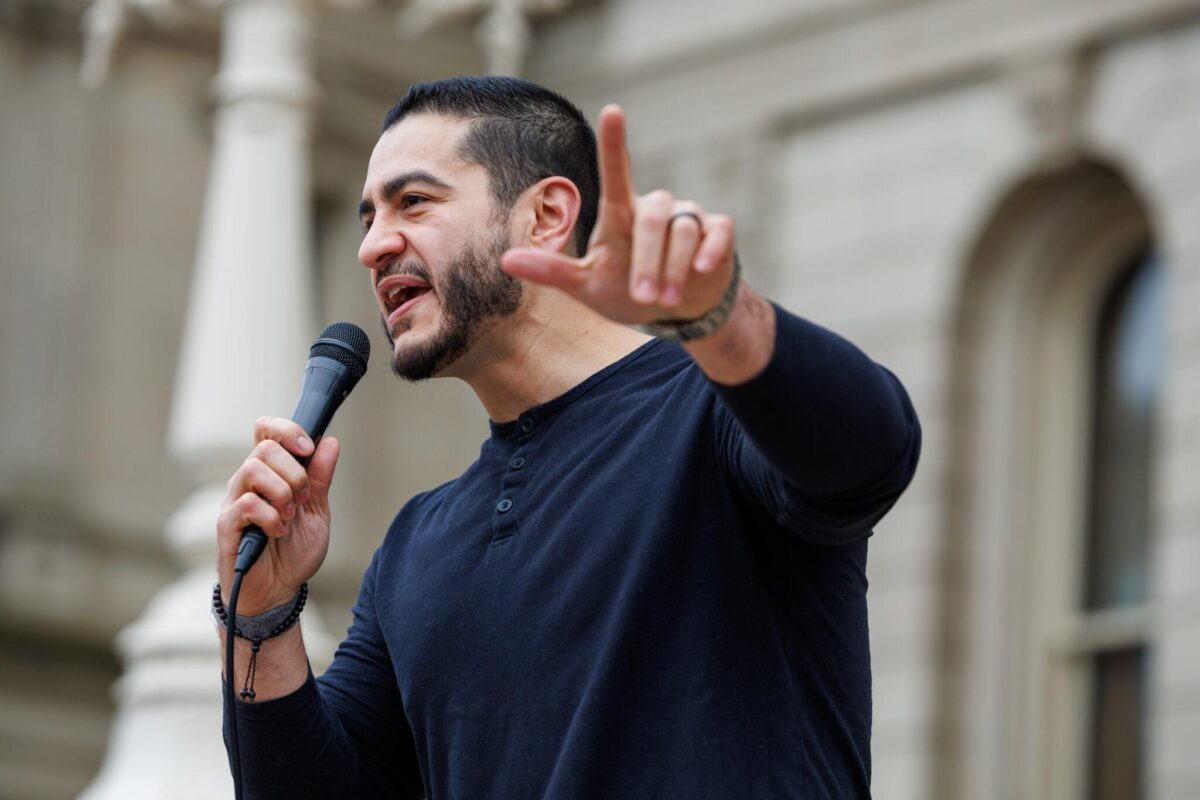
El-Sayed’s win represents a significant victory for the Democratic Party’s progressive wing. He entered the contest promoting Medicare for All, stronger restrictions on corporate influence, higher taxes on extreme wealth and a foreign policy less closely tied to traditional Washington thinking.
Stevens offered voters a different model. The sitting congresswoman leaned heavily on her experience in government, her work connected to the Obama administration’s auto industry rescue and her relationships with Michigan’s manufacturing sector. She also received support from powerful Democratic figures, including Senate Minority Leader Chuck Schumer and Michigan Gov. Gretchen Whitmer. El-Sayed, by contrast, drew backing from progressive leaders such as Sen. Bernie Sanders and Rep. Alexandria Ocasio-Cortez.
The result showed that endorsements from established party leaders were not enough to overcome El-Sayed’s energetic campaign. He held hundreds of events, traveled throughout the state and presented himself as a candidate powered by ordinary voters rather than wealthy donors or national political organizations. His campaign said volunteers knocked on more than 200,000 doors and made approximately 1 million phone calls. It also said El-Sayed attended more than 500 campaign events and visited 150 churches while building support across Michigan. Those figures came from the campaign and have not been independently audited.
Money Became the Race’s Defining Argument
Few issues shaped the primary more than campaign spending. El-Sayed repeatedly accused outside groups and major donors of attempting to overwhelm his campaign with advertising. His team said nearly $70 million in outside spending entered the race against him, describing the contest as the most expensive Senate primary in American history.
Independent reporting found that tens of millions of dollars flowed into the race through groups supporting Stevens or opposing El-Sayed. Organizations linked to the American Israel Public Affairs Committee were among the major outside forces involved. Rather than avoiding the financial imbalance, El-Sayed turned it into the emotional center of his campaign. He argued that the race was not simply about progressive and moderate policies. It was a test of whether grass-roots organizing could survive an avalanche of political advertising.
After his victory, El-Sayed declared that “the power of our many is greater than the power of their money.” That message appeared to resonate with voters frustrated by rising housing costs, grocery bills and medical expenses. El-Sayed framed those daily pressures as consequences of a political system that gives corporations, billionaires and special-interest groups too much influence. His campaign manager, Alia Kapasi, described the contest as “the many versus the money,” saying Michigan voters had embraced a platform focused on reducing political corruption, improving household finances and expanding health coverage.
Stevens Moves Quickly to Unite Democrats
Despite the bitterness of the campaign, Stevens did not challenge the result or prolong the battle. She congratulated El-Sayed and promised to support him against Rogers. “I spoke with Abdul a few moments ago to offer him my full support,” Stevens said in her concession statement.
She praised El-Sayed as a doctor, Rhodes Scholar, community health official and committed Michigander. Stevens also warned that a divided Democratic Party would make it easier for Republicans to capture the open Senate seat. Her response gave El-Sayed an important opportunity to begin repairing relationships with moderate Democrats, union households, Black voters and suburban communities that supported her during the primary. McMorrow also endorsed El-Sayed after the results became clear, urging Democrats to enter the general election as a unified party.
El-Sayed echoed that appeal. During his election-night remarks, delivered while the race was still too close to call, he told supporters that the party would need to begin mending fences immediately. “There is so much more that unites us than divides us,” he said. The statement reflected the difficult political balance now facing him. El-Sayed cannot abandon the progressive voters and volunteers who powered his primary victory. However, he must also persuade Stevens supporters and political independents that his agenda can work in a state that has repeatedly swung between Republicans and Democrats.
Mike Rogers Prepares for a Different Campaign
The general election will present El-Sayed with a completely different challenge. Rogers, a former congressman and former chairman of the House Intelligence Committee, faced no opposition in the Republican primary. He previously ran for the Senate in 2024 but narrowly lost to Democrat Elissa Slotkin.
Republicans are expected to portray El-Sayed as too far left for Michigan, focusing on his support for Medicare for All, his criticism of U.S. military assistance to Israel and his calls for major changes to the immigration system. El-Sayed is likely to respond by emphasizing health care, affordability, corporate power and Rogers’ long record in Washington. Shortly after winning the primary, he challenged Rogers to participate in five debates across Michigan, signaling that he intends to make the general election a direct comparison between their records and priorities.
The state’s recent election history ensures that neither candidate can take victory for granted. Donald Trump carried Michigan in 2016 and 2024, while Joe Biden won it in 2020. Both of Michigan’s current senators are Democrats, but the state’s close margins make the open seat one of the most competitive contests on the 2026 map. Should El-Sayed defeat Rogers, he could become the first Muslim elected to the U.S. Senate.
For now, his primary victory has already delivered a powerful political message. A candidate who was outspent, challenged by influential Democratic leaders and targeted by an enormous advertising campaign survived. The celebration, however, will be brief. El-Sayed has won the Democratic argument. He must now convince Michigan’s broader electorate that his movement can govern.