America’s 250th Independence Day Celebrations Erupt in Tension as White Nationalists’ March Near Washington, D.C. Draws Nationwide Attention
America’s 250th Independence Day was meant to be a grand national birthday party: flags, fireworks, speeches, music, and the kind of patriotic spectacle Washington knows how to stage when the country wants to look powerful, united, and proud. But as crowds gathered for July 4 festivities, another image cut through the celebration: hundreds of masked men marching in formation through the nation’s capital.
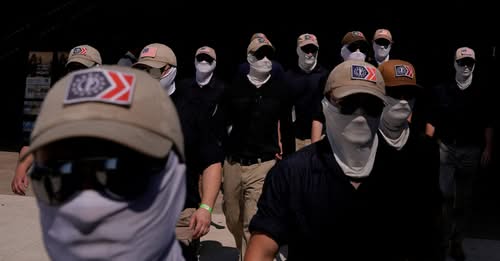
The group, identified as Patriot Front, moved through parts of Washington, D.C., wearing coordinated clothing, white face coverings, and sunglasses. Some carried Confederate flags and altered American flags, while others marched behind banners and chanted slogans including “Reclaim America.” The timing was impossible to ignore. On the very day the United States marked 250 years since its independence, a white nationalist march turned a patriotic celebration into a national flashpoint.
A Celebration Meets a Disturbing Counter-Image
The federal celebration had been promoted as one of the biggest patriotic displays in modern American history, with programming on the National Mall, official ceremonies, musical performances, and fireworks planned for the milestone anniversary. The event was wrapped in red, white, and blue, the language of unity, memory, sacrifice, and national pride.
But the march created a sharply different scene. Instead of families lining up only for fireworks and concerts, Washington also saw a masked extremist group moving through public spaces near major landmarks, including areas around Union Station and Capitol Hill. Their presence was quickly captured in photos and videos that spread online, drawing alarm from residents, visitors, and political observers.
Police monitored the march, and no arrests or major incidents were reported in the immediate accounts. Local authorities also acknowledged the group’s First Amendment rights while emphasizing public safety. That legal reality, however, did little to soften the shock of the images. For many Americans, the sight of masked white nationalists marching through the capital during the country’s 250th birthday was not just a protest. It was a symbol.
It turned the day into a split-screen moment: one America celebrating freedom, another America arguing over who that freedom has historically included, and who some groups still want to exclude.
Who Is Patriot Front?
Patriot Front is widely described by extremism researchers and civil rights organizations as a white nationalist and white supremacist organization. The group formed after the 2017 “Unite the Right” rally in Charlottesville, Virginia, breaking away from Vanguard America, a neo-Nazi organization connected to that violent gathering.
The group has become known for highly staged public appearances. Members often wear matching uniforms, conceal their faces, carry flags, and use patriotic imagery to package extremist ideas in a cleaner, more disciplined visual style. According to the Anti-Defamation League, Patriot Front has been one of the most visible white supremacist groups in the United States, partly because of its use of coordinated flash demonstrations.
That is what made the Washington march so striking. It was not random. It appeared designed for cameras, social media, and shock value. The masks, the flags, the chants, the route, and the timing all seemed built to force attention during a national celebration.
The group’s message has long centered on a narrow and exclusionary view of American identity. Extremism monitors say white nationalist groups often promote the idea of a white ethnostate and frame demographic or social change as a threat. That ideology sits in direct conflict with the broader civic promise often celebrated on Independence Day, that the country belongs to its people, not one race, one religion, or one political tribe.
Why the March Hit Such a Nerve
The march drew attention not only because of who participated, but because of when it happened. The 250th anniversary of American independence was always going to carry emotional weight. Anniversaries like this are not just parties; they are mirrors. They force a country to ask what it has become, what it has survived, and what it still refuses to confront.
That is why the images felt so heavy. A day built around liberty was interrupted by a group associated with exclusion. A celebration of democracy took place as masked men marched with symbols tied to division and racial intimidation. A national birthday became another reminder that America’s oldest conflicts are not buried safely in history books. They still walk into public view.
For some observers, the march was also a warning about how extremist groups use national symbols. Patriot Front does not always present itself with the crude visual language of older hate movements. Instead, it often wraps its message in flags, slogans, and historic references. That strategy can make extremism appear more polished, more organized, and more palatable to people who might otherwise reject it outright.
But the symbols carried during the march told their own story. Confederate flags appearing during a celebration of American independence sharpened the contradiction. The Confederate cause was built around secession and the defense of slavery, while July 4 is supposed to celebrate the founding ideals of liberty and self-government. Placing those symbols side by side was bound to provoke anger.
The moment also landed in a country already politically exhausted. America’s 250th celebration came amid fierce debates over nationalism, immigration, race, political violence, and the meaning of patriotism itself. In that environment, the march did not feel like an isolated stunt. It felt like a flare shot into an already smoky sky.
A National Birthday With an Uncomfortable Lesson
There is no evidence from early reports that the march stopped the official celebration or led to mass arrests. Fireworks still went up. Crowds still gathered. Speeches were still delivered. Families still came to mark a historic anniversary. But the march changed the day’s tone because it exposed the tension beneath the celebration.
America often tells its story as a march toward freedom. But the truth has always been more complicated. The same country that wrote soaring words about liberty also tolerated slavery. The same country that celebrates democracy has repeatedly fought over who deserves its full protection. The same flag that inspires pride in millions can also be used by groups trying to narrow the meaning of belonging.
That is why the July 4 march mattered. It was not the largest event of the day, but it became one of the most discussed. It forced a simple question into the middle of a national party: What kind of country is America celebrating after 250 years?
For many, the answer is still worth defending. The United States remains a country where people can gather, speak, protest, celebrate, and challenge power. But the same freedom that protects peaceful expression also creates moments when hateful ideologies can step into public view. That is the uncomfortable balance of a free society.
The march near Washington, D.C., did not define America’s 250th birthday by itself. But it did complicate it. It reminded the country that patriotism is not just about waving flags when the fireworks begin. Sometimes it is about confronting what marches beneath those flags, and deciding, again and again, what America is supposed to stand for.