Bernie Sanders Warns of “Oligarchy” as Elon Musk Prepares New Political Spending Push
Bernie Sanders says the fight over America’s future is no longer just about elections. It is about who has the power to shape them.
Sen. Bernie Sanders is sounding the alarm over the growing influence of billionaires in American politics after Elon Musk’s massive political spending during Donald Trump’s 2024 presidential campaign and his reported plans to spend more than $100 million to help Republicans hold onto power in Congress.
The Vermont senator argues that wealthy individuals’ ability to pour enormous sums into elections threatens the balance of American democracy. Sanders has repeatedly criticized what he calls the rise of an “oligarchy,” warning that a small group of billionaires could gain outsized influence over government decisions.
Musk’s supporters argue that he is exercising his right to participate in politics and support candidates who share his views. Critics, including Sanders, say the scale of that spending raises deeper questions about whether ordinary voters can compete with billionaire-level political influence.
Musk’s political spending becomes a major election issue
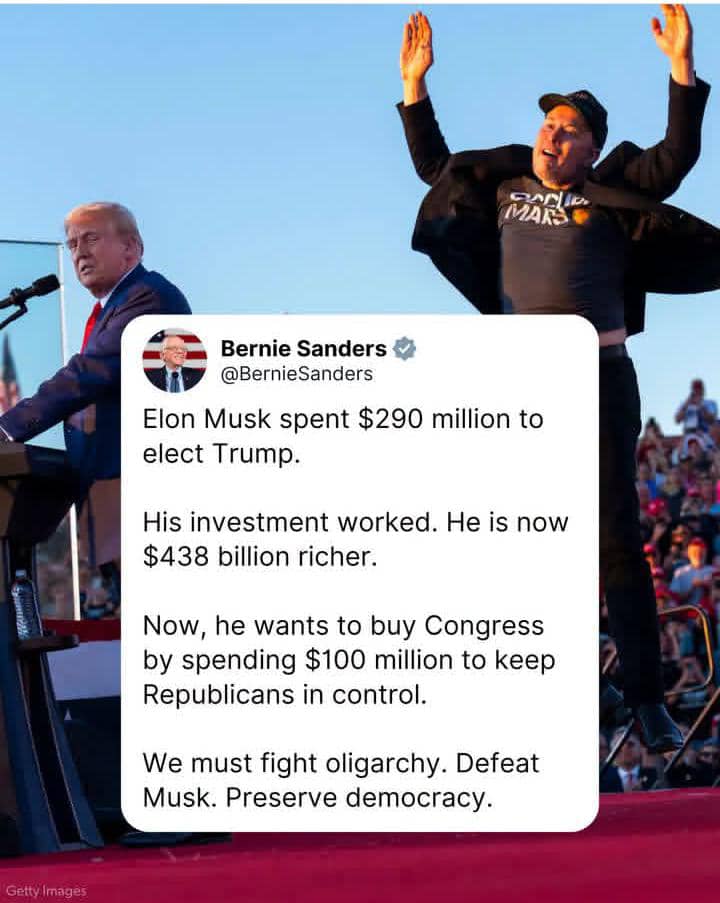
Elon Musk emerged as one of the biggest individual political donors during the 2024 election cycle. Through America PAC, the political action committee he helped create, Musk spent hundreds of millions of dollars supporting efforts connected to Trump’s campaign. Sanders cited a figure of at least $290 million spent by Musk to help elect Trump.
That spending placed Musk at the center of a larger debate over campaign finance and the role of wealthy donors in elections.
Now, as the 2026 midterm elections approach, Musk’s political operation is once again drawing attention. Reports indicate that America PAC is preparing a major effort of roughly $100 million or more to boost Republican voter turnout and help the party maintain control of Congress.
The planned spending reportedly focuses on voter outreach efforts, including digital advertising, direct mail, and grassroots organizing in competitive races.
For Sanders, the issue goes beyond one billionaire or one election cycle.
In a statement announcing legislation aimed at limiting super PAC influence, Sanders said: “In the 2024 elections, Elon Musk, the richest man in the world, spent at least $290 million to elect Trump.” He argued that the growing influence of billionaires represents a threat to democratic decision-making.
Sanders says democracy cannot be controlled by billionaires
Sanders has made the fight against concentrated wealth a central theme of his political message for years.
He argues that America risks moving toward a system where wealthy individuals have more influence over government than millions of ordinary voters. In previous remarks, Sanders warned about what he described as “a government of the billionaires, by the billionaires and for the billionaires.”
His criticism is not limited to Musk. Sanders has also targeted the broader role of super PACs, wealthy donors, and corporate political spending.
In 2026, Sanders and Rep. Summer Lee introduced the Abolish Super PACs Act, legislation designed to restrict the role of large donors in elections. Sanders said the goal was to “put power back into the hands of the people.”
The debate touches on a long-running argument in American politics: whether large political donations represent free speech or whether they allow wealthy individuals to have too much control over elections.
Supporters of campaign spending rights argue that individuals and organizations should be allowed to advocate for political ideas. Opponents argue that massive financial advantages can drown out smaller voices.
A battle over money, power, and the future of Congress
Musk’s renewed political involvement comes as both parties prepare for a competitive midterm election season.
Republicans see outside spending as a valuable tool to organize voters and protect their congressional majority. Musk’s allies say his political spending reflects his personal beliefs and his desire to influence policies involving issues such as government efficiency, technology, and regulation.
Democrats and progressive lawmakers see something different. They argue that billionaires should not be able to dramatically reshape elections through personal wealth.
Sanders framed the moment as a larger struggle over the direction of the country.
“We must fight oligarchy, defeat Trump, defend democracy,” Sanders has argued as he calls for limits on billionaire influence in politics.
The clash between Musk and Sanders represents two opposing views of political power. One side sees wealthy individuals using their resources to participate in the democratic process. The other sees a warning sign that money is becoming too powerful in deciding who wins elections.
As the 2026 elections move closer, the debate over campaign spending is likely to become one of the biggest political battles in America. At the center of it is a simple question: how much influence should the richest Americans have over the country’s political future?