Bishop Warns Christianity Is Being Pushed Out of Europe as Migration Debate Erupts
A Catholic bishop’s blunt warning about Europe’s religious future has returned to the spotlight, stirring a fierce argument over immigration, Islam, national identity and the meaning of Christian compassion.
Bishop Athanasius Schneider, the auxiliary bishop of Astana in Kazakhstan, has repeatedly claimed that influential political forces are using large-scale migration to weaken Europe’s Christian character. His critics say the allegation lacks evidence and unfairly portrays millions of migrants as participants in a coordinated religious campaign.
The disagreement is bigger than one viral video. It touches a question Europe has struggled with for years: Is Christianity being deliberately pushed aside, or is the continent becoming less Christian because Europeans themselves are steadily walking away from organized religion?
Bishop Schneider Says Europe Is Facing an Organized Cultural Shift
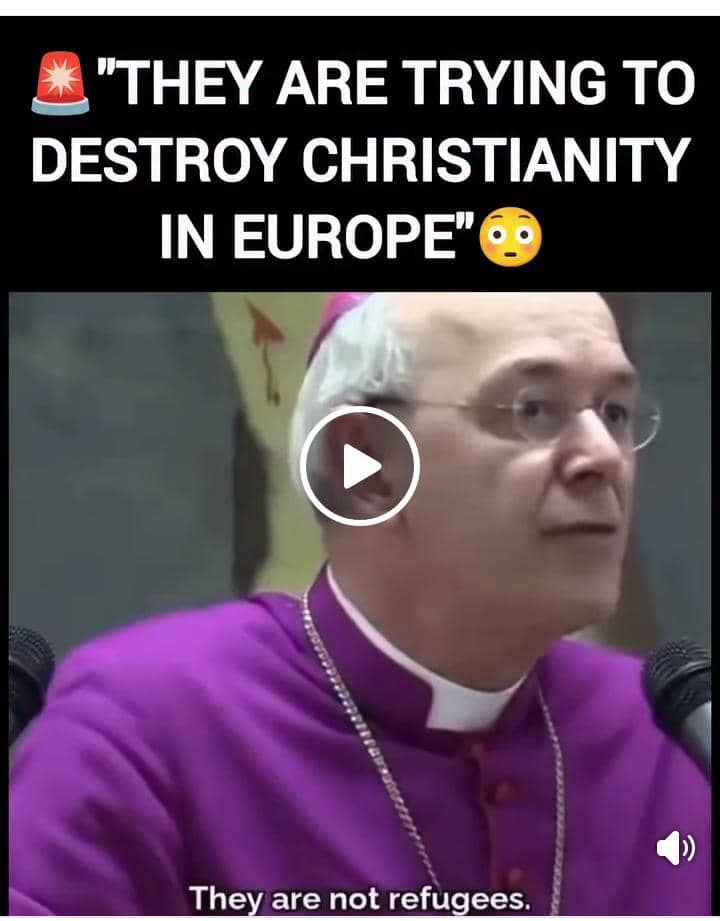
In a widely shared clip posted by RealClearPolitics on June 1, 2025, Schneider described Muslim migration into Europe as an “invasion” and argued that the process was intended “to destroy Christianity in Europe.” He also predicted that Europe could eventually develop a Muslim majority because of differences in birth rates.
Schneider did not leave his argument behind when the clip stopped trending. During a January 26, 2026, appearance on the Pints With Aquinas podcast, he accused “powerful political elites” and the European Union of encouraging Muslim immigration as part of an effort to de-Christianize the continent.
He pointed to halal food in schools, public Ramadan celebrations and the appointment of Muslim military chaplains as evidence of what he called a “systematic Islamization.” However, he also said individual migrants were not personally responsible, describing many of them as ordinary people seeking safer or more prosperous lives.
In an April 2026 interview reported by the Catholic Herald, Schneider went further. He called migration an “instrument for subverting Europe” and alleged that it was part of an organized political campaign to suppress Western and Christian identity.
His proposed response was not a total ban on Muslims. Schneider said European governments could accept migrants in limited numbers while expecting newcomers to respect local laws and integrate into the surrounding culture. He also argued that wealthy countries should invest more in poorer nations so fewer people feel forced to leave their homes.
Still, the central accusation remains extremely serious. In the interviews reviewed, Schneider did not produce a government document, named directive, or other verifiable evidence proving that European leaders have created a coordinated plan to destroy Christianity. His argument rests largely on his interpretation of migration policies and visible cultural changes.
WHO Chief Says the “Invasion” Language Crosses a Dangerous Line
The debate exploded again in July 2026 when World Health Organization Director-General Tedros Adhanom Ghebreyesus publicly responded to the bishop’s remarks.
Writing on his personal X account, Tedros said he read the comments “with a heavy heart.” He warned that calling human beings invaders strips them of their names, faces, and personal stories.
Tedros argued that the people reaching Europe include both Christians and Muslims fleeing war, hunger, persecution, and economic desperation. He rejected the idea that migrant families should be treated as foot soldiers in a hidden campaign against European civilization.
“The people arriving on Europe’s shores are not an army,” he wrote, insisting that migration should be discussed through evidence rather than fear.
Importantly, Tedros did not argue that borders should disappear. He acknowledged that governments must manage immigration honestly and respond to pressure on housing, schools, jobs, and public services. His objection was to the leap from debating immigration policy to describing migrants collectively as religious invaders.
Tedros also challenged Schneider on Christian grounds. He said Europe’s Christian inheritance would be protected not by fearing strangers, but by practicing the Gospel’s call to welcome and care for vulnerable people.
“Compassion is not weakness, and fear is not faith,” Tedros concluded.
That response captures the uncomfortable heart of the dispute. Schneider sees mass migration as a threat to Christian civilization. Tedros sees the treatment of frightened and displaced people as a test of whether that civilization still practices what it preaches.
Europe’s Christian Decline Is Real, but the Numbers Tell a Complicated Story

There is no serious doubt that Christianity’s position in Europe has weakened. Churches have closed, congregations have aged, and Christian affiliation has fallen across several major countries.
Pew Research Center estimated that Europe’s Christian population fell to about 505 million between 2010 and 2020, a decline of roughly nine percent. Europe was also overtaken by sub-Saharan Africa as the region containing the world’s largest Christian population.
But Pew’s findings do not support the simple claim that Muslim immigration is the main reason Christianity is shrinking. The research identified religious disaffiliation, especially people raised as Christians who later stopped identifying with any religion, as a major driver of the decline.
The United Kingdom, France, and the Netherlands are among the places where Christianity has lost majority status or where the religiously unaffiliated have become dominant. In those countries, people identifying with smaller religions combined still represent a much smaller share than Christians and the nonreligious.
That does not mean concerns about hostility toward Christians are invented. In January 2026, the European Parliament formally used the term “Christianophobia” while expressing concern about anti-Christian persecution and the absence of an EU coordinator dedicated to combating hatred against Christians.
Europe is therefore dealing with several realities at once. Christian identification is declining. Anti-Christian discrimination can occur. Muslim communities are growing in some cities. Migration creates genuine political and cultural challenges. Yet none of those facts, alone or together, proves the existence of a continent-wide conspiracy to eliminate Christianity.
Schneider’s warning resonates because many Europeans can see their religious landscape changing. Tedros’ response resonates because migrants are human beings, not demographic symbols.
Christianity’s future in Europe may ultimately depend less on who enters the continent than on whether Europeans continue to believe, worship, raise their children in the faith and live by the values they say they want to preserve.