Iran’s Swiss Power Play Turns a Diplomatic Summit Into Global Theater
The mountains were calm, the room was polished, and the cameras were waiting. Then Iran’s delegation arrived in Switzerland and reminded everyone that diplomacy is not always soft smiles, warm handshakes, and perfect photo ops.
At the Lake Lucerne Summit in Bürgenstock, Switzerland, the United States and Iran met for high-level talks with Qatar and Pakistan acting as mediators. On paper, the meeting was about nuclear issues, sanctions, Lebanon, and the Strait of Hormuz. In practice, it quickly became something else too: a carefully watched display of power, posture, and political messaging.
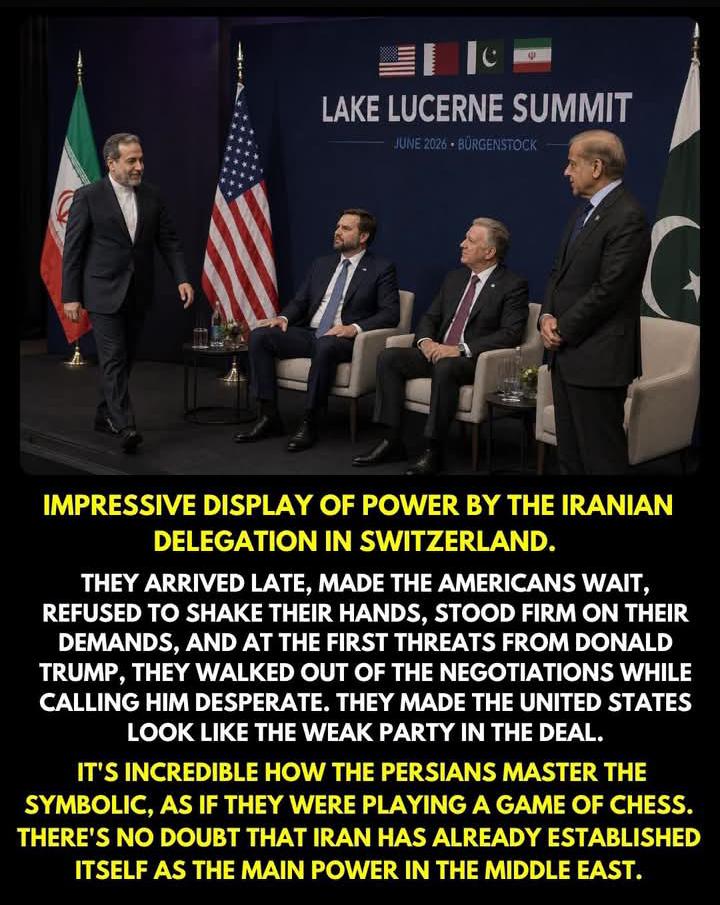
The moment that grabbed attention came before the serious talking even began. Iran’s negotiating team declined to take part in a planned joint photo opportunity with the U.S. delegation, according to reports citing a source close to the negotiations. A planned handshake and group photo also became part of the dispute. U.S. officials and Iranian media later offered different accounts of what happened, so the safest way to put it is this: the photo moment did not go as planned, and both sides understood exactly how powerful that image would have been.
For Iran, skipping the photo was more than a snub. It was a message. Tehran did not want to hand Washington a clean image of friendly normalcy while major tensions remained unresolved. For the U.S., the meeting itself was still important because it opened the door to direct, high-level engagement after months of dangerous escalation.
That is why the summit mattered. It looked dramatic, but it did not collapse. The cameras caught tension. The negotiators still produced movement.
A Photo Op Became the First Battle
Diplomacy loves symbols, and few symbols are bigger than a handshake between enemies.
That is why the Swiss talks became instantly interesting. A handshake could have told the world that Washington and Tehran were ready to soften their public hostility. By refusing or avoiding that moment, Iran kept the mood cold and controlled its own image.
The Iranian side was led by Parliament Speaker Mohammad Bagher Ghalibaf and Foreign Minister Abbas Araghchi. The U.S. side included Vice President JD Vance, Steve Witkoff, and Jared Kushner. Qatar’s prime minister and Pakistan’s leadership played key roles as mediators.
Vance tried to frame the talks as historic and forward-looking. Before the trilateral meeting, he asked, “Can we turn over a new leaf? Can we change relations in the Middle East permanently, or do we go back to doing things the old way?”
That line showed the American pitch. Washington wanted the meeting to look like the start of something bigger than a temporary pause.
Iran’s message was sharper. During the talks, President Donald Trump issued a public warning about Iran and Hezbollah, writing that Iran must stop its “PROXIES in Lebanon” or the U.S. would hit Iran “very hard again.” Ghalibaf responded with his own tough language, saying, “We do not take American threats seriously. They would do well to be careful about their statements.”
That exchange explains why a photo op became so sensitive. Both sides were negotiating, but neither wanted to look weak. Iran wanted to show it would not be pressured into smiling for cameras. The U.S. wanted to show it was talking from a position of strength.
So, yes, the Iranian delegation’s appearance in Switzerland looked like a display of power. But the bigger point is that the show of power did not stop the process. It became part of the process.
The Real Outcome Was Bigger Than the Snub
The viral moment was the snub. The real news was the structure that came after it.
Qatar and Pakistan later said the Lake Lucerne Summit was held in a “positive and constructive atmosphere” and that “encouraging progress” had been made. That may sound like classic diplomatic language, but it carried real weight because the talks produced several concrete steps.
The parties agreed to create a High-Level Committee to provide political oversight. Chief negotiators are expected to report to that committee, while working groups focus on nuclear issues, sanctions, monitoring, dispute resolution, and other matters.
Most importantly, mediators announced a roadmap toward a final deal within sixty days. That does not mean a final agreement is guaranteed. It means the sides have a clock, a process, and a structure for continuing the hard work.
Vance described the progress with a house-building metaphor. “The final deal is the house,” he told reporters. “We set the foundation. We haven’t built the house, but we’ve laid a successful foundation to get to a good place for the American people.”
That quote is important because it keeps expectations realistic. The talks in Switzerland did not solve everything. They did not erase years of mistrust. They did not magically settle the nuclear question or the sanctions fight. But they did create a foundation, and in Middle East diplomacy, even a foundation can be a serious achievement.
Iran also left with something it could sell. Tehran could point to the fact that Lebanon was not pushed aside, that the Strait of Hormuz was part of the conversation, and that sanctions remained central to the next stage.
That is the clever part of the summit. Everyone got a talking point. The U.S. got “foundation.” Iran got “resistance with results.” Qatar and Pakistan got proof that their mediation mattered.
Why This Matters Beyond Switzerland
The talks were not just about a single meeting at a beautiful Swiss resort. They were about whether two longtime adversaries can move from threats to mechanisms.
One major outcome was the creation of a communication line aimed at preventing incidents and miscommunication related to commercial shipping through the Strait of Hormuz. That matters because the strait is one of the world’s most important energy routes. Trouble there can shake oil markets and raise fears far beyond the Middle East.
Another major outcome was the creation of a deconfliction cell involving the parties, Lebanon, and the mediators. Its purpose is to support the termination of military operations in Lebanon under the broader framework of the agreement. That is a complicated task because Lebanon’s security crisis involves multiple actors, and not all of them are neatly controlled from one room.
Still, the inclusion of Lebanon and Hormuz shows how broad the talks have become. This is not a narrow argument over one nuclear file. It is a regional negotiation touching energy, sanctions, military escalation, and political survival.
That is why the Iranian delegation’s performance drew so much attention. It showed Tehran trying to control both the table and the theater around the table. The delegation avoided the image it did not want, answered Trump’s threats with its own tough language, and still remained inside a process that produced new diplomatic machinery.
But power has a second test. It is not only about refusing a handshake. It is about turning posture into results.
For now, Iran won attention. The U.S. won the continued talks. Qatar and Pakistan won diplomatic credibility. The world won a little more time before another dangerous breakdown.
The Swiss summit may be remembered for the missing handshake, but its real importance lies in what happened after the cameras stopped being the main event. The negotiators kept talking. The mediators announced progress. And for once, a cold moment did not freeze the entire process.