Judge Clears Brad Lander After ICE Protest Arrest, but New York’s Immigration Court Fight Is Far From Over
A New York courtroom just turned a small obstruction case into a much bigger political moment.
Democratic congressional candidate Brad Lander was acquitted Thursday after a federal judge ruled that prosecutors had not proved he intentionally blocked an elevator during a protest inside 26 Federal Plaza, the Lower Manhattan building that houses one of New York City’s immigration courts. The charge came from a September 18, 2025, protest that placed Lander and other elected officials directly inside one of the city’s most tense immigration flashpoints.
The ruling did more than clear one candidate of a misdemeanor charge. It pushed a larger question back into public view: how far can elected officials go in protesting federal immigration enforcement, and how much power should the government have to arrest them when a protest crosses onto federal property?
A small charge became a major political test.

The case centered on a narrow allegation. Federal prosecutors said Lander obstructed an elevator on the tenth floor of 26 Federal Plaza while sitting with other protesters near the elevator bank for roughly 20 to 25 minutes.
But the judge found that the government failed to prove the most important part of the case. Prosecutors had to show that Lander meant to obstruct access or refused clear orders from law enforcement, and the court found the evidence did not get them there.
That distinction matters. In court, intent can separate a criminal violation from a chaotic protest scene where instructions are unclear, emotions are high, and several officers may be giving different commands at once.
What happened at 26 Federal Plaza
The September protest took place inside a building that has become a symbol of New York’s immigration fight. The federal complex houses immigration court operations and multiple federal agencies, making it both a legal checkpoint and a political target.
Lander and other officials were protesting conditions and enforcement actions tied to immigration detention. They had sought access to areas connected to immigrant holding rooms, according to reports, before the situation escalated into a sit-in near the elevator area.
Federal authorities accused Lander of blocking movement. Lander testified that he did not intend to stop elevator traffic and said he had not been clearly told that he was obstructing access before he was arrested.
The judge focused on intent.
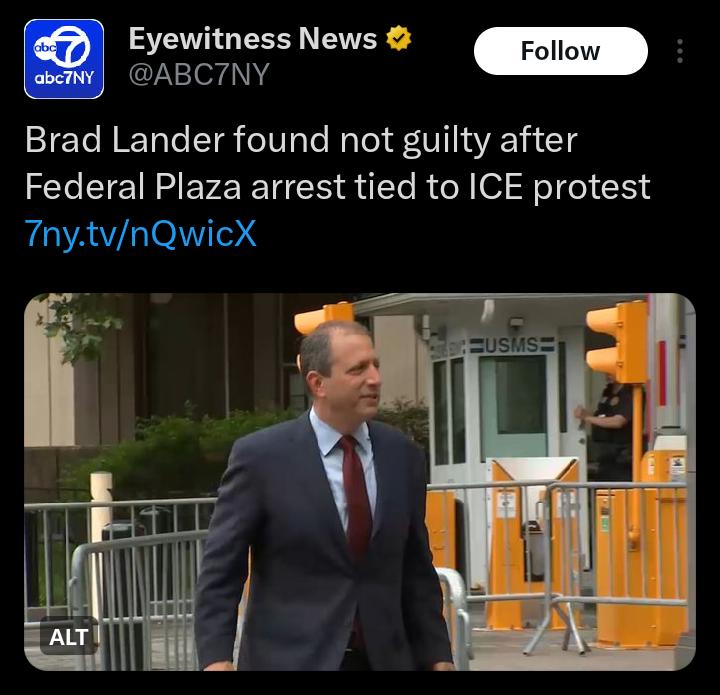
U.S. Magistrate Judge Henry J. Ricardo delivered the verdict after presiding over a one-day bench trial in Manhattan. There was no jury. The judge reviewed the testimony, the evidence, and the circumstances surrounding the arrest before finding Lander not guilty.
The ruling did not declare every protest tactic lawful. It simply said prosecutors had not carried their burden in this specific case.
That is a crucial point for readers. An acquittal means the government failed to prove the charge beyond a reasonable doubt. It does not erase the political debate over what happened inside the building, but it does end this criminal case against Lander.
Why the verdict lands during a heated House race
Lander is not just a former New York City comptroller. He is also challenging U.S. Rep. Dan Goldman in a Democratic primary, making the acquittal politically significant as well as legally important.
The timing gives Lander a powerful campaign narrative. He can now say he fought the federal charge, rejected a deal that would have ended the matter earlier, took the case to trial, and walked out cleared by a judge.
For voters in a deeply Democratic district, the case may sharpen an already emotional debate over immigration, protest, federal enforcement, and what kind of opposition Democratic candidates should show toward the Trump administration’s policies.
Lander rejected an easier exit.
One of the most striking parts of the story is that Lander reportedly turned down a deal that could have led to the charge being dismissed after several months. Many defendants facing a low-level case might have taken that route and moved on.
Instead, he chose trial. That decision carried risk because a conviction, even on a minor charge, would have followed him into the primary.
But the choice also gave him a platform. It allowed him to argue that the case was about more than one elevator lobby, and that the public deserved more scrutiny of what happens inside federal immigration spaces in New York.
The prosecution’s problem
The government’s case depended on proving that Lander knowingly blocked access or refused proper commands. The judge found that the evidence did not clearly show that.
Court reports described conflicting instructions from federal law enforcement during the protest. That confusion appears to have weakened the prosecution’s argument that Lander deliberately defied a clear order.
For readers, this is the heart of the ruling. The judge did not need to decide whether the protest was politically wise, polite, or disruptive. The legal question was whether the government proved the charged offense, and the court said it did not.
A courtroom win with a larger message
Outside the court, Lander framed the acquittal in terms of the rule of law and access to legal defense. He contrasted his own ability to fight the government in court with the far more fragile position of immigrants facing possible deportation.
That message is likely to resonate with supporters who already see federal immigration enforcement as too aggressive. It may also frustrate critics who view elected officials’ protest arrests as political theater.
Either way, the case gave both sides something to argue. Supporters can call it vindication. Critics can say the courtroom result does not settle the broader question of whether elected officials should stage protests inside federal buildings.
This was not Lander’s first immigration court arrest
The acquittal also comes after an earlier immigration related arrest involving Lander in June 2025. In that case, he was arrested at a Manhattan immigration court after linking arms with a person authorities were trying to detain, but charges were not filed.
That earlier incident made Lander a more visible figure in New York’s immigration enforcement clashes. The September case then turned that activism into a formal court fight.
Together, the two episodes show how immigration court protests have moved from sidewalk demonstrations into federal buildings, courtrooms, and campaign ads.
What New Yorkers should watch next
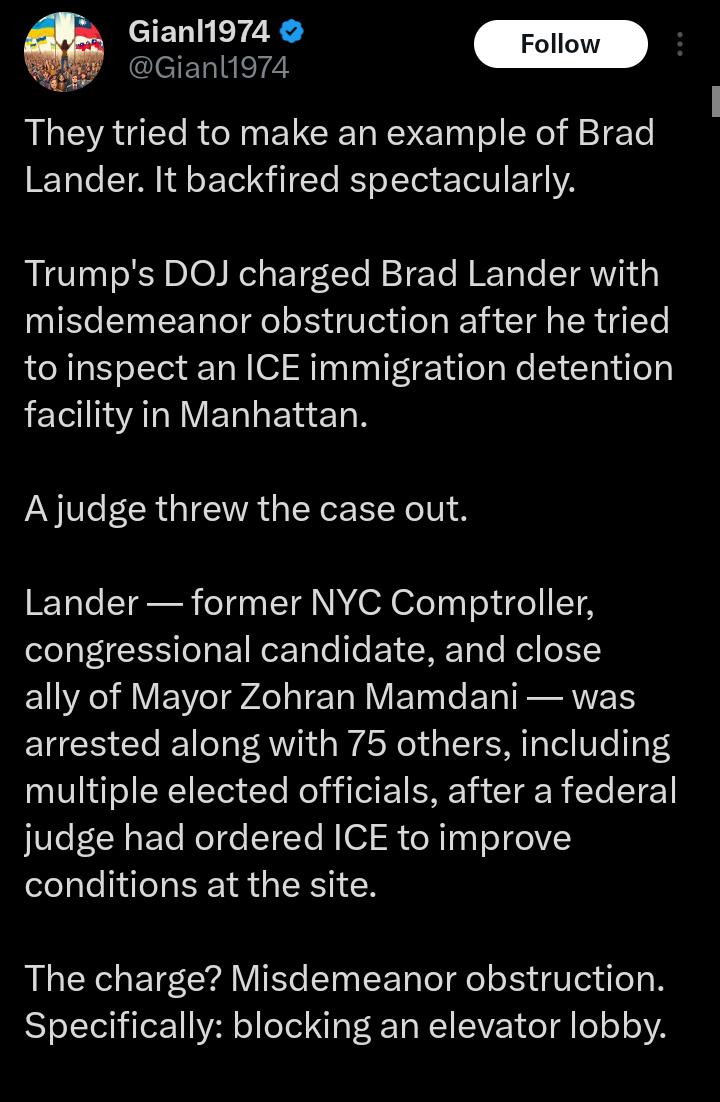
The immediate legal question is over for Lander, but the political questions are not. His campaign can use the acquittal as evidence that he stood his ground and won.
Goldman’s supporters may argue that the district needs legislative power more than protest symbolism. Lander’s supporters may counter that direct confrontation is exactly what the moment requires.
That contrast could shape the final stretch of the Democratic primary. For many voters, the case may become a test of temperament as much as ideology: who fights, how they fight, and whether the fight changes anything for the people caught inside the immigration system.
The bigger fight did not end with the verdict
The acquittal closes the criminal case, but it does not close the argument over 26 Federal Plaza. The building remains a focal point for immigrant advocates, federal enforcement, elected officials, and families trying to navigate a system that can change lives in a single hearing.
For Lander, the ruling removes a legal cloud at a critical political moment. For New York, it adds another chapter to a widening battle over immigration enforcement, civil disobedience, and the limits of protest within the spaces where federal power is exercised.
The judge answered one question in court. The city is still arguing over the rest.