Mamdani Says Netanyahu Belongs in The Hague, but New York Hits a Legal Wall
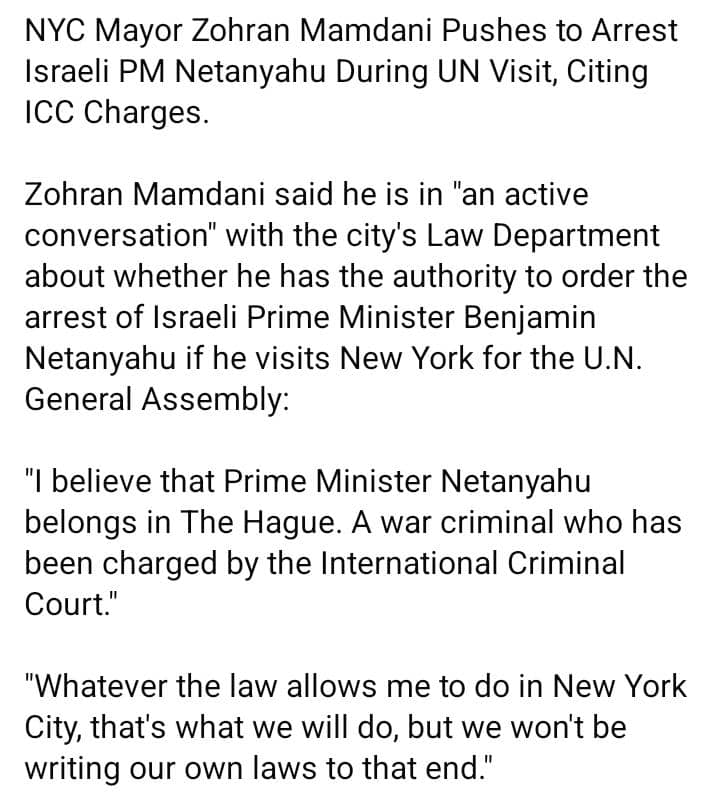
New York City Mayor Zohran Mamdani has turned a long-running campaign promise into a full-blown clash over international law, presidential power and the limits of City Hall. Speaking about Israeli Prime Minister Benjamin Netanyahu, Mamdani said, “I believe that Prime Minister Netanyahu belongs in The Hague. He’s a war criminal who has been charged by the International Criminal Court.” The remark was tied to Mamdani’s earlier pledge to explore whether New York police could act if Netanyahu arrived for the United Nations General Assembly.
The statement landed with all the subtlety of a siren on Fifth Avenue. Supporters saw a mayor demanding accountability for alleged crimes in Gaza. Critics saw a local official wandering into foreign policy and promising an arrest he could not legally deliver. After New York City lawyers reviewed the issue, Mamdani acknowledged that the city does not have independent authority to enforce the ICC warrant, although he did not retreat from his condemnation of Netanyahu.
Mamdani Draws a Line at The Hague

Mamdani’s argument begins with the International Criminal Court’s November 21, 2024, arrest warrants for Netanyahu and former Israeli Defense Minister Yoav Gallant. The ICC said judges found reasonable grounds to believe the two men bore responsibility for alleged war crimes and crimes against humanity connected to Israel’s military campaign in Gaza. The allegations listed by the court include starvation as a method of warfare, murder, persecution and other inhumane acts, as well as intentionally directing an attack against civilians.
That wording matters. Netanyahu has not been convicted by the ICC, and the warrant does not amount to a final judgment. It means the court found the legal threshold necessary to seek his arrest and bring him before judges. Israel rejects the ICC’s jurisdiction and denies committing war crimes, arguing that its military campaign has targeted Hamas following the group’s October 7, 2023, attack on Israel.
Mamdani nevertheless made clear that his personal and political judgment had not changed. After the city’s legal review, he said, “It is clear that we do not have the independent legal authority to enforce this warrant.” He then urged the federal government to join the ICC and act, adding that Netanyahu was not welcome in New York.
The Warrant Is Real, but City Hall Cannot Simply Enforce It
This is where the politics runs into the machinery of American law. The United States is not a party to the Rome Statute, the treaty that created the ICC, and Israel is also not a member of the court. An ICC warrant therefore does not automatically function like a New York arrest warrant that the NYPD can simply pick up and execute.
Legal experts cited by Reuters said several barriers stand in the way. Federal law sharply limits American cooperation with the ICC, and protections surrounding foreign leaders and United Nations visits add another layer of difficulty. A New York mayor controls the city’s police department, but that authority does not allow City Hall to invent an international arrest power that federal law does not provide.
Mamdani’s revised position therefore separates his political message from his legal options. He still describes Netanyahu as a war criminal and supports the ICC process, but he now says the city cannot independently carry out the warrant. That is a significant correction to the arrest promise he made during his mayoral campaign, even though he presents it as the result of following legal advice rather than abandoning his position.
Trump and Israel Push Back Hard
President Donald Trump removed any doubt about the federal government’s current position. “Benjamin Netanyahu will not be arrested, in any way, shape, or form, while in the United States of America,” Trump wrote in a social media post. His declaration placed the White House squarely against Mamdani and reinforced Washington’s rejection of the ICC’s attempt to exercise authority over the Israeli leader.
Netanyahu’s office was equally blunt. It called the ICC a “kangaroo court,” described the warrant as “bogus” and accused Mamdani of trying to distract attention from problems in New York. Israel’s ambassador to the United Nations, Danny Danon, told the mayor, “You were elected to serve New Yorkers, not Hamas’ propaganda. Do your job!”
The exchange has now become larger than one possible September visit. Mamdani is using the case to argue that international law should apply even to powerful allies of the United States. Trump and Israeli officials are arguing that the ICC has no legitimate authority over Israel or the United States and that a New York mayor has no business trying to enforce its decisions.
For now, the practical question is settled more clearly than the political one. New York City will not arrest Netanyahu under the ICC warrant based on the authority Mamdani currently holds. But Mamdani has not softened his judgment of the Israeli prime minister, and the argument over Gaza, accountability and America’s relationship with the ICC is now firmly planted inside New York politics.