Man With Tibetan Flag Dies After Setting Himself on Fire Outside UN Headquarters
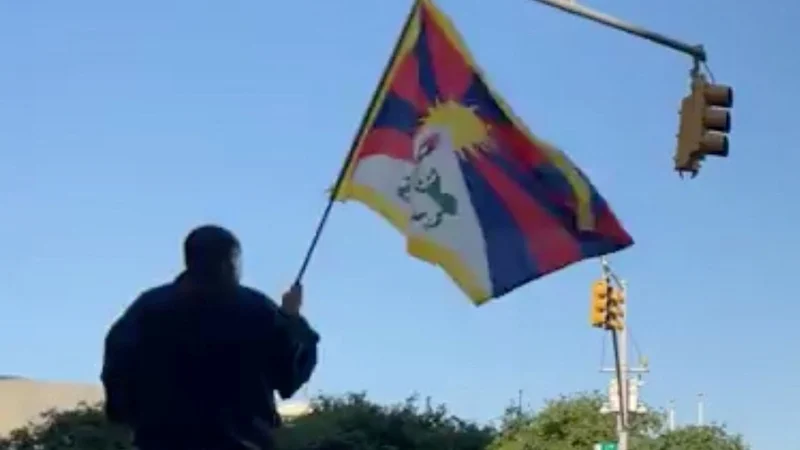
A man holding a Tibetan flag died after setting himself on fire outside the United Nations headquarters in New York, turning one of the world’s most visible diplomatic landmarks into the scene of a rare and devastating political protest.
The incident happened Thursday evening, July 2, near the UN complex in Manhattan. Police responding to a 911 call around 6:30 p.m. found the man suffering from severe burns. He was taken to Bellevue Hospital, where he was later pronounced dead. Authorities said the investigation remained ongoing, and officials had not immediately released the man’s name pending family notification.
Activists later identified him as Lobga Rangzen, a Tibetan man and supporter of the Free Tibet movement. Exile-linked Tibetan media said he had made a live appeal for Tibetan independence and unity before the self-immolation. Reuters reported that Rangzen was an Uber driver and that activists connected his final act to opposition against China’s control of Tibet and Beijing’s new ethnic unity law.
The location gave the act its painful symbolism. The United Nations sits at the center of global diplomacy, a place where nations argue over war, borders, rights, and sovereignty. For Tibetans who feel the world has looked away from their struggle, the sidewalk outside that building became a stage of desperation.
The UN confirmed the incident happened after official meetings had ended and said no UN business was disrupted. But for Tibetan activists, disruption was never only about schedules. It was about attention. A man with a flag chose a place built for international appeals and made one with his body.
A protest rooted in a long Tibetan wound
Self-immolation has a long and tragic history in Tibetan protest. The International Campaign for Tibet says 159 Tibetans have self-immolated in Tibet and China since 2009, with 127 known to have died. The group’s data includes monks, nuns, former monks and laypeople, as well as Tibetans living in exile.
These acts are not ordinary protests. They are final, irreversible statements from people who believe every other form of appeal has failed. They are also difficult to report on responsibly because they sit at the edge of politics, grief, religion, and mental anguish. But they cannot be dismissed as isolated tragedies when so many have occurred across the Tibetan world.
China has ruled Tibet since 1951 and insists Tibet has long been part of Chinese territory. Many Tibetans, especially in exile, argue that Tibet was historically independent and that Chinese rule has brought political repression, religious restrictions, and cultural assimilation. Dialogue between Beijing and representatives of the Dalai Lama has been stalled since 2010.
That silence has shaped the frustration of Tibetans abroad. For decades, activists have called for religious freedom, cultural protection, meaningful autonomy, or outright independence, depending on the group. Beijing rejects separatism and has repeatedly framed Tibetan activism as a threat to national unity.
China’s new ethnic unity law adds fresh tension.
Rangzen’s death came in the same week China’s new ethnic unity law took effect. The law is designed to promote a shared national identity among China’s 55 ethnic minority groups, including Tibetans and Uyghurs. Critics say it could accelerate forced assimilation and give Beijing a legal basis to target critics outside China.
The European Union and the United States have raised concerns about the law’s potential reach beyond China’s borders. Beijing has defended the measure, saying it protects sovereignty and social harmony and targets illegal separatist activity rather than ordinary international exchange.
For Tibetans in exile, however, the law lands differently. It is not viewed as a neutral civic project. It is seen as another tool in a long campaign to pressure minority communities into political obedience and cultural sameness.
That is why the UN self-immolation has struck such a raw nerve. It was not only about one man’s death. It was about people trying to force the world to look again at a conflict that often disappears beneath larger geopolitical headlines.
A flag, a sidewalk, and a global message
The Tibetan flag has been one of the most recognizable symbols of the exile movement. In China, it is politically sensitive. Outside China, it has become a shorthand for identity, resistance, and longing for a homeland many younger Tibetans have never seen.
Witness accounts and activist statements suggest Rangzen’s final moments were meant to be read as political. But the deeper story is not only the dramatic manner of his death. It is the distance between a global institution built to hear grievances and a community that still feels unheard.
There is also a human life at the center of this story. Rangzen was described by activists as someone devoted to the Tibetan cause. That devotion ended in a public death that has shaken fellow Tibetans and renewed attention on China’s policies in Tibet.
Self-immolation does not settle political arguments. It does not deliver freedom, autonomy, or reconciliation. What it does is expose a level of despair that cannot be neatly folded into diplomatic language.
The flames outside the UN went out quickly. The question they left behind will last longer: how much suffering must a stateless or occupied people display before the world treats their cause as urgent again?
For Tibetans mourning Rangzen, the answer is already overdue.