Paper Ballots Still Offer the Strongest Defense Against Election Hacks
A paper ballot is not flashy. It does not require facial recognition, artificial intelligence or a complicated app. It cannot send notifications, update itself overnight or produce an animated “vote received” screen.
That simplicity is precisely the point.
In an era when foreign governments possess sophisticated cyber capabilities, elections need more than software promising that everything worked correctly. They need physical evidence that voters, election officials and auditors can examine independently.
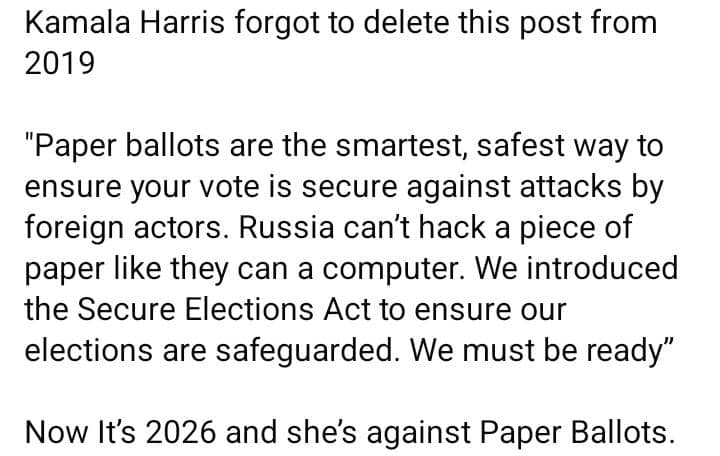
Human-readable paper ballots provide that evidence. They cannot stop every form of election interference, and they are not automatically secure simply because they are printed. However, when voters can inspect them, and officials protect and audit them properly, paper ballots create something a remote attacker cannot quietly rewrite: a durable record of voter intent.
Foreign Governments Target Elections and Public Confidence

The danger is no longer theoretical.
A bipartisan Senate Intelligence Committee investigation found that Russia conducted extensive activity against state and local election infrastructure surrounding the 2016 election. Russian-linked actors scanned government systems and attempted to access election-related networks. The committee found no evidence that votes were changed or voting machines were manipulated, but the operation exposed serious weaknesses in America’s preparedness.
Former Senate Intelligence Committee Chairman Richard Burr said the country had been “unprepared at all levels of government” for the coordinated campaign. Then-Vice Chairman Mark Warner warned that although security had improved, “there’s still much more we can and must do.”
The threat also extends beyond hacking voting equipment.
During the 2024 election cycle, intelligence officials identified growing influence operations linked to Russia, Iran and China. Those efforts included propaganda, stolen political information and campaigns designed to deepen divisions or weaken trust in democratic institutions.
Importantly, intelligence officials said they had not observed a foreign actor attempting to interfere directly with the conduct of the 2024 election as of early September. They also assessed that changing enough votes to determine a federal election would be extremely difficult without detection because of audits, monitoring and the country’s decentralized election system.
That distinction matters. Foreign adversaries do not always need to alter ballots to achieve their goals. Sometimes convincing Americans that their votes were altered can be damaging enough.
Director of National Intelligence Avril Haines told senators that the government “has never been better prepared to address the challenge.” Still, preparation must include a way to prove that computerized totals match what voters actually selected.
That is where paper becomes surprisingly powerful.
Paper Creates Evidence That Software Cannot Replace
Computers are excellent at counting millions of votes quickly. They are also complicated machines running software that most voters will never see or understand.
A paper ballot gives the voter something visible.
The National Academies of Sciences, Engineering, and Medicine recommended that elections use human-readable paper ballots because they create physical evidence independent of voting software. Voters should be able to examine their selections before submitting the ballot, regardless of whether they marked it by hand or used an accessible ballot-marking device.
Michael McRobbie, who co-chaired the committee behind the recommendation, described the 2016 election as “a watershed moment” that revealed vulnerabilities requiring immediate attention.
The principle is wonderfully simple: trust the computer to count quickly, but keep the paper so the computer can be checked.
If a scanner malfunctions, investigators can return to the original ballots. If suspicious software produces an incorrect tally, officials can compare the digital records with the physical votes. If someone claims that machines secretly switched thousands of selections, an audit can test that claim using evidence rather than social-media speculation.
America has already moved significantly in this direction. During the 2024 general election, more than 98% of election jurisdictions used systems in which voters marked paper ballots or received an auditable paper record of their choices. Only 80 jurisdictions in three states reported using systems without a verified paper trail, and only one relied exclusively on such equipment.
That progress does not mean every election system is identical. Some voters fill in ovals with a pen. Others use machines that print their selections. Some ballots are counted by optical scanners, and others may be counted manually during audits or recounts.
The essential requirement is that the voter, not a barcode, computer, or hidden software process, can read and confirm the official record.
Paper Ballots Need Audits, Security and Careful Handling
Paper is not magic.
Ballots can be misplaced, damaged, or mishandled. Human beings can make counting mistakes. Poor storage practices can create legitimate questions about whether every ballot remained protected.
That is why the strongest election-security model is not simply “use paper and hope for the best.” It combines voter-verifiable paper ballots with secure storage, documented chains of custody, accurate ballot accounting and meaningful post-election audits.
Counting every ballot entirely by hand is not necessarily the best answer. The National Academies found that full manual counts are time-consuming and can be vulnerable to human error or deliberate miscounting. Scanners provide speed and efficiency; paper provides the evidence needed to verify their work.
Risk-limiting audits offer an especially useful safeguard. Officials randomly inspect paper ballots until they reach a predetermined level of statistical confidence that the reported winner actually won. An election involving tens of millions of ballots may sometimes be checked by examining only several hundred randomly selected ballots, although close races can require larger samples or a complete recount.
These audits work only when officials have maintained secure custody of the ballots from the moment they are submitted until the review is completed. The people conducting the audit must also follow transparent procedures independent of the equipment that generated the original totals.
The Election Assistance Commission says audits help confirm that voting systems operated accurately, identify discrepancies and strengthen public confidence. Yet audit methods still vary widely because the United States has no single national auditing standard.
Paper ballots cannot stop foreign propaganda, protect campaign emails or prevent every cyberattack on voter-registration databases. They can do something equally important: preserve trustworthy evidence of the votes themselves.
Election security should never depend on asking the public to accept that a machine probably worked. A secure system should be able to demonstrate it. Paper ballots, protected carefully and tested through rigorous audits, give democracy its most convincing receipt.