Parents Are on Devices During Meals Even More Than Their Kids, and The Family Dinner Table is Paying The Price
The family dinner table has always carried more weight than the plates placed on it. It is where children retell the small dramas of school, where parents hear what did not make it into a text message, and where a normal Tuesday night can quietly become a child’s memory of belonging. But the modern dinner table now has another guest: the glowing screen.
A new study published in JAMA Pediatrics has put a sharp number on a habit many families already recognize. More than 75% of parents reported using media during their last family meal, while nearly 70% said their children did the same. The finding is striking because the usual public conversation about screen time often points toward children. This time, the mirror turns toward adults.
We are not simply watching children drift away from family meals because of tablets, phones, and televisions. We are seeing parents pulled into the same current, checking work messages, scanning notifications, answering texts, scrolling headlines, refreshing group chats, and trying to manage the invisible pressure of modern life while sitting within arm’s reach of their children.
That does not make parents careless. It makes them human in a culture that has trained everyone to be reachable, responsive, and distracted. Still, the research lands at an important moment: family meals remain one of the most reliable opportunities for daily connection, yet many of those meals are now being interrupted by devices that turn shared time into side-by-side isolation.
The New Family Dinner Problem Is Not Just Kids on Screens
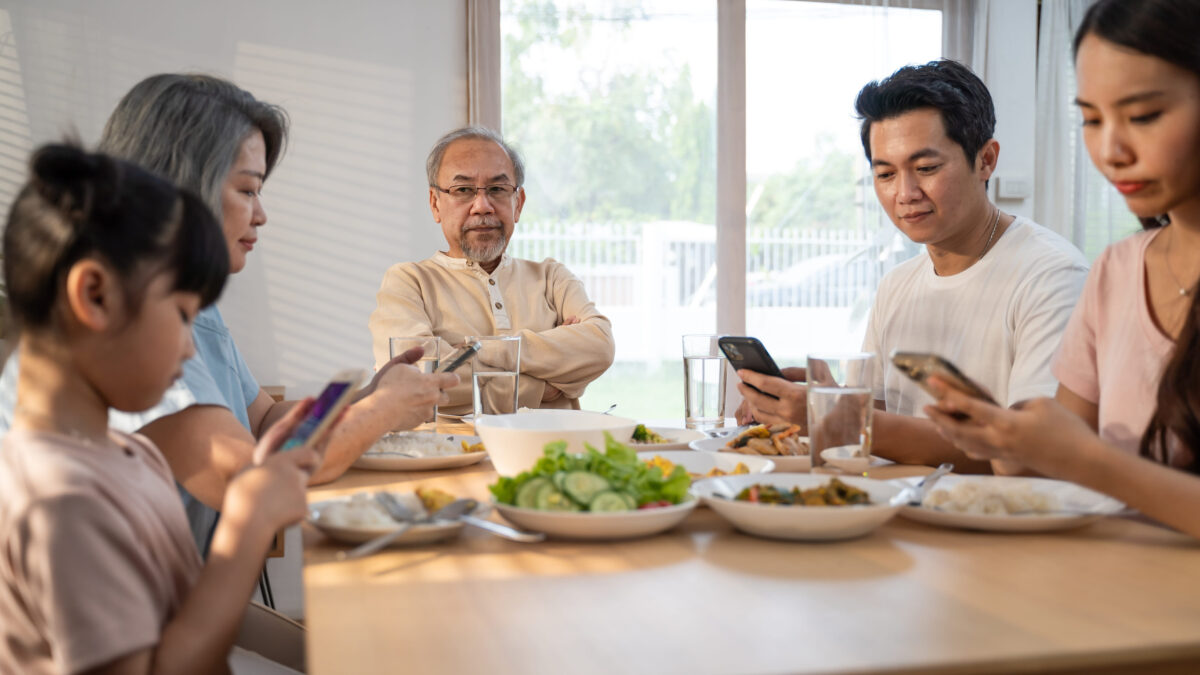
For years, the screen-time debate has sounded like a warning aimed mostly at children. We have talked about toddlers with tablets, teens with phones, video games after school, and YouTube at bedtime. But family meals reveal a more complicated picture. Children are not the only ones reaching for devices at the table.
Parents often do it first. That matters because children not only follow household rules but also study household rhythms. When a parent checks a phone between bites, answers a message during a child’s story or keeps one eye on a work email, the child receives a quiet signal. The table may be shared, but attention is divided.
The problem is not one rushed text or one emergency call. The real issue is the slow normalization of distracted presence. A parent can be physically at dinner and emotionally elsewhere. A child can sit across from an adult and still feel like they are competing with a screen.
This is why the study feels bigger than a simple technology story. It is really a story about attention. We can have the food, the chairs, the family, and the timing right, yet still lose the moment if everyone is mentally scattered across different digital worlds.
Why Family Meals Still Matter in a Busy American Household
Family meals have survived because they solve a problem that busy households struggle to name: they create a regular place to reconnect. The meal does not need to be elegant. It does not need candles, matching plates, or a home-cooked main course. It needs people who pause long enough to notice one another.
Research has long associated regular family meals with healthier eating habits, stronger emotional bonds, and better communication between parents and children. For adolescents, shared meals can also create a protective routine, offering a steady space where adults can notice changes in mood, behavior, or stress before those changes become bigger problems.
The power of the meal is not hidden in the recipe. It is found in the repeated act of gathering. Children benefit from knowing there is a dependable time when adults ask questions, listen without rushing, and show interest in the details of their lives.
That predictability can be especially important in homes where schedules are chaotic. Between school, work, sports, tutoring, dance, commuting, and evening chores, many families do not have long stretches of quiet time together. A 20-minute meal may be the only moment in the day when everyone stops moving in separate directions.
Parents Are Not Failing, They Are Overloaded

It is too easy to turn this issue into another guilt trip for parents. That would miss the deeper truth. Many parents are using devices at meals because the modern household often leaves them with no clean boundary between work, parenting, and personal life.
A parent may be answering a supervisor, checking a school update, confirming a ride, paying a bill, responding to a family emergency, or managing a calendar that feels like air traffic control. The phone is not always entertainment. Sometimes it is the tool that keeps the household running.
But that is exactly why families need clearer rituals. When every moment becomes available for every demand, no moment feels protected. Dinner becomes just another open tab in the day.
The goal should not be perfection. The goal should be protection. We do not need every meal to become a sacred ceremony. We need some meals, even one or two a week, to be shielded from the constant pull of digital life.
The “One Device-Free Meal” Rule Is More Realistic Than Daily Perfection
Many families fail with screen rules because they start too big. They announce that every dinner will now be device-free, then life happens. Someone gets home late. A parent is exhausted. A child has homework. A work message comes in. Within days, the rule collapses, and everyone feels like the effort failed.
A better strategy is to start with one protected meal. One device-free dinner each week can be more powerful than seven tense, unrealistic attempts. Families can choose the night that already has the best chance of working Sunday dinner, Saturday breakfast, Friday pizza night, or even a weekday meal when everyone gets home earliest.
The point is not the day. The point is the expectation. Everyone knows the phones go away. The television stays off unless the family has chosen a shared watch night. The meal does not need to be long. Twenty minutes of real attention can matter more than an hour of distracted togetherness.
This approach also lowers resistance. Children are more likely to cooperate when the rule feels possible. Parents are more likely to follow through when the commitment does not feel like another impossible standard.