Strange “8647” Marking on the National Mall Turns America’s Front Yard Into a Political Crime Scene
A strange message appeared across the grass of the National Mall, and Washington, D.C., suddenly had a new mystery sitting in plain sight.
The number “8647” was marked in the lawn near some of the most symbolic ground in America, close to the Washington Monument and the World War II Memorial. From the ground, the marking was not easy for every visitor to read, but from above, it became a political image built for cameras, screenshots, and national argument.
Now federal authorities are investigating what happened, how the grass was damaged, and whether the message was simple vandalism, political protest, or something more serious.
A Message Written Into America’s Front Yard
The National Mall is often called America’s front yard for a reason. It is where families take school-trip photos, veterans gather near memorials, tourists walk between monuments, protesters hold signs, presidents hold ceremonies, and the country performs its own idea of democracy in public.
That is why the “8647” marking appears larger than the damaged grass. A message placed on the Mall is never just a message. It lands on ground tied to war memory, national grief, presidential power, public protest, and civic pride.
The numbers appeared in a place where America usually looks at itself with ceremony. Instead, the country was forced to confront a coded political message set across one of its most visible green spaces.
Why “8647” Immediately Triggered Political Alarm
The sequence of numbers carries a meaning that prompted officials to respond urgently. The phrase “86” is commonly understood as slang for removing, canceling, rejecting, or getting rid of something. The “47” is widely understood as a reference to President Donald Trump as the forty-seventh president.
That does not automatically explain the intent of the person or group behind the marking. It does, however, explain why the response became serious so quickly. In a country already tense over political language, threats, protests, and presidential security, four numbers on the grass were enough to ignite a national conversation.
For Trump supporters, the marking may look like another sign that political hostility has crossed a dangerous line. For Trump critics, the official reaction may raise questions about how aggressively protest language is now being interpreted. For many Americans, the concern is simpler and sharper: why does even the grass in Washington now feel like part of the fight?
The Marking Was Built for Cameras, Not Crowds
One of the most important details is that the marking appeared clearer from above than from the ground. That changes the story.
This was not a protest sign meant only for people walking nearby. It looked more like a visual message designed for webcam views, aerial images, news photos, and online circulation. In other words, the true audience may not have been tourists on the Mall. The real audience may have been the national feed.
Modern protest no longer always needs a crowd. One visual, placed in the right symbolic location, can travel farther than a speech. It can be photographed, reposted, debated, condemned, defended, and turned into a political identity test before investigators finish their work.
That may be the most modern part of this case. The grass was the surface, but the internet was the stage.
The Grass Samples May Tell the Real Story
Authorities collected grass samples from the area, and that detail deserves attention. It suggests that investigators are not only asking who made the marking. They are also asking how it was made.
The discoloration could point to different possibilities. It could involve chemicals, heat, scraping, pressure, repeated foot traffic, turf treatment, or another method entirely. Until testing is complete, the method remains a mystery.
That matters because the method could affect the case’s seriousness. If the grass was damaged with a simple physical act, the issue may be treated mainly as vandalism. If a chemical or other substance was used, investigators may need to examine whether there was any broader safety concern for visitors, workers, animals, or the surrounding grounds.
The clue may not be in a confession or a social media post. It may be in the grass itself.
Why This Location Carries More Weight Than Ordinary Vandalism
The marking appeared near the ground that carries deep national symbolism. The Washington Monument stands as one of the most recognized presidential symbols in the country. The World War II Memorial honors a generation tied to sacrifice, victory, and national unity.
That setting makes the act feel more pointed. A marking like this on a random field might still draw attention, but on the National Mall, it becomes a statement placed inside the country’s civic memory.
Americans do not visit the Mall only to see monuments. They visit it to feel connected to a national story, even when they disagree about what that story means. That is why political damage to the Mall can feel personal to people who live hundreds or thousands of miles away.
This was not a wall in an alley. It was the front lawn of the republic.
The Timing Makes the Mystery Harder To Ignore
The timing adds another layer of tension. Washington is preparing for major public gatherings, high-visibility events, and America’s two hundred fiftieth anniversary season.
The Great American State Fair is scheduled to run on the National Mall from June twenty fifth through July tenth. The event is being promoted as a large national celebration with state and territory displays, public programming, cultural events, family attractions, military elements, and extended hours around Independence Day.
That means the marking did not appear during a quiet summer lull. It appeared just before the Mall is expected to carry even more national attention, more visitors, more law enforcement, more planning, and more political symbolism.
For D.C. residents, this is not abstract. Big national events often mean road closures, blocked sidewalks, police staging, packed Metro stations, restricted lawn access, and sudden changes to daily movement. A politically charged marking on the Mall only adds more pressure to an already sensitive calendar.
Washington Residents May Feel the Impact First
National audiences may see this as a political mystery. Local residents may see something more practical: another disruption landing in their city.
When incidents like this happen around the Mall, security patterns can change quickly. Visitors may notice more officers, tighter monitoring, temporary barriers, closed sections of grass, maintenance crews, and restricted access near event zones. Commuters may face traffic changes or larger security footprints than expected.
Businesses near the Mall may also feel the ripple effect. Major events can bring customers, but they can also bring confusion, blocked routes, and unpredictable foot traffic. Families planning a simple monument visit may find themselves walking into a political security story instead of a quiet sightseeing day.
That local angle makes the marking more than a viral image. It becomes part of daily life in a city that often absorbs the consequences of national conflict.
One Marking, Three Different Reactions
The same four numbers can produce three very different reactions.
One group may see a threat. Another may see a protest. Another may see reckless vandalism that damages public land and forces taxpayers, workers, and agencies to deal with the aftermath.
That split is why the story is so combustible. The marking does not simply ask what happened to the grass. It asks how Americans now read political symbols. It asks whether a coded phrase should be treated as speech, intimidation, property damage, or all three.
The answer may depend on the reader’s politics, but the investigation cannot depend on emotion alone. Authorities still have to determine the method, responsibility, and intent.
The “8647” Phrase Already Had Political Baggage
The phrase did not begin with the National Mall marking. It had already circulated in political arguments, online posts, and public controversy before appearing on the grass.
That background matters because symbols gather force through repetition. A number sequence that might confuse one person can feel instantly recognizable to another. Once a slogan becomes politically coded, it no longer needs explanation for the audience already trained to read it.
That is what makes “8647” different from random graffiti. It arrives with a built-in argument. People are not only reacting to the marking itself. They are reacting to everything they believe the marking represents.
The Mall Has Always Been a Place for Public Conflict
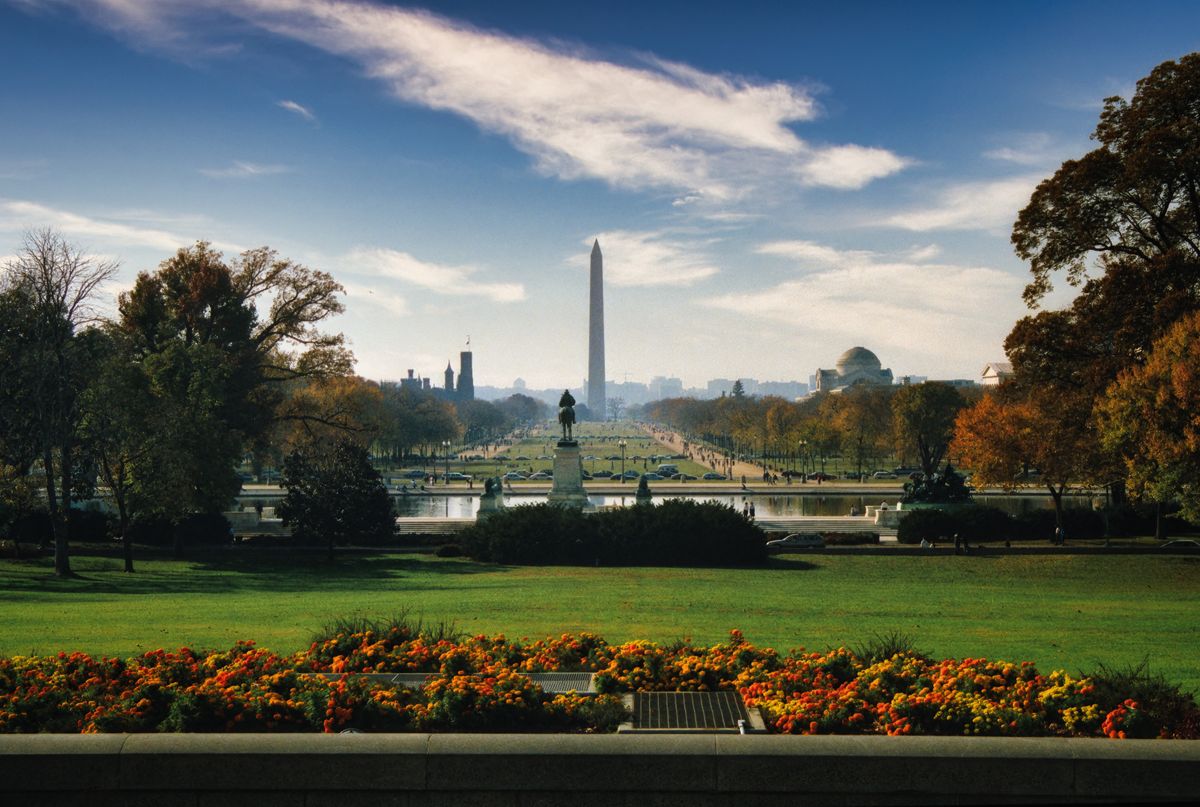
The National Mall has never been politically neutral in the way some people imagine. It has hosted civil rights marches, antiwar protests, presidential inaugurations, veterans’ gatherings, climate demonstrations, religious events, and mass celebrations.
The Mall is powerful because it is open. It allows Americans to show up with grief, anger, pride, hope, and demands. That openness is part of democracy’s visual language.
But openness also makes the Mall vulnerable. A person can damage grass, place a message, create a spectacle, or force a national debate before anyone fully understands what happened. Security officials must protect the space without destroying the very openness that gives it meaning.
That is the hard balance this incident exposes.
The New Age of Viral Vandalism
This case also points to a larger trend: public spaces are increasingly being used to create viral political images.
The goal is not always to persuade in the traditional sense. Sometimes the goal is to provoke, dominate attention, force outrage, and make every side reveal itself. A message does not have to be beautiful, clear, or even permanent. It only has to be photographed before it disappears.
That is why the “8647” marking feels like more than a lawn incident. It belongs to a new era where political messages are designed for speed. The act occurs in one location, but the real impact is felt through phones, feeds, headlines, and comment sections.
In that world, the National Mall is not just a park. It is a giant screen.
What Investigators Still Need To Answer
Several questions remain open.
Who made the marking? Was it one person or more than one? Was it planned in advance or created quickly? Was the person trying to create a protest image, send a threat, damage public property, or trigger national attention?
Investigators also need to determine how long the marking had been there before it was noticed. If nearby cameras captured the area, footage may help narrow the timeline. If the person left behind physical evidence, the grass samples and the surrounding ground may offer more clues.
The biggest question is intent. That is often the hardest part of a politically charged case. The same image can be defended as a protest by one person and interpreted as a menace by another. Investigators will need more than public outrage to prove what the act was meant to do.
Why This Story Will Keep Pulling Readers In
This story has the elements that make people stop scrolling. It has a famous location, a strange visual, a political code, a president, federal police, possible security concerns, and a public mystery.
But the reason it keeps growing is deeper. The story touches the national mood. Americans are exhausted by political hostility, yet drawn to every new symbol of it. They condemn the chaos, then click to understand it. They say they want calm, but they argue over every sign of conflict.
The “8647” marking works as a news story because it is both simple and loaded. Four numbers appeared on the grass. Somehow, those four numbers now carry a debate about speech, power, fear, vandalism, law enforcement, and the condition of the country.
A Stronger Way To Frame the Story
The most compelling frame is not just that someone marked “8647” into the National Mall.
The stronger framing is that America’s front yard has become another site of political anger. The message was not placed on a campaign sign or written into a private argument. It was marked into public ground near monuments that millions of Americans treat as sacred civic space.
That is why the story matters. It captures a country where even symbols of unity now become battlegrounds.
The grass will likely be repaired. The mark may fade. Tourists may walk through the same area later without knowing that it briefly became the center of a national argument.
But the meaning will be harder to erase.
The “8647” marking turned the National Mall into a political crime scene, a security concern, a viral image, and a cultural mirror. It showed how quickly public space can become a message board, how quickly coded language can become a national dispute, and how easily America’s most symbolic places can be pulled into the anger of the moment.
We may soon learn who made the mark and how. The harder question is what it says about a country where the front yard of democracy now has to be watched not only for crowds, but for messages written directly into the ground.