Supreme Court Blocks Alabama Nitrogen Execution as Death Penalty Fight Enters a New Phase
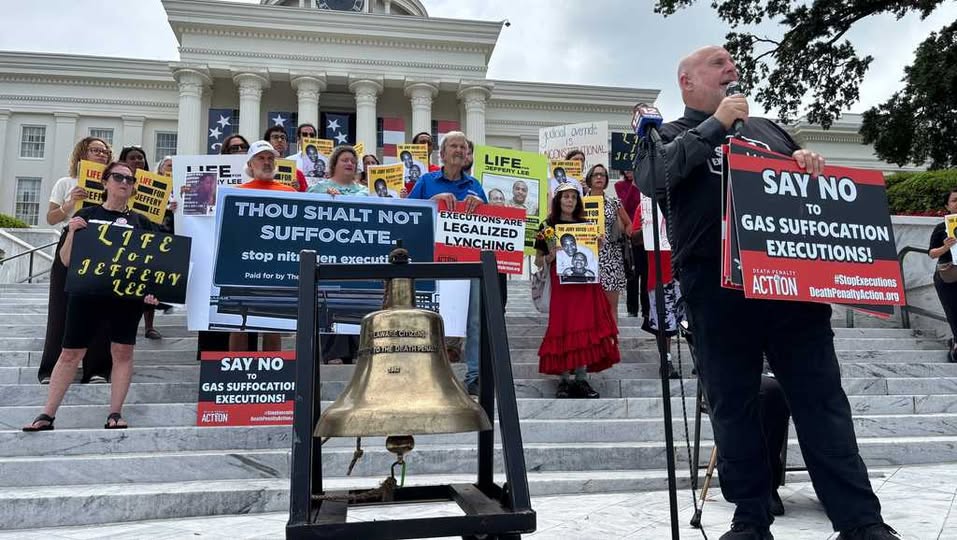
Alabama’s attempt to carry out another nitrogen gas execution hit a dramatic wall on June 11, 2026, when the U.S. Supreme Court declined to clear the way for the planned execution of Jeffery Lee. The order did not erase Lee’s death sentence, but it stopped the state from using nitrogen hypoxia that night.
We are now watching a case that reaches far beyond one execution chamber in Alabama. It has become a national test of whether a new execution method can survive constitutional scrutiny when lower courts say it may create an unacceptable risk of suffering.
Supreme Court Leaves Alabama Execution Block In Place
The Supreme Court’s latest action came in Greg Lovelace, Commissioner, Alabama Department of Corrections, et al. v. Jeffery Lee, listed on the official Supreme Court docket.
Alabama had asked the justices to lift or vacate a lower-court injunction that barred the state from executing Lee by nitrogen hypoxia.
The Court refused that request. Justices Clarence Thomas, Samuel Alito, and Neil Gorsuch said they would have granted Alabama’s application, but the majority allowed the injunction to stand.
That decision made Lee’s scheduled execution impossible for the evening. According to the Associated Press report, Alabama officials said the execution was off, and the state would not attempt to use another method that night.
Why Jeffery Lee’s Case Became A National Flashpoint

Jeffery Lee was convicted in Alabama for the December 12, 1998, killings of Jimmy Ellis and Elaine Thompson. His case has drawn renewed attention because a judge imposed the death penalty after a jury recommended life imprisonment.
That detail matters because Alabama later ended judicial override, the system that allowed judges to impose death even when jurors recommended life.
The Equal Justice Initiative has documented Alabama’s history of judge override and noted that the state abolished the practice on April 11, 2017, though the change was not retroactive to earlier cases.
For critics, Lee’s case sits at the intersection of two painful debates. One is about execution methods. The other is about whether older death sentences imposed through now-abolished sentencing practices should continue unchanged.
What Nitrogen Hypoxia Means In Alabama Executions
Nitrogen hypoxia is designed to kill by replacing breathable oxygen with nitrogen. Alabama has defended the method as lawful and efficient, while opponents argue that it may cause severe distress before unconsciousness.
Alabama became the first state to use nitrogen gas in an execution in January 2024. Since then, the method has faced intense scrutiny from lawyers, doctors, death penalty researchers, and civil rights advocates.
The latest Lee ruling does not ban nitrogen executions nationwide. It does, however, place Alabama’s protocol under the sharpest judicial pressure it has faced since the state began using the method.
Lower Courts Saw A Serious Eighth Amendment Problem
The legal fight turned on the Eighth Amendment, which bars cruel and unusual punishment. A federal judge initially ruled in Alabama’s favor after a trial, but the Eleventh Circuit later raised major concerns about the nitrogen protocol.
The Eleventh Circuit’s ruling, available through the federal appeals court opinion, focused on whether the protocol could expose Lee to severe air hunger, distress, and physical suffering before death. That question became central to the inquiry into whether the method created a constitutionally unacceptable risk.
After the appeals court sent the case back, U.S. District Judge Emily Marks permanently barred Alabama from executing Lee by nitrogen gas. AP reported that the judge found the protocol unconstitutional as applied in Lee’s case and left Alabama with other legally authorized options.
Alabama Still Has Other Execution Methods
The Supreme Court’s denial did not commute Lee’s sentence. It did not order his release. It did not rule that Alabama can never carry out the death sentence.
Instead, it left in place a narrower ruling against Lee’s use of nitrogen hypoxia. Alabama law still authorizes other execution methods, including lethal injection and electrocution, and the state may continue pursuing legal avenues.
That distinction is crucial. The Court blocked the nitrogen execution plan at this stage, not Alabama’s entire capital punishment system.
The State’s Argument: Finality And Victims’ Justice
Alabama officials framed the case around finality, the jury’s conviction, and the state’s authority to enforce a lawful sentence. Their emergency filing argued that Lee had chosen nitrogen hypoxia years earlier and that the state had already defended its protocol through trial.
From the state’s view, last-minute court intervention disrupts justice for victims’ families and weakens the finality of criminal judgments. Alabama also argued that Lee’s proposed alternative, the firing squad, was not a readily implemented option under state law.
That argument speaks to a broader frustration among death penalty states. They say repeated litigation over execution methods can delay sentences for decades, even after convictions and appeals have long been exhausted.
Lee’s Argument: A Sentence Cannot Become A Pain Experiment
Lee’s legal team argued that the Constitution still limits how the state may carry out a death sentence. Their position was not simply that Lee faced execution, but that Alabama’s nitrogen method created a serious risk of needless suffering.
That argument gained force after the Eleventh Circuit questioned the protocol, and the district court entered a permanent injunction. Death penalty critics say the ruling shows courts are beginning to take the real-world experience of nitrogen executions more seriously.
The Death Penalty Information Center update described the case as a major development in the growing legal battle over nitrogen hypoxia.
Why This Ruling Could Shape Future Executions
The Supreme Court’s order was brief, but the impact could be large. Every state watching nitrogen hypoxia now has to consider whether its own protocol could face similar challenges.
Alabama has been the lead state in using the method. If its protocol cannot withstand review in a high-profile case, other states may hesitate to adopt or expand similar procedures.
Still, the Court did not issue a full merits opinion. That means the national constitutional question remains unsettled, and future litigation may return to the justices with a larger record and broader consequences.
The Bigger Death Penalty Debate Is Not Going Away
This case exposes the pressure at the heart of modern capital punishment. States want execution methods that are legally defensible, medically workable, and politically acceptable. Courts must decide whether those methods cross a constitutional line.
The problem is that every new method arrives with a promise of control, only to face the same hard question once it reaches the execution chamber.
Can the state guarantee that the punishment will not add needless suffering beyond death itself?
In Lee’s case, lower courts said Alabama had not cleared that line for nitrogen hypoxia. The Supreme Court let that judgment stand for now.
What Happens Next In Alabama
Alabama may continue appealing, revise its protocol, or pursue another authorized execution method. Lee’s lawyers may also continue pressing arguments tied to his sentencing history, including the judge override issue that still shadows older Alabama death penalty cases.
For now, the immediate result is clear. Jeffery Lee was not executed by nitrogen gas on June 11, 2026, and Alabama’s most controversial execution method is facing its strongest legal setback yet.
The story is no longer only about one condemned man. It is about how far a state can go when the method of punishment becomes the central constitutional question.