The First 23 Black Members of Congress Were Republicans: The Forgotten History Behind the Fact
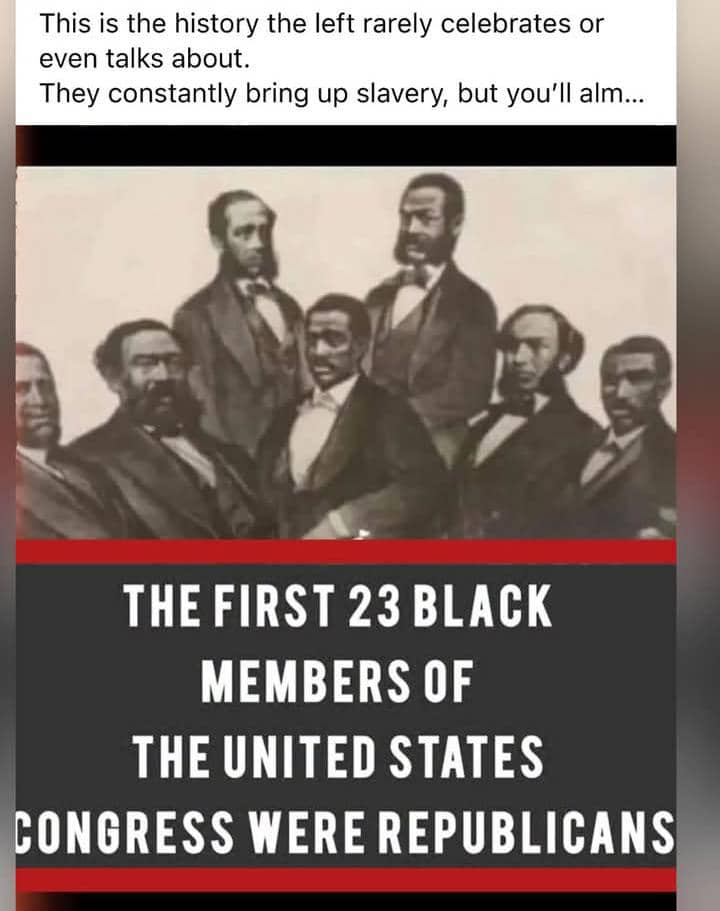
It is one of the most surprising facts in American political history: the first 23 Black members of the United States Congress were Republicans.
The statement often sparks debate today because America’s political parties have changed significantly over the past century. But historical records confirm that every one of the first 23 Black lawmakers who served in Congress was affiliated with the Republican Party.
The first 22 Black members served during the Reconstruction era following the Civil War, a period when Republicans controlled Congress and pushed major constitutional changes aimed at protecting the rights of formerly enslaved Americans. After a long absence of Black representation in Washington, Republican Oscar De Priest became the 23rd Black member of Congress when he was elected from Chicago in 1928.
The history behind this fact is more complicated than a simple party comparison. It is a story of emancipation, constitutional change, political courage, and the struggle over who would have a voice in American democracy.
Reconstruction Opened the Door for Black Representation
The rise of Black Republican lawmakers began after the Civil War, when the nation faced the enormous challenge of rebuilding after slavery.
Republicans in Congress played a major role in passing some of the most important civil rights measures of the era, including the 13th Amendment ending slavery, the 14th Amendment granting citizenship and equal protection under the law, and the 15th Amendment protecting voting rights regardless of race.
For many newly freed Black Americans, the Republican Party became associated with emancipation and the fight against slavery. Black voters in the South supported Republican candidates, and several Black leaders soon gained positions in local, state, and federal government.
Hiram Revels of Mississippi made history in 1870 when he became the first Black person to serve in the United States Senate. He filled the seat previously held by Confederate President Jefferson Davis.
Revels understood that his position represented more than personal achievement. It symbolized the possibility of political equality for millions of formerly enslaved people.
“I have always held that the people of the South should be treated as brothers,” Revels said during his time in office.
Soon afterward, Joseph Rainey of South Carolina became the first Black member of the House of Representatives. Born enslaved, Rainey became one of the strongest voices in Congress for civil rights, education and equal treatment under the law.
“We ask for nothing more than equal protection under the law,” Rainey argued during his congressional career.
By the late 1870s, dozens of Black Americans had won elections to political offices across the South, including seats in Congress. Every Black senator and representative from this early period was a Republican.
Black Republican Lawmakers Faced Enormous Challenges
The achievements of these lawmakers were remarkable because they happened during one of the most dangerous periods in American racial history.
Many Black politicians faced threats, violence, and intimidation from groups determined to stop Black citizens from participating in government. Despite these challenges, they continued pushing legislation focused on civil rights, education, and economic opportunity.
Blanche K. Bruce of Mississippi became the first Black senator to serve a full six-year term. Born enslaved, Bruce rose through politics and became one of the most influential Black leaders of the Reconstruction era.
Another major figure was Robert Smalls of South Carolina. Before entering Congress, Smalls escaped slavery during the Civil War by taking control of a Confederate ship and delivering it to Union forces. After the war, he became a politician who fought for the rights of Black citizens.
Robert Brown Elliott also gained national attention for his powerful speeches defending civil rights legislation. He argued that the country had a responsibility to protect the freedoms promised after the Civil War.
However, Reconstruction began to collapse as federal support weakened. Southern states introduced new restrictions designed to reduce Black political participation, including poll taxes, literacy tests and other barriers.

As these policies expanded, Black representation in Congress disappeared.
George Henry White of North Carolina became the last Black member of Congress from that first Reconstruction generation. When he left office in 1901, he predicted that Black political power would eventually return.
“Phoenix-like he will rise up someday and come again,” White said in his farewell address.
His prediction eventually came true.
Oscar De Priest Continued the Republican Legacy Before Politics Changed
After nearly three decades without a Black member of Congress, Chicago Republican Oscar De Priest broke the barrier in 1928.
De Priest became the first Black congressman elected from outside the South and the first Black member of Congress in the 20th century. His election also made him the 23rd Black person to serve in Congress, extending the historical Republican connection.
During his time in office, De Priest fought against discrimination and challenged segregation in Washington. One of his most notable battles involved racial segregation inside the U.S. Capitol.
He also supported anti-lynching legislation and pushed for greater equality for Black Americans.
“Prejudice has got to be broken down in this country,” De Priest said during his career.
However, American politics began changing during the Great Depression. Many Black voters in northern cities became increasingly supportive of Democratic candidates because of New Deal programs under President Franklin Roosevelt.
That shift eventually led to a historic change in Congress.
In 1934, Arthur Mitchell defeated Oscar De Priest and became the first Black Democrat elected to Congress. Mitchell’s victory marked a turning point in Black political history and reflected the changing relationship between Black voters and the two major parties.
The story of the first 23 Black members of Congress is not simply about party labels. It is about a generation of leaders who entered American politics during one of the nation’s most difficult periods and fought for rights that had only recently been recognized.
Their history shows how political alliances can change over time, but the struggle for representation and equality remains a central part of America’s story.