Trump’s Senate GOP Alliance Faces Rising Internal Strain Over Legislative Control
A Growing Power Struggle Inside the Republican Governing Structure
The relationship between Donald Trump and Senate Republicans is entering a more complicated phase defined not by open rupture, but by steady institutional strain. What once appeared to be a unified governing front is now increasingly shaped by procedural delays, competing political incentives, and a widening gap between presidential demands and the Senate’s capacity.
At the center of this tension is a simple but powerful reality: Trump’s political direction remains dominant in Republican politics, while the Senate operates under rules that require negotiation, consensus-building, and time-consuming legislative math. That mismatch is now producing visible friction across key policy areas.
The result is not a formal break. It is a slow recalibration of power inside the Republican Party.
The Core Conflict Between Political Momentum and Senate Procedure
The Senate is not designed for speed. It is designed for constraint. Even with a Republican majority, most major legislation faces a 60-vote threshold under filibuster rules, forcing bipartisan cooperation or procedural workarounds.
Trump’s governing style, however, is built on urgency and direct pressure. He advances broad legislative demands and expects rapid alignment from party lawmakers. Senate Republicans, led by figures such as John Thune, must instead calculate what can realistically pass through committee structures, floor debate, and cross-party negotiation.
This structural mismatch has become the foundation of the current conflict.
The disagreement is no longer simply about ideology. It is about whether the Senate can physically deliver the speed and scope of action being demanded.

The SAVE America Act as a Legislative Flashpoint
One of the most visible pressure points is the SAVE America Act, a voting-related legislative proposal centered on documentary proof of citizenship for federal voter registration.
Trump has elevated the bill to a priority, framing it as essential to election integrity. Senate Republicans, however, face a different calculation. While many support elements of the proposal, the bill confronts a steep procedural barrier in the Senate, where 60 votes are typically required for passage.
This has created a widening gap between political messaging and legislative feasibility. The bill has become less a policy instrument and more a test of alignment between the White House and Senate leadership.
The result is mounting frustration on both sides. The president presses for action. Senate Republicans confront vote counts that do not support swift passage.

Leadership Pressure and the Role of John Thune
Senate Majority Leader John Thune occupies a central position in this evolving tension. His role requires balancing presidential expectations with institutional reality.
Thune’s challenge is not opposition to Trump’s agenda. It is the management of a legislative body in which every major initiative must navigate procedural hurdles, committee negotiations, and internal party differences.
This places him in a difficult position: absorbing pressure from the White House while maintaining the operational stability of the Senate GOP conference.
The result is a leadership posture defined less by confrontation and more by controlled resistance to unworkable timelines.
Procedural Power Shapes the Slowdown
Much of the current friction does not appear in public floor votes. Instead, it emerges through Senate procedure.
Delays in committee hearings, stalled nomination timelines, and informal holds on legislation are increasingly shaping the pace of governance. These tools allow senators to influence outcomes without directly opposing the president in public.
This procedural layer is critical to understanding the current dynamic. The conflict is not always expressed through dramatic votes. It often unfolds through scheduling, sequencing, and controlled delay.
In practice, this creates a system where agreement is rarely absent, but execution is frequently slowed.
The Intelligence Nomination Dispute and Institutional Friction
Tensions have also surfaced in the confirmation process for key national security and intelligence roles. Delays surrounding nominations, such as Jay Clayton’s appointment, have highlighted the difficulty of synchronizing White House decisions with Senate expectations.
Additional controversy around acting intelligence roles has intensified concerns among senators who prefer traditional qualification pathways for sensitive positions.
These disputes are less about individual nominees and more about process. Senate Republicans are signaling discomfort when nominations bypass customary expectations or disrupt established confirmation timelines.

Electoral Pressure and Changing Senate Incentives
A major factor influencing Senate behavior is electoral vulnerability. Republican senators must balance loyalty to Trump with the realities of statewide elections, where broader voter coalitions matter more than primary electorates alone.
This creates a dual-pressure system. Senators must consider both primary challenges influenced by Trump’s endorsements and general election dynamics shaped by independent and moderate voters.
The result is a more cautious governing posture. Public alignment often coexists with private resistance, especially when legislative proposals risk political backlash in competitive states.
The Filibuster and Structural Resistance to Rapid Change
The Senate filibuster remains one of the most significant structural barriers shaping this conflict. While some political actors advocate reducing or eliminating it, many Senate Republicans view it as a stabilizing mechanism that protects long-term party interests.
This creates an internal contradiction. Trump’s policy goals often require rapid legislative movement, while Senate rules are designed to slow or diffuse such momentum.
The filibuster, therefore, is not just a procedural detail. It is a central point of tension between executive urgency and legislative restraint.
House and Senate Republicans Are Operating on Different Timelines
An additional layer of complexity comes from the divergence between House and Senate Republicans. House members, facing smaller margins and more ideologically homogeneous districts, often align more closely with aggressive policy timelines.
Senate Republicans, representing broader statewide constituencies, tend to prioritize durability and legislative caution.
This has created a two-track Republican Party: one driven by rapid political messaging, and another constrained by institutional governance requirements.
The gap between these approaches is increasingly visible in legislative coordination.
Trump’s Influence Remains Strong but Increasingly Negotiated
Trump continues to exert significant influence over Republican politics. His impact on primary elections, fundraising networks, and media narratives remains substantial.
However, within the Senate, that influence is increasingly negotiated rather than absolute. Senators respond to presidential pressure, but they also filter it through procedural constraints, electoral calculations, and institutional priorities.
This produces a relationship defined by partial alignment rather than automatic execution.

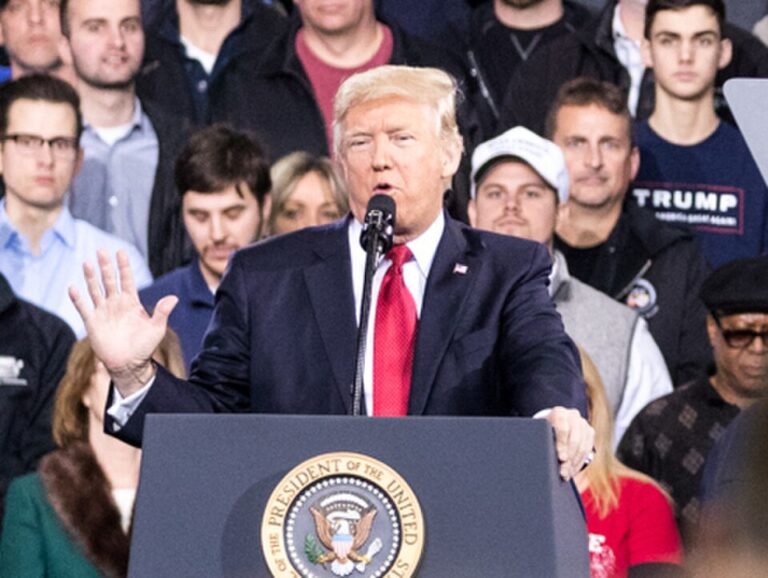
The White House from Washington, DC, Public domain, via Wikimedia Commons
Institutional Fatigue and Internal Conference Strain
A quieter but important factor is institutional fatigue. Years of high-intensity political cycles, repeated legislative confrontations, and continuous media pressure have created a more cautious Senate environment.
Many lawmakers are now focused on minimizing disruption, preserving procedural stability, and avoiding unnecessary internal conflict.
This environment naturally slows responsiveness to external pressure, even from a party leader with significant influence.
Conclusion: A Party Still Aligned but Operationally Divided
The relationship between Donald Trump and Senate Republicans is not collapsing into open rebellion. Instead, it is evolving into a more complex governing arrangement shaped by institutional limits and political incentives.
The Senate GOP remains broadly aligned with Trump on major ideological goals. However, the process of turning those goals into legislation is increasingly defined by delay, negotiation, and procedural constraint.
What is emerging is a Republican Party that is still unified in purpose but no longer unified in execution. The difference between those two states is now shaping the rhythm of American governance.