5 Disadvantages of Ordering the Filet-O-Fish at McDonald’s
There’s something comforting about the McDonald’s Filet-O-Fish. Maybe it’s the soft, steamed bun, the creamy tartar sauce, or that little square of cheese tucked beneath the fish patty. For decades, this seafood sandwich has offered customers a familiar alternative to the usual lineup of beef burgers.
But just because it contains fish doesn’t automatically make it the best choice on the menu.
The Filet-O-Fish has a few drawbacks worth knowing about, particularly when it comes to price, ingredients, and nutritional value. Some might surprise even longtime fans.
Before you order your next one, here are five disadvantages worth considering.
You Could Pay More and Get Less Protein

Ever looked at the price of a Filet-O-Fish and wondered why a relatively simple sandwich costs that much? You’re not imagining the difference compared with some of McDonald’s cheaper options.
At a McDonald’s location on Pidgeon Hill Drive in Virginia, an online ordering menu checked on November 6, 2026, listed the Filet-O-Fish at $6.23. Meanwhile, a McDouble cost $3.58, and a McChicken was just $3.39.
That’s a $2.65 difference between the fish sandwich and the McDouble.
The nutritional comparison makes things even more interesting. According to McDonald’s, the Filet-O-Fish provides 16 grams of protein, while the McDouble delivers 22 grams.
In other words, the cheaper beef sandwich offers six additional grams of protein.
A second location on Brookhurst Road in California showed a similar pattern, although the price gap was smaller. Its Filet-O-Fish was listed at $5.89 compared with $4.99 for a McDouble.
Of course, these are location-specific online prices, not nationwide averages. Premium sandwiches such as the Big Mac can also cost more than the Filet-O-Fish.
Still, if you’re trying to stretch your fast-food budget while getting more protein, comparing menu options before ordering may be worth it.
You’re Getting More Than Just Fish

Fish often sounds like a lighter alternative to beef. And the Alaska pollock used in McDonald’s Filet-O-Fish is naturally a relatively lean fish.
The catch? You’re not ordering a plain piece of pollock.
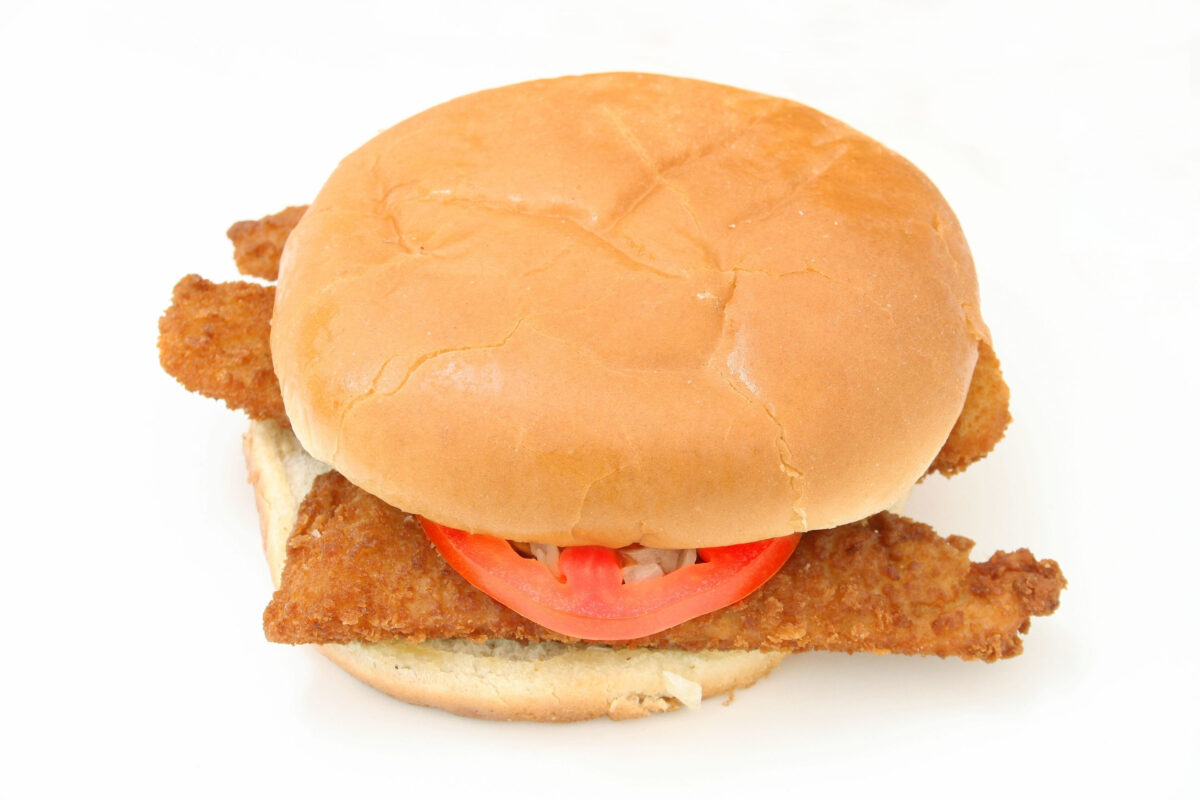
The standard sandwich includes a breaded fish patty, a steamed bun, tartar sauce, and half a slice of American cheese. All those extras change its nutritional profile considerably.
According to McDonald’s nutritional information, a regular Filet-O-Fish contains 380 calories, 19 grams of total fat, and 4 grams of saturated fat.
Here’s a detail worth noticing: the standard portion of tartar sauce contributes approximately 90 calories on its own.
That’s nearly one-quarter of the sandwich’s listed calories.
The fish patty itself also contains ingredients beyond pollock, including vegetable oil, wheat flour, and modified food starch.
None of this means the sandwich is made from inferior fish. It simply means that a breaded fast-food sandwich isn’t equivalent to a plain, unbreaded fish fillet.
If you’re looking for a simpler fish preparation, the standard Filet-O-Fish might not quite match what you had in mind.
One practical option is to request less tartar sauce or leave it off altogether, depending on your preference. Just remember that changing the sauce doesn’t turn the breaded patty into plain fish.
The Sodium Adds Up Faster Than You Might Expect
Here’s something that can easily slip under the radar when ordering fast food: sodium.
A standard Filet-O-Fish contains approximately 580 milligrams of sodium.
For perspective, the U.S. Food and Drug Administration uses 2,300 milligrams as the Daily Value for sodium. That means one fish sandwich contributes roughly 25% of that daily reference amount.
And that’s before you add fries, another side, or anything else you’re eating throughout the day.
However, context matters.
The Filet-O-Fish actually contains considerably less sodium than several familiar McDonald’s beef sandwiches. A Big Mac contains approximately 1,060 milligrams, while a McDouble has 920 milligrams.
So, calling the Filet-O-Fish one of the saltiest sandwiches would be misleading.
The real downside is that it still contributes meaningfully to your daily sodium intake, despite its simple appearance.
If you’re watching sodium, checking the whole meal rather than focusing on the sandwich alone is a sensible approach.
The Bun and Bread Don’t Offer Much Fiber
The Filet-O-Fish might feature seafood, but the sandwich also relies heavily on refined-flour ingredients.
According to McDonald’s nutritional information, it contains 38 grams of carbohydrates and just 1 gram of dietary fiber.
The bun’s primary ingredient is enriched flour, not whole-grain flour. The fish patty’s coating also contains wheat flour and starch.
That’s not necessarily a problem for everyone. However, it’s worth considering if you’re hoping to include more fiber-rich foods in your meals.
The FDA’s Daily Value for dietary fiber is 28 grams, meaning the Filet-O-Fish provides only a small contribution toward that reference amount.
And while enriched flour contains added nutrients, it isn’t the same as a whole-grain ingredient.
For comparison, McDonald’s McDouble lists 2 grams of fiber, although neither sandwich is particularly fiber-rich.
The practical takeaway? Don’t count on the Filet-O-Fish to provide much of your day’s fiber.
If you’re choosing it for lunch, consider including fiber-rich foods such as fruit, vegetables, beans, or whole grains elsewhere in your meals.
Removing the Cheese Won’t Remove All the Allergens
This might be the most surprising detail on the list, especially for customers who carefully check ingredient labels.
At first glance, the Filet-O-Fish looks fairly straightforward: fish, bread, cheese, and sauce.
However, its ingredient list reveals several allergens.
According to McDonald’s U.S. ingredient information, the fish patty contains fish, wheat, and milk. The tartar sauce contains egg, while the American cheese contains milk and soy.
Even the bun adds another consideration: it contains wheat and carries a warning that it may contain sesame.
Here’s where things get particularly tricky.
You might assume that ordering a Filet-O-Fish without cheese makes the sandwich dairy-free. Unfortunately, that isn’t the case because the fish patty itself contains milk ingredients, including whey.
Similarly, removing the bun doesn’t eliminate wheat from the sandwich because wheat flour is also used in the fish coating.
McDonald’s also warns that shared equipment and preparation areas can create opportunities for allergen cross-contact.
For customers with food allergies or specific dietary restrictions, these details matter far more than the sandwich’s calorie count or price.
Checking the official ingredient information before ordering is particularly important when avoiding a particular allergen.
Is the Filet-O-Fish Still Worth Ordering?
Absolutely, if you enjoy it and it fits your preferences.
The Filet-O-Fish isn’t automatically a worse choice than every beef sandwich at McDonald’s. In fact, it contains fewer calories, less sodium, and less saturated fat than several popular burger options.
But it also offers less protein than some cheaper sandwiches, provides very little fiber, and contains ingredients that may surprise customers expecting a simpler seafood option.
Ultimately, the best order depends on what matters most to you.
If you’re craving that familiar combination of crispy fish, creamy tartar sauce, and a soft bun, there’s no reason you can’t enjoy it. Just remember that knowing what’s in your sandwich helps you decide whether it’s worth the price.